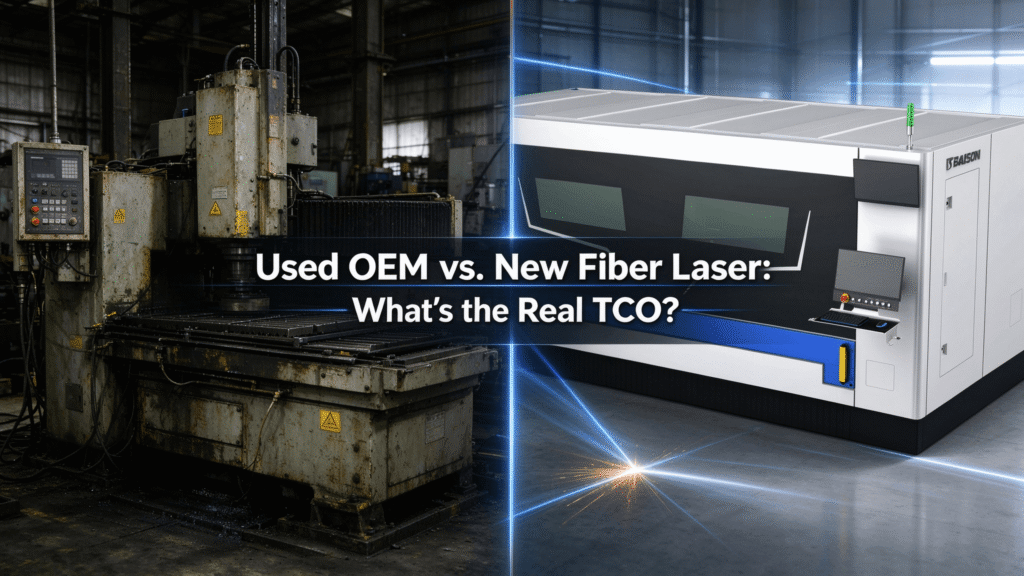
When sourcing industrial laser equipment, the initial purchase price accounts for only about 30% of its total lifetime cost. Smart fabricators must calculate the 3-to-5-year Total Cost of Ownership (TCO), machine uptime, consumable ecosystem, and cross-border after-sales risks. While pre-owned European or Japanese machines may serve low-frequency, temporary operations, a brand-new Chinese fiber laser machine delivers significantly higher ROI, superior reliability, and scalable profitability for long-term production.
In today’s global supply chain restructuring and factory automation push, sheet metal fabricators, steel structure contractors, heavy machinery manufacturers, and automotive parts suppliers inevitably face a critical decision when expanding capacity:
“With a defined budget, should we buy a pre-owned machine from legacy European or Japanese brands (such as Trumpf or Amada), or invest in a high-configuration, brand-new fiber laser cutting machine made in China (such as Baison Laser)?”
For overseas Procurement Managers and Chief Operating Officers (COOs), this is far more than a brand preference. It is a precise financial calculation involving Total Cost of Ownership (TCO), equipment uptime, after-sales service speed, and 3-to-5-year return on investment (ROI).
This article breaks down the real financial gains, hidden operational risks, and optimal application scenarios for both options based on global industrial procurement pain points.
Used Imported Machines (Trumpf / Amada): Legacy Prestige vs. Overseas Hidden Cost Traps
Top European and Japanese brands have earned strong reputations over decades of industrial engineering. However, overseas buyers must clearly distinguish between Factory-Refurbished Machines (backed by OEM warranties) and Broker/Auction Used Machines circulating on the open market.
Ideal Scenarios for Pre-Owned Machines
- Existing OEM Ecosystem: Your shop floor already runs the same brand, uses proprietary software/tooling, and can secure certified OEM refurbishment.
- Low Machine Uptime / Short-Term Projects: The machine operates under 15 hours per week (e.g., temporary capacity buffer), lead time is not critical, and your factory maintains a dedicated, highly skilled in-house maintenance engineering team.
4 Hidden Cost Traps Overseas Buyers Often Overlook
Trap 1: The Technology Gap & Energy Efficiency Hole
Many pre-owned imported machines on the open market rely on legacy fiber sources or obsolete CO₂ laser resonators.
- Extreme Energy Consumption: CO₂ lasers convert only 8%–10% of electricity into laser light, whereas modern fiber lasers achieve 30%–40%+ wall-plug efficiency. In regions with high electricity tariffs (such as Europe and North America), the power bill difference alone can exceed tens of thousands of dollars per year.
- Power Bottleneck: Older used units typically range from 2kW to 6kW, making them incapable of matching modern 12kW–30kW+ high-speed thick-plate processing demands.
If you are debating whether a mid-range capacity is sufficient for your current workload, read our 6kW vs 12kW fiber laser power range comparison guide to evaluate cutting speed differences.
Trap 2: Expensive Overseas Labor & 3–6 Week Spare Part Lead Times
OEM service technician fees in North America, Europe, the Middle East, and LATAM average $150–$300/hour. Furthermore, legacy proprietary circuit boards, crystals, and ball screws are no longer stocked locally. When a core component fails, international shipping and customs clearance can cause 3 to 6 weeks of downtime, leading to severe order delivery penalties.
Trap 3: Closed Software Systems & Costly MES Integration
Older controllers use closed software architectures that cannot easily connect to modern MES (Manufacturing Execution Systems) or IoT factory platforms. Unlocking API interfaces or updating software frequently incurs exorbitant secondary licensing fees.
Trap 4: Proprietary Consumables Premium
Older Trumpf and Amada models require proprietary lenses, ceramic rings, and nozzles. Standard market consumables cannot be used. These OEM consumables carry heavy price markups that drive up cost-per-part over time.
💡 Field Inspection Checklist for Used Laser Equipment (Buyer Protection Guide)
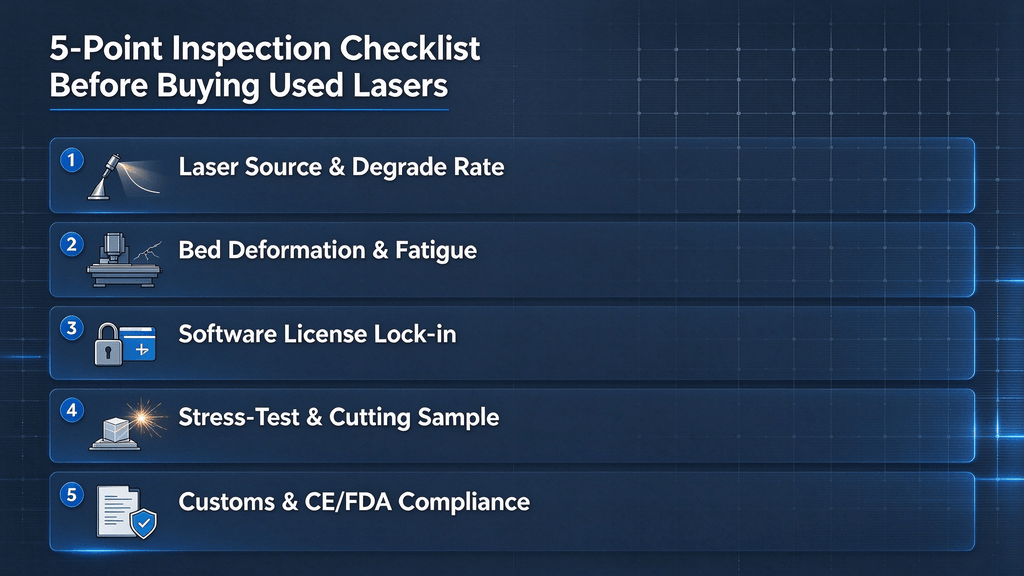
If you decide to evaluate pre-owned imported machinery, ensure a qualified field engineer inspects these key areas before transferring funds or loading containers:
- Laser Source Integrity: Check cumulative power-on hours and fiber attenuation logs. Perform full-power continuous test cuts to verify zero power degradation. Confirm serial numbers match original records to rule out unauthorized retrofits.
- Mechanical Structure & Frame Stress: Inspect the bed frame for collision deformation or weld cracking. Measure XY positioning and repeatability precision. Inspect linear guides and rack-and-pinion gear wear.
- Software Licensing & Board Age: Verify that software licenses can legally transfer to your company without serial-number locks or remote shutdown risks. Confirm servo and driver board part numbers to avoid mixed/refurbished electronic assemblies.
- Max-Load Cutting Performance: Conduct real-time tests including high-speed thin-sheet cutting and thick-plate heavy piercing. Run continuously under full load for 1 hour to monitor thermal drift, lost steps, or height sensor failures.
- Regulatory Compliance & Customs: Check that nameplates and CE laser safety certifications remain valid. Verify local customs import restrictions for pre-owned industrial machinery and budget extra for dismantling, rigging, and local inspections.
Brand-New Chinese Fiber Lasers: Core Advantages of Leading Manufacturers
As China’s industrial laser supply chain has matured, top-tier manufacturers like Baison Laser have moved far beyond simple assembly. They have established fully vertically integrated manufacturing and global service networks.
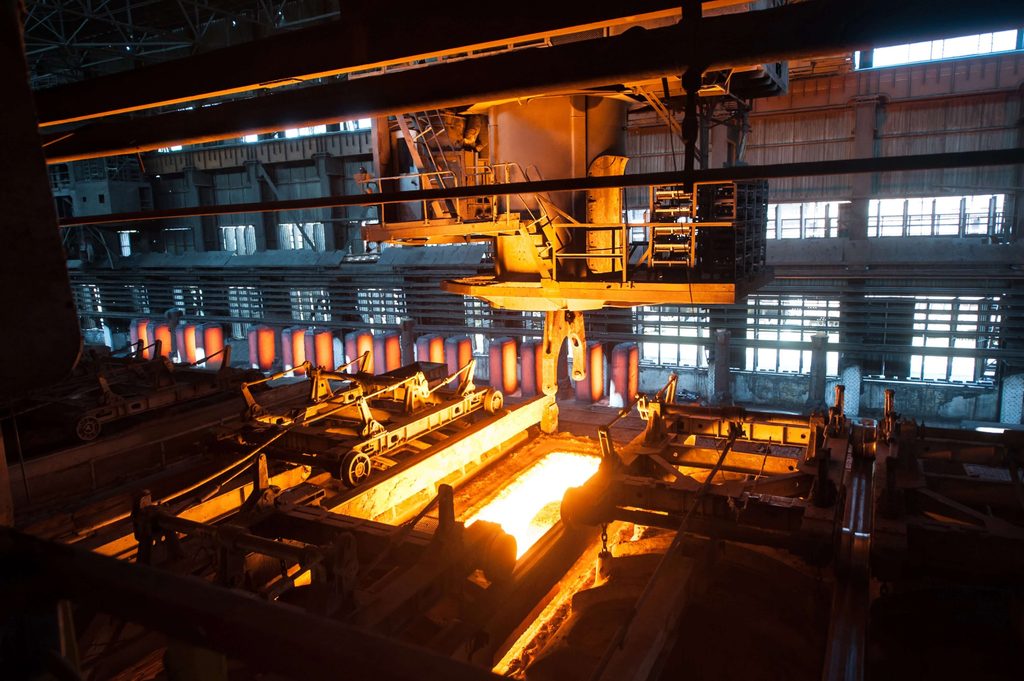
Heavy-Duty Annealed Machine Beds (Long-Term Structural Stability)
Long-term cutting accuracy depends on structural stress relief. Baison Laser operates a 100,000 m² modern manufacturing campus in Foshan, Guangdong, equipped with large CNC gantry machining centers and dedicated high-temperature annealing furnaces. Machine beds undergo 600°C–650°C thermal stress relief followed by prolonged natural aging before gantry precision milling, drastically minimizing frame deformation under high-acceleration, high-power cutting.
Premium Global Supply Chain & Advanced CNC Systems
- Laser Source: Powered by high-efficiency Raycus fiber laser generators, featuring high beam quality, stable power output, and an operational lifespan of up to 100,000 hours.
- CNC Control System: Integrated with industry-standard Bochu (CypCut) CNC software natively supporting Fly-Cutting, Frog-Leap piercing, Non-Sensing Piercing, and Anti-Shake Follower technologies.
- Drivetrain & Chucks: Premium servo motors paired with self-developed high-precision chucks enable high-speed sheet cutting and zero-tailing tube processing.
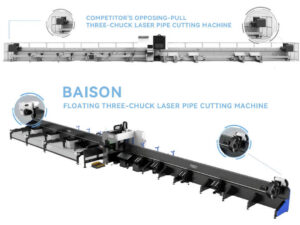
For fabricators handling heavy structural profiles, integrating zero-tailstock tube laser technology dramatically reduces expensive raw material yield loss.
International Compliance & Cleanroom Optical Assembly
Baison Laser machinery meets full export standards, holding EU CE compliance, US FDA laser safety registration, and ISO 9001/14001/45001 certifications. Critical optical heads are assembled inside Class 100 cleanrooms under microscopic inspection to eliminate optical contamination and lens burnout risks.
Streamlined Delivery & Direct Import Workflows
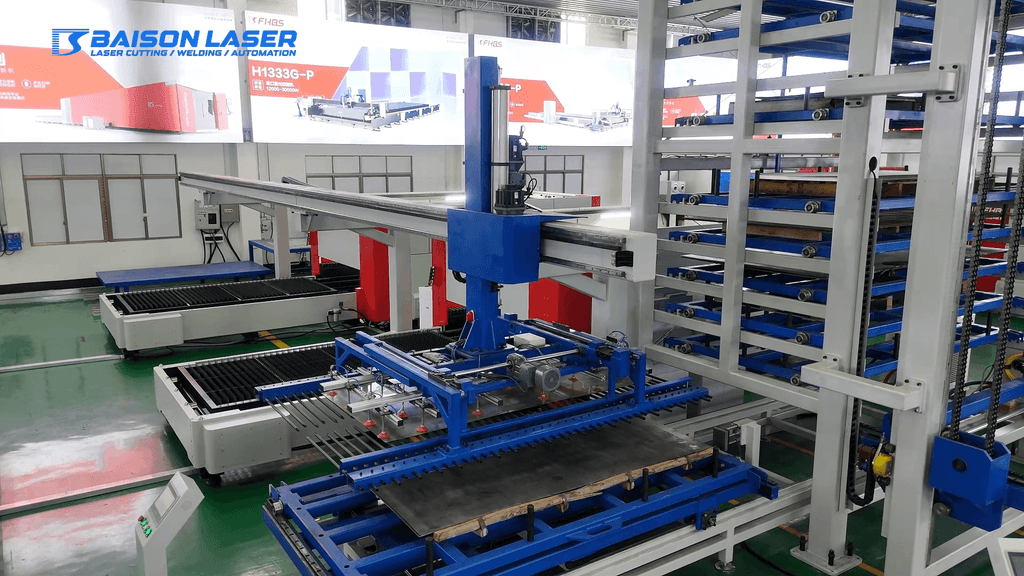
Standard production lead times require only 15–25 business days. Machines are packaged in export-grade vacuum anti-rust wrapping accompanied by complete customs clearance paperwork. Native automation interfaces allow seamless pairing with automatic loading/unloading systems and storage towers.
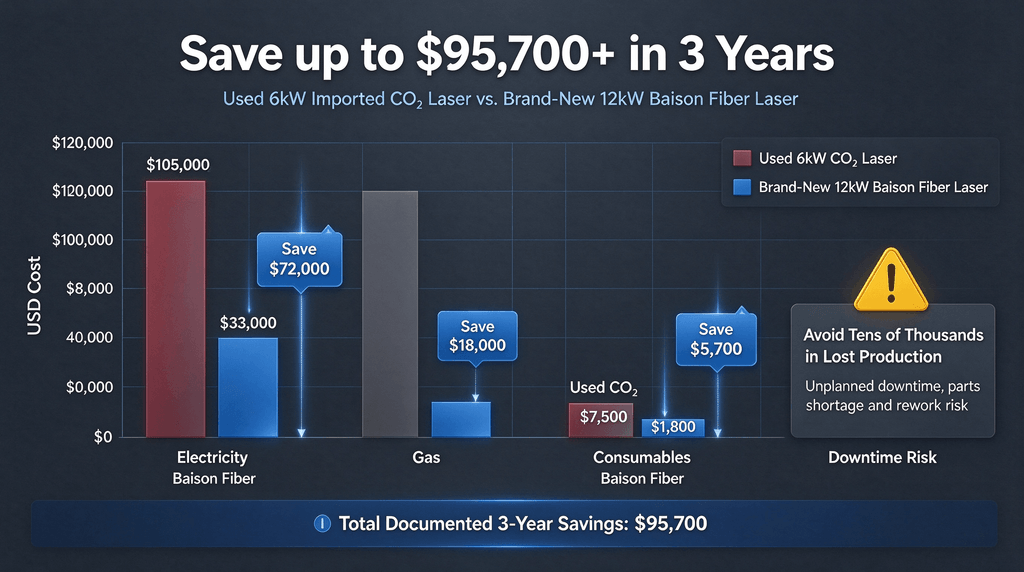
3-Year Total Cost of Ownership (TCO) Comparison: Numbers Don’t Lie
Note: This financial model compares an existing pre-owned 6kW CO₂ machine against a modern 12kW fiber laser machine. Operating parameters assume 8 hours/day, 250 days/year, at an electricity rate of $0.20/kWh. Values represent conservative industry benchmarks for financial planning.
| Cost Category | Used 6kW Imported CO₂ Laser | Brand-New 12kW Fiber Laser (Baison) | Estimated 3-Year Savings |
| Annual Electricity Cost | ~$35,000 / year(Low efficiency + resonator gas) | ~$11,000 / year(>35% wall-plug efficiency) | Save ~$72,000 |
| Cutting Gas Consumption | Requires high-purity laser gas mixtures + O₂/N₂ | Standard assist gases + compressed air support | Save ~$18,000 |
| Consumables (Nozzles/Lenses) | Proprietary OEM parts (~$2,500 / year) | Standard universal parts (~$600 / year) | Save ~$5,700 |
| Unplanned Downtime Risk | 2–3 breakdowns/year; 2–3 week wait for technicians/parts ($3,000–$10,000 per event) | 1-Year Full Warranty + Overseas Spare Part Hubs + 24/48-Hour Service Response | Avoid Tens of Thousands in Lost Production |
Financial Takeaway: Even if a used machine purchase price appears $50,000 lower upfront, the electricity and consumable savings of a new fiber laser completely bridge the price gap within 18 to 24 months of operation.
Comprehensive Comparison Matrix: Pre-Owned vs. New Chinese Fiber Laser
| Feature / Dimension | Open-Market Used Imported Laser (Trumpf/Amada) | Brand-New Chinese Fiber Laser (Baison Laser) |
| Upfront Capital Cost | Appears lower initially; hidden repair, dismantling, and shipping costs are unpredictable. | Transparent, all-inclusive pricing including equipment, installation, and operator training. |
| Total Cost of Ownership (TCO) | Uncontrolled: High power bills, expensive proprietary consumables, costly repairs, and extended downtime. | Highly Predictable: >35% energy conversion efficiency, affordable universal consumables, low maintenance cost. |
| Consumable Availability | Proprietary OEM parts with high price markups and long delivery cycles. | Standard universal parts available locally worldwide at competitive costs. |
| Cutting Speed & Power | Mostly low power (2kW–6kW CO₂); struggles with high-speed processing and thick plates. | Complete power range from 1.5kW up to 120kW for thin-sheet speed and heavy-plate processing. |
| Structural Integrity | Aged machine bed subject to metal fatigue, stress degradation, and frame accuracy loss. | Heavy-duty welded bed with 650°C thermal stress relief annealing and laser interferometer calibration. |
| Automation Upgrades | Legacy hardware architecture makes adding automatic loaders or storage towers difficult and costly. | Native automation interfaces ready for immediate pairing with loading/unloading units and MES systems. |
| Customs & Lead Times | Complex dismantling, shipping, and customs inspections; regulatory hurdles on used capital goods. | Fast 15–25 business day production; full CE/FDA documentation for smooth customs clearance. |
| After-Sales Support | Expired OEM warranty; relies on 3rd-party technicians with 3–6 week spare part shipping delays. | Global network with 200+ agency partners, 150+ international field engineers, and local spare part hubs. |
| Safety Compliance | Nameplate ratings and safety certifications may be expired or non-compliant with modern standards. | Fully certified with CE, FDA, and ISO standards; optional fully enclosed protective housing. |
To understand how strict local workplace safety regulations affect equipment selection, explore our guide on international safety compliance and ROI standards.
Decision Framework: Which Solution Fits Your Factory Floor?
Making the right procurement decision comes down to maximizing your shop’s overall Return on Investment (ROI).
Choose a Certified Pre-Owned Imported Machine If:
- Your facility is located near major European or North American OEM service centers.
- You maintain an experienced in-house laser repair and engineering team.
- Your production involves low-frequency job shop orders with low machine uptime (<15 hours per week).
- You require a temporary equipment bridge for a project lasting under 12 months.
Choose a Brand-New Chinese Fiber Laser Machine If:
- You target high machine uptime and expect full equipment payback within 12 to 18 months.
- You need high-power fiber cutting (12kW–30kW+) for thick carbon steel, stainless steel, or aluminum processing.
- You plan to scale operations with automated loading systems, tube lasers, or factory MES integration.
- You require factory warranties, local spare part availability, and ongoing technical support.
⚠️ Objective Disclaimer: 3 Scenarios Where Baison Equipment May Not Be Your Primary Option
We believe in complete procurement transparency. A brand-new Chinese fiber laser may not be the primary choice under the following specific conditions:
- Deeply Locked OEM Ecosystems: Your plant operates exclusively on proprietary legacy software and workflows, your operator team is exclusively trained on one system, and there is zero internal desire to adopt open Bochu/CypCut control platforms.
- Laboratory-Grade Micro-Machining: Your production requires specialized sub-micron micro-machining, femtosecond/picosecond pulse laser sources, or custom beam-shaping optics.
- Ultra-Short Temporary Leases: Your project duration spans only a few months, and you can secure a locally warranted, short-term lease on a pre-owned machine under an extreme budget constraint.
❓ Curious How Much Energy & Operating Budget Your Shop Could Save This Year?
Every fabrication facility runs unique materials, plate thicknesses, and shift schedules. What specific material types and maximum thickness ranges are currently clogging your cutting throughput?
Share your average daily operating hours with our application engineering team, and we will build a customized TCO Financial Audit & Machine Selection Breakdown tailored directly to your production workflow.
Frequently Asked Questions (FAQ)
Q1: Is a factory-refurbished Trumpf or Amada machine worth buying?
A: If it is an official OEM-certified refurbishment accompanied by a 6-to-12-month factory warranty, it can be a valid candidate. However, certified refurbished units often cost 1.5x to 2x more than standard used equipment, bringing their price very close to a brand-new high-spec fiber laser. You must carefully calculate ongoing power consumption, proprietary part costs, and the fact that most refurbished models do not include free lifetime software or tech table upgrades.
Q2: How do Chinese laser manufacturers handle overseas after-sales service and spare parts?
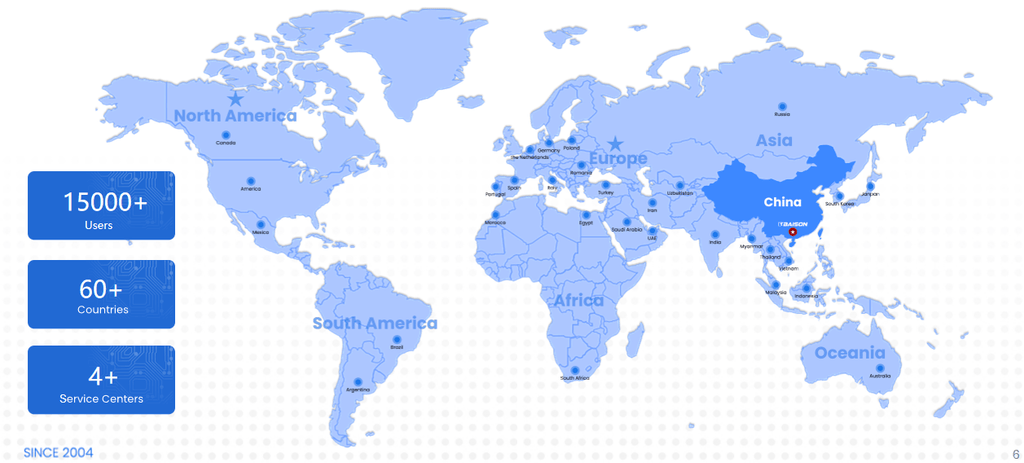
A: Service support is a top priority for international buyers. Leading manufacturers like Baison Laser operate across 60+ countries with over 200 service agency partners and dedicated regional spare part warehouses (including US hubs in states like Indiana). Technical support includes 24/7 remote diagnostics, video walkthroughs, and dispatchable field engineers for installation, operator training, and emergency repairs.
Learn more about how Baison’s global support network and spare parts infrastructure minimize downtime risks for overseas buyers.
Q3: Do Chinese fiber lasers comply with North American and European import regulations?
A: Yes. Export-model machines hold full compliance certifications, including EU CE directives, US FDA CDRH laser safety registration, and ISO quality standards. For strict safety compliance, machines can be built with fully enclosed protective housing, OD6+ radiation-proof glass, and interlocked safety light curtains.
Before making your final purchase decision, review the 7 costly mistakes sheet metal shops make when buying fiber lasers to avoid unexpected post-purchase expense traps.
Q4: Why do modern fiber lasers consume so much less electricity while cutting faster?
A: Fiber laser power sources achieve a wall-plug electrical efficiency of 30%–40%, compared to 8%–10% for legacy CO₂ lasers. Furthermore, fiber laser light operates at a 1.06-micron wavelength—one-tenth that of CO₂—allowing vastly superior beam absorption in metals. Combined with intelligent CNC algorithms (such as fly-cutting and frog-leap positioning), thin-to-medium sheet cutting speed increases by 300%–500% while cutting overall power consumption by over 60%.
Q5: Will foreign machine operators struggle with CNC software interfaces?
A: No. Bochu (CypCut) CNC control software natively supports over 20 international languages, including English, German, French, Spanish, Russian, and Arabic. The system features pre-loaded, field-tested material cutting parameter libraries. Operators simply select material type and thickness, and the CNC automatically adjusts focal position, power, gas pressure, and nozzle height. New operators typically master job setup within 1 to 2 days of training.
Final Investment Thought
Industrial laser procurement is not a simple comparison of brand name plates or initial purchase quotes. It is a strategic investment evaluation centered around 3-to-5-year total cost of ownership, operational uptime, and scalable production capacity.
If your facility prioritizes predictable operating costs, continuous equipment availability, cutting-edge fiber cutting speeds, and direct factory technical backing, investing in a new high-configuration fiber laser machine provides the strongest path toward long-term manufacturing profitability.
💡 Ready to Audit Your Shop’s Real ROI?
Send us your typical metal material types, plate thickness spectrum, and projected monthly cutting hours. The Baison Laser Application Engineering Team will provide:
- Custom 3-Year Used vs. New Fiber Laser TCO & Payback Analysis Report
- Free Sample Test Cutting on Your DXF Drawings(includes high-definition cut-edge video footage and dimensional inspection reports)
Have an existing pre-owned laser quote on your desk? Send your current line-item breakdown to our team—we will help you identify potential hidden maintenance fees, software upgrade costs, and power bill overhead before you sign.