When Upgrading Fiber Lasers, Power Choice Defines Profitability
When expanding or upgrading production capacity, deciding between a 6kW and a 12kW fiber laser cutter is one of the most critical capital investment decisions for mid-to-heavy metal fabrication job shops globally.
Many international equipment buyers fall into a simplistic investment trap: “Higher power is always better—buying a 12kW laser guarantees faster production.” In real-world factory environments, however, many workshops purchase 12kW machines only to process 3–8 mm (1/8″ to 5/16″) thin sheet metal daily.
This leads to underutilized hardware, excessive electrical draw, and unrecoverable initial capital expenditure (CAPEX). Conversely, shops that under-invest in a 6kW laser to save upfront capital often encounter severe production bottlenecks, long piercing delays, and missed delivery schedules when medium-to-thick plate orders arrive.
Having served hundreds of overseas metal processing workshops, Baison Laser presents an objective, engineering-driven comparison of 6kW and 12kW fiber lasers across stable production limits, feed speeds, total cost of ownership (TCO), and operational risk management to help you achieve the fastest return on investment (ROI).
Stable Production Capacity: Lab Specs vs. Floor Reality
💡 Baison Field Note: Maximum cutting thickness claims in sales brochures often reflect single-sample laboratory tests under controlled conditions. They do not represent 8-to-12-hour continuous mass-production reliability. Evaluators must focus strictly on stable production parameters, rather than temporary piercing limits.
| Metric / Parameter | 6kW Fiber Laser Cutter | 12kW Fiber Laser Cutter |
| Max Stable Carbon Steel (CS) | 0.5–20 mm (12–20 mm relies on Oxygen, moderate speed) | 0.5–30+ mm (Superior piercing & Oxygen cutting speed on thick plate) |
| Max Stable Stainless Steel (SS) | 0.5–12 mm (8–12 mm Nitrogen speed is limited) | 0.5–25 mm (High-speed Nitrogen & High-Pressure Air Cutting on medium plate) |
| Max Stable Aluminum (AL) | 0.5–8 mm (Requires high optical anti-reflection protection) | 0.5–16 mm (Significantly enhanced thick-plate production capacity) |
| High-Pressure Air Cutting | Effective up to 3–4 mm SS / CS / AL | Game-Changer! Highly effective on 6–12 mm SS / CS (Massive gas savings) |
| Thin Gauge Processing (1–6 mm) | Linear speed fully satisfies mass-production requirements | Marginally faster, but real throughput is capped by servo acceleration & thermal dissipation |
Throughput Dynamics: When Does 12kW Actually Pay Off?
Medium-to-Thick Plate Orders (>30% Workload)
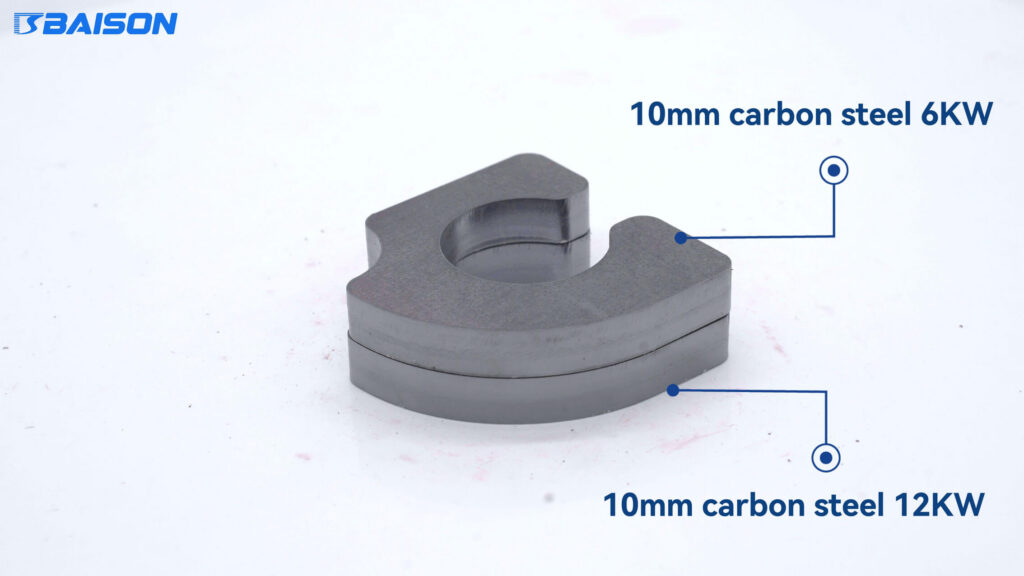
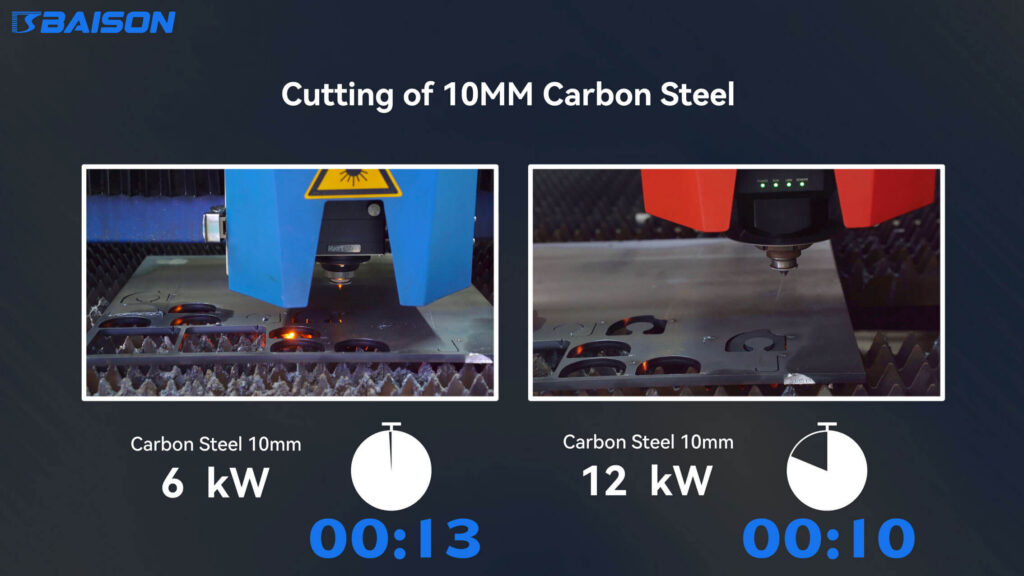
If your daily production mix involves continuous processing of >10 mm carbon steel or >8 mm stainless steel, a 12kW laser delivers an extraordinary speed jump. Piercing time is drastically reduced, linear feed speeds double on key gauges, and overall tonnage processed per shift increases exponentially.
Thin Sheet Fabrication (3–6 mm Workload)
For workshops producing control cabinets, architectural metalwork, or enclosures, most stock remains under 6 mm. In this range, an optimized 6kW system cuts at extremely high linear velocities. While a 12kW laser boasts higher theoretical speed on paper, servo dynamics, thermal dissipation, and slag ejection limits mean actual finished-part throughput rarely scales with the extra horsepower.
Total Cost of Ownership (TCO) & Operational Economics
Evaluating a laser investment requires analyzing long-term operational expenditures (OPEX), not just the initial purchase price:
Capital Expenditure & Machine Infrastructure (CAPEX)
A 12kW machine demands a higher upfront investment. Beyond the laser source itself, the chiller unit, gas delivery manifolds, structural machine frame, and electrical transformers must be scaled up accordingly.
Engineering Reality: High-power optical systems require heavy-duty annealed machine beds. Installing a 12kW optical source on a lightweight chassis causes severe micro-vibrations at high acceleration, degrading edge quality and dimensional tolerance.
Electrical Grid Load & Power Draw
- 6kW System: Full-load consumption averages 28–35 kWh.
- 12kW System: Full-load consumption averages 50–62 kWh.
In overseas regions with high industrial electricity tariffs or restricted grid capacity, running a 12kW unit primarily on thin gauge work leads to higher per-part energy overhead, accumulating substantial utility costs over time.
Auxiliary Gas Revolution: The 12kW Air Cutting Advantage
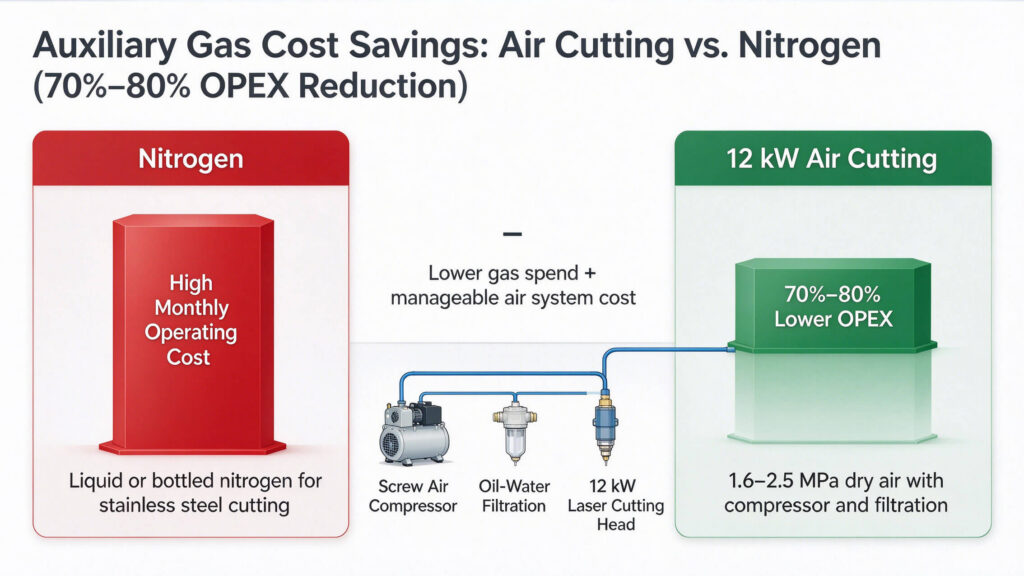
- The Nitrogen Bottleneck: Purchasing liquid nitrogen N2 or bottled gas manifolds for medium-plate stainless steel processing represents a major recurring expense for overseas fab shops.
- The Air Cutting Breakthrough: With 12kW optical density, operators can utilize high-pressure dry compressed air (1.6–2.5 MPa) to cut 6–12 mm stainless steel and carbon steel. Transitioning from bottled N2 to an integrated high-pressure air compressor system slashes auxiliary gas expenses by 70% to 80%, saving tens of thousands of dollars annually.
Strategic Decision Framework: Matching Machine to Shop Profile
Choose a 6kW Fiber Laser Cutter if:
- Your material stock focuses heavily on 0.5–10 mm sheet metal (cabinets, enclosures, brackets, light ducting).
- You run a small-to-mid-sized job shop where orders fluctuate and thick plate work (>16 mm) is routinely outsourced (subcontracted).
- You require a short capital payback period and operate under strict facility grid transformer limitations.
- This is your shop’s first fiber laser installation, prioritizing high overall operational versatility.
Upgrade to a 12kW Fiber Laser Cutter if:
- You produce heavy industrial equipment, pressure vessels, structural steel, or heavy machinery parts with heavy reliance on >10 mm plate.
- Existing 6kW machines create a persistent production bottleneck, and order volume requires multi-shift (16–24 hour) continuous operation.
- You aim to eliminate expensive liquid nitrogen supply chains by switching to high-pressure compressed air cutting on 6–12 mm metals.
💡 Pro Tip (The Machine Dynamic Myth: High Power & High Precision)
High laser wattage only delivers precision when paired with a heavy-duty, stress-relieved annealed machine bed and precision servo drive mechanics. Baison Laser’s high-power systems utilize reinforced structural beds engineered to withstand dynamic acceleration forces, eliminating the common industry pitfall of pairing high-power sources with lightweight frames.
Three Critical Procurement Pitfalls to Avoid
- Never Evaluate the Laser Source in Isolation: Pay equal attention to bed rigidity, dual-circuit chiller capacity, and gas pressure control valves.
- Account for 2–3 Year Growth Trajectories: Check if the machine platform allows future optical power upgrades to prevent premature equipment turnover.
- Verify Continuous Production Videos: Ask manufacturers for unedited, 8-hour continuous mass-production footage on thick plate rather than short promotional clip cuts.
Unlocking Hidden Savings: Custom ROI & Part-Cost Analysis
Selecting the ideal fiber laser power is not about chasing the highest wattage—it is about matching your machine configuration to your facility’s exact part geometry, material thickness distribution, and regional gas/power costs.
🔒 Need Precision Engineering Data for Your Shop Floor?
Operating costs vary dramatically based on local utility rates and gas logistics. Baison Laser’s application engineering team provides customized Cost-Per-Part Calculations and 6kW vs 12kW ROI Audits based on your uploaded CAD files and monthly production volume.
Frequently Asked Questions (FAQ)
Q1: What electrical grid and transformer capacity does a 12kW fiber laser demand compared to a 6kW unit?
A: A standard 6kW fiber laser system typically requires an installed transformer capacity of 50–65 kVA, whereas a 12kW system requires 90–120 kVA due to larger chiller units and heavy-duty electrical components.
Overseas facilities must verify local industrial power grid quotas before installing high-wattage machinery. Curious whether your current electrical panel can handle a 12kW setup without expensive facility upgrades? Contact our technical support team for a facility power compatibility check.
Q2: Does high-pressure air cutting on a 12kW laser leave an oxide layer on stainless steel cut edges?
A: Air cutting creates a minor, light-yellow or silver-grey edge tint due to the ~21% oxygen content in atmospheric air. However, it does not produce heavy black dross or loose scale. For structural parts, agricultural machinery, and heavy fabrications, air-cut edges are directly weldable and powder-coatable without secondary deburring. Want to inspect real cut samples? Request a free air-cut sample kit delivered directly to your shop.
Q3: Can an existing 6kW laser machine frame be retrofitted with a 12kW laser source later?
A: Retrofitting depends entirely on the original bed design. Only machine beds engineered with heavy-duty annealing heat treatment, high-flow gas piping, and reinforced gantry dynamics can handle the thermal load and acceleration forces of a 12kW laser source.
Retrofitting a lightweight 6kW frame with a 12kW source often results in frame resonance and poor cutting accuracy. Baison Laser designs select heavy-duty machine frames with modular upgrade paths.
Q4: What air compressor specifications are required to run high-pressure air cutting on a 12kW fiber laser?
A: High-pressure air cutting requires a dedicated industrial screw air compressor system capable of delivering stable pressures between 1.6–2.5 MPa (230–360 PSI). The system must include a refrigerated dryer, desiccant dryer, and 4-stage precision filtration to achieve ISO 8573-1 Class 1 oil-and-water purity standards, protecting internal protective windows from contamination. Unsure which compressor package matches your production duty cycle? Consult a Baison application engineer for complete air system sizing guidance.
Final Selection Summary
- Choose 6kW: If your workload is focused on thin sheet metal (<10 mm), requiring low operational overhead, lower capital outlay, and rapid ROI.
- Upgrade to 12kW: If thick plate processing (>10 mm) forms your core revenue, production volume is high, and you want to leverage high-pressure air cutting to eliminate nitrogen costs.
Equipment selection is not about purchasing the highest power rating; it is about finding the optimal match for your factory’s production requirements. If you are unsure whether a 6kW or 12kW machine fits your shop floor, Baison Laser’s application engineers are available to provide a free, customized selection assessment based on your material thickness profile and order mix.
Looking for complete machine specs and pricing benchmarks? Read our comprehensive 2026 Fiber Laser Cutting Machine Buying Guide.