European safety audits for industrial laser machinery are tightening drastically. Open-bed fiber laser cutters are facing severe compliance pressure under EN 60825-1 and the Machinery Directive 2006/42/EC.
To solve space and compliance bottlenecks, the Baison M3 fully enclosed single-table fiber laser cutter features a compact 3000×1500 mm working area, a footprint of only 10.36 m2, and fits entirely inside a standard 20ft shipping container.
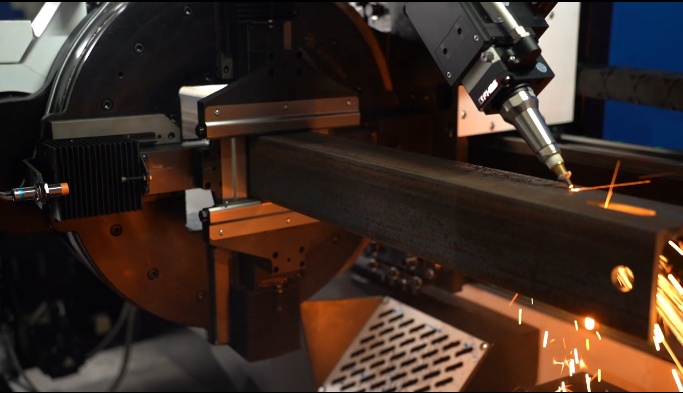
For tube processing, the Baison G24CP dual-chuck medium-duty bevel laser tube cutting machine eliminates material waste through zero-tail-stock cutting while handling tube diameters up to .
See these machines live at EUROBLECH 2026 in Hanover, Germany (October 20-23, Hall 15, Stand E42). Want to know if your current workshop layout qualifies for an immediate upgrade without structural changes? Contact our engineering team today to share your facility specs, and let us help you map out the ideal layout for maximum efficiency.
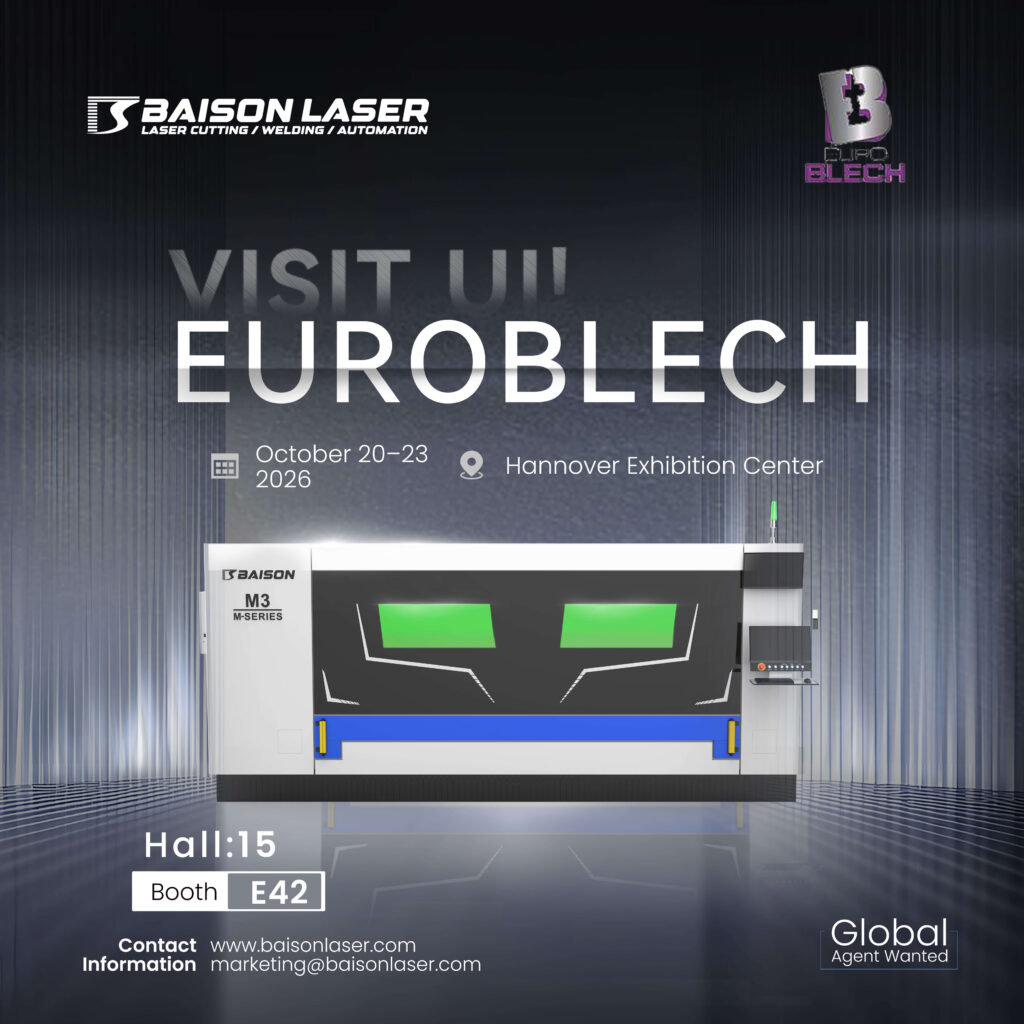
That Open-Bed Laser Cutter in Your Shop Might Be a Walking Fine
This is not alarmism. Over the past two years, European regulatory bodies have aggressively tightened safety audits for industrial laser equipment. Under current CE compliance frameworks, open-bed fiber laser cutters must simultaneously satisfy the mechanical safety mandates of the Machinery Directive 2006/42/EC and the rigorous laser safety regulations outlined in EN 60825-1.
While the former requires absolute operator safety during standard operations and foreseeable misoperations, the latter strictly dictates accessible laser radiation zones, safety enclosure interlocks, and warning signage.
Open-bed systems lack physical shielding, forcing operators to wear specialized protective eyewear while discharging unfiltered workshop smoke directly into the air. Across Europe, countless small-to-medium metal fabrication shops are discovering a harsh reality: their machine still cuts metal, but it can no longer pass safety audits.
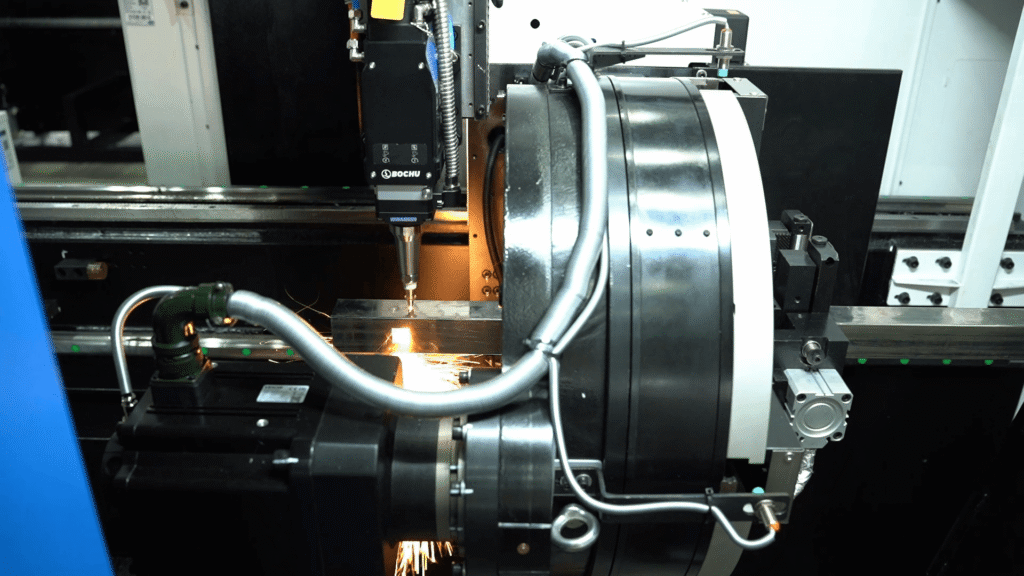
Simultaneously, your tube processing profit margins are being quietly consumed by two major culprits: material tail waste and frequent tooling changeover times. When cutting a standard 6-meter tube, traditional cutters leave behind 80—150 mm of unusable scrap—wasting enough raw material annually to fund a brand-new machine.
This article skips the generic spec-sheet fluff. It answers one vital question: Can your workshop keep pace with the structural shifts sweeping across European metal fabrication?
Two Major Shifts Rewriting European Metal Fabrication Margins
EUROBLECH 2026 is right around the corner (October 20-23 in Hanover, Germany). The previous edition drew 1,317 exhibitors and 38,946 professional visitors from 114 countries, with 81% holding direct purchasing decision power.
However, structural market shifts matter far more than visitor stats. Shift One hits compliance: CE standards for laser safety are becoming granular, leaving zero room for interpretation regarding EN 60825-1 radiation rules on open machines. Shift Two hits profitability: Tube processing scrap and setup costs are under intense financial re-evaluation.
These two distinct challenges map directly to two engineered solutions. Let’s break them down.
Shift 1: CE Compliance Tightens, Turning Open-Bed Lasers Into Financial Liabilities
Is an open-bed fiber laser cutter still legal in the EU under CE regulations?
Open-bed fiber laser cutters remain legal to operate in the EU only if they completely fulfill EN 60825-1 laser radiation protection standards, featuring mandatory physical barriers, safety interlocks, warning labels, and compliant operator PPE. In practice, legacy open systems rarely pass modern audits without expensive retrofits that often exceed the machine’s residual value.
By contrast, a fully enclosed fiber laser cutter locks radiation, smoke, and sparks inside a sealed housing fitted with CE-compliant laser protection glass. Operators require no secondary gear, and workshop air quality remains pristine.
The Baison M3 fully enclosed single-table fiber laser cutter was explicitly engineered to counter this regulatory shift. Featuring heavy-duty protective enclosure panels, 6 independent zoned exhaust ports beneath the cutting bed, and an integrated security monitoring camera, operators can track cutting status via high-definition screens without ever opening safety doors.
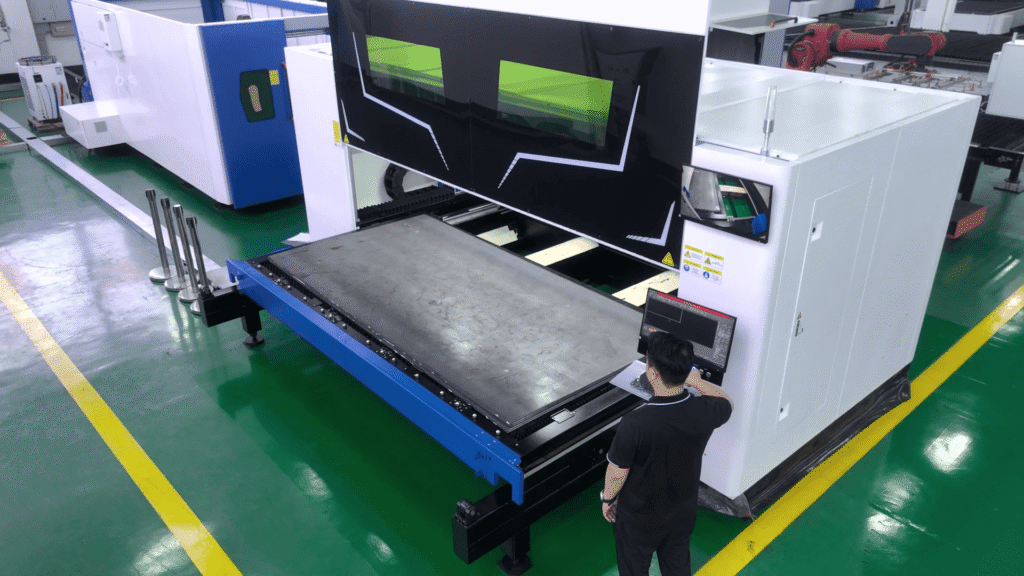
Real-World Case Study: Baden-Württemberg Sheet Metal Shop, Germany
A family-owned metal fabrication shop with roughly 35 employees in Baden-Württemberg specializes in stainless and carbon steel enclosures, chassis, and architectural hardware. Operating an older open-bed fiber laser, they faced a strict local occupational safety audit mandating immediate upgrades to radiation shielding and dust extraction. Given their tight floor plan, building a custom enclosure was physically impossible.
After integrating the Baison M3, the factory instantly met CE safety compliance standards for radiation shielding, entirely avoiding costly facility renovations. Delivery-to-production took just 3 days thanks to standard 20ft container shipping that bypasses complex on-site optical alignment. The plant manager reported that internal rush orders are now finished same-day, dropping single-part processing costs by roughly 25% compared to outsourcing.
What Does This Mean For You?
If your shop floor has a spare 15–20 m² corner, the M3’s 3000 × 1500 mm cutting bed easily manages most thin-sheet and small-batch components. Its fully enclosed architecture secures your CE compliance effortlessly while integrated extraction eliminates workshop ductwork overhauls.
Curious about how your specific workshop layout can integrate the M3 without halting daily production? Send us your floor dimensions for a customized layout simulation.
Shift 2: Tube Processing Profits Under Scrutiny from Tail Waste & Setup Drag
How much material does a zero-tail tube laser cutter actually save?
Real-world savings achieved with zero tail cutting depend on tube length, nesting efficiency, and outer diameter. The core engineering relies on Dual-Chuck Synchronous Transmission: the front chuck feeds the tube forward while the rear chuck takes over grip as the cut nears completion, forcing the residual tail length close to zero.
For instance, processing standard 6-meter tubes on a traditional single-chuck machine generates 80–150 mm of waste. Processing 20 tons of tubing monthly at roughly €800/ton yields approx. €800 in monthly raw material savings (€9,600 annually). Higher material consumption scales these savings upward exponentially.
The Baison G24CP dual-chuck medium-duty bevel laser tube cutting machine handles round tubes (Φ10–240 mm), square tubes (□10 × 10–□220 × 220 mm), channels (5#–24C#), I-beams (10#–24b#), and H-beams (100 × 100–230 × 230 mm). Pneumatic dual-row roller jaws secure powerful clamping without repetitive jaw swaps, while automatic centering calibration corrects raw tube deformations to guarantee precision.
Its ±45° dynamic bevel cutting head supports V, Y, and X weld preparations on tubes above 50 mm diameter, handling batch carbon and stainless steel beveling thickness from 1–10 mm in a single pass—eliminating secondary outsourcing steps entirely.
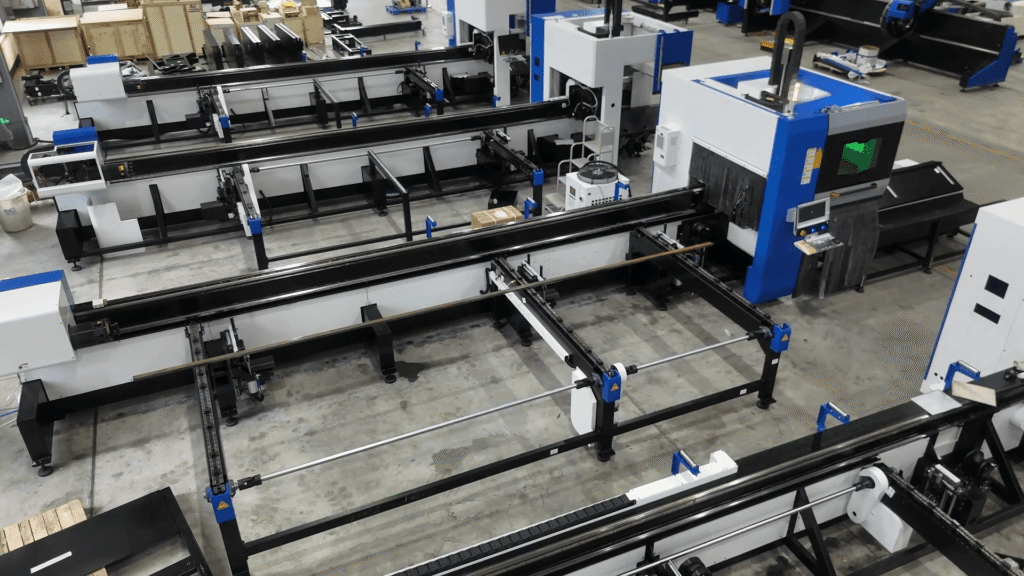
Real-World Case Study: Konya Tube Processing Plant, Turkey
A 50-person tube fabrication factory in Konya, Turkey, produces structural frames for agricultural machinery, trailer chassis, and architectural guardrails using round, square, and channel profiles. Relying previously on traditional band saws and plasma cutters, their tail waste regularly hit 80–150 mm, and bevel preparation required external outsourcing, causing chronic delivery delays.
Deploying the Baison G24CP boosted material utilization by roughly 30%, saving enough raw material yearly to handle 20% more customer orders. Single-pass bevel cutting slashed delivery lead times by 3–5 days, while the standard semi-automatic loading rack reduced operator overhead from 3 workers down to 1. Plant management projects a complete return on investment within 12 to 18 months.
What Does This Mean For You?
If your operators spend hours swapping chuck jaws and discarding massive metal tails across dozens of tube sizes every week, you are funding a brand-new machine with pure waste. The G24CP seals both profit leaks permanently.
You’ve seen the numbers, but here is the question every plant manager hates to calculate: How much uncounted scrap and bottleneck delay is your current shop floor bleeding right now? Stop guessing based on generic industry averages. Send us your current material specs and monthly cutting volume today, and our senior engineers will run a confidential, custom waste-to-profit audit tailored to your facility—completely free of charge before your next production cycle begins.
Side-by-Side Comparison: Solving Two Distinct Industrial Bottlenecks
| Comparison Dimension | Baison M3 Enclosed Single-Table Fiber Laser | Baison G24CP Dual-Chuck Bevel Tube Laser |
| Core Problem Solved | Open-bed CE safety non-compliance + limited shop floor space | Excessive tube tail waste + heavy reliance on outsourced beveling |
| Processing Target | Sheet Metal: Carbon steel, stainless steel, aluminum, brass, copper | Metal Tubes: Round, square, rectangular, channels, I-beams, angles, H-beams |
| Typical Capabilities | 3000×1500 mm bed; carbon steel up to 12 mm (air) / 40 mm (oxygen) | Φ10–240 mm round tubes; 300 kg single-tube load; zero tail waste |
| Safety & Compliance | Fully enclosed design, CE-compliant safety glass, built-in camera | Fully enclosed chuck zones, anti-dust and debris containment |
| Footprint & Deployment | Approx. 10.36 m2; 20ft container shipping; plug-and-play ready | Overall machine size approx. 11991×3819×3539 mm; semi-auto loader included |
| Efficiency & ROI Logic | Eliminates sheet outsourcing; drastically cuts delivery waiting times | Zero-tail cutting maximizes material yield; eliminates secondary beveling |
This comparison is not meant to force a choice between machines. It highlights a fundamental truth: sheet metal compliance and tube processing profitability are two separate ledgers requiring targeted solutions.
For a comprehensive understanding of how laser parameters and machine stability influence final output, check out Baison’s expert insights on Tube Laser Cutting Tolerance and Precision Factors.
Cost-Benefit & ROI Analysis: Owning vs. Outsourcing
How much does a compact fiber laser cutter cost for a small workshop?
The price of a compact fiber laser cutter depends heavily on laser source power, bed size, and automation packages. Taking the Baison M3 as an example, depending on power configuration, stainless steel cutting maxes out at 40 mm limits with premium batch quality up to 30 mm.
Exact quotes require tailoring to destination logistics and power configurations. The true ROI isn’t found on the price tag—it is calculated by comparing cumulative outsourcing fees and raw material waste against direct equipment ownership.
For the M3 Sheet Laser:
Assuming monthly outsourced sheet cutting costs hit €3,000, with 3-day average lead times and a 30% rush surcharge:
- Outsourced Cost Reduction: ~€2,500/month (net of electricity, assist gas, and consumables)
- Rush Surcharge Savings: ~€500/month
- Revenue Growth from Faster Turnaround: Conservatively estimated at ~€500/month in extra profit
- Net Monthly Improvement:~€3,500 (yielding an estimated payback period of 8–14 months based on M3 investment models).
For the G24CP Tube Laser:
Assuming monthly tube consumption of 20 tons, a traditional tail waste rate of 5%, and material costs of €800/ton:
- Material Savings via Zero Tail: ~€800/month
- Outsourced Beveling Savings: ~€1,200/month
- Labor Reduction (3 operators down to 1): ~€1,600/month
- Net Monthly Improvement:~€3,600 (yielding an estimated payback period of 12–18 months).
Can a 6kW laser cutter cut 20mm stainless steel?
Yes.With proper nitrogen or air assistance, fiber laser cutters typically achieve premium batch quality for stainless steel cuts between 1–14 mm, while maximum separation capabilities can reach 20 mm or higher. For instance, depending on the configured laser power, the Baison M3 pushes stainless steel cutting limits up to 40 mm, with stable batch processing up to 30 mm.
Quick-Fire Q&A: What Sets the M3 Apart from the G24CP?
Q: What is the core difference between the Baison M3 and the G24CP?
A: The M3 is a sheet metal cutting system—featuring a fully enclosed single table, a 3000×1500 mm bed, designed to resolve CE compliance and spatial constraints for thin stainless, carbon, and aluminum sheets. The G24CP is a dedicated tube processing system—utilizing dual-chuck medium-duty architecture (Φ10–240 mm round tube capacity) built to eliminate tail waste and conquer complex beveling. They complement each other rather than compete, addressing entirely different manufacturing workflows.
See Them Run Live at EUROBLECH 2026: Hall 15, Stand E42
What should I see at EUROBLECH 2026 for laser cutting machines?
Key technological directions worth examining at EUROBLECH 2026 include fully enclosed safety architectures, zero-tail tube cutting, single-pass beveling, and integrated automated loading/unloading systems. Baison will feature live running demonstrations of both the M3 and G24CP at Hall 15, Stand E42. If you require custom material tests not showcased on-site, post-show private trials can be scheduled directly at our Foshan manufacturing headquarters.
Dates: October 20–23, 2026
Location: Hannover Exhibition Center, Germany
Booth: Hall 15, Stand E42
At our booth, you can accomplish three things:
- Bring your own sheet or tube technical drawings to review trial-cut strategies directly with our senior application engineers.
- Watch the Baison M3 process thin stainless steel within a compact $10.36\text{ m}^2$ footprint and experience firsthand how fully enclosed designs secure regulatory compliance.
- Inspect the Baison G24CP zero-tail cutting demonstration and calculate precise annual material savings for your tube inventory.
Why Do These Machines Come From a Foshan Factory?
Baison Laser, established in 2004, is headquartered in Foshan, Guangdong, with a massive 100,000 m² production base. Backed by over 300 technological patents and a dedicated team of 65 R&D engineers, our product lines span power configurations from 1,500W to 120,000W, covering sheet cutting, tube cutting, combi systems, welding, cleaning, and bending machinery.
Supported by 200+ global service locations and 150+ after-sales engineers, every machine includes a standard 1-year warranty, free software upgrades during the warranty period, and lifetime maintenance support.
The unifying philosophy behind the M3 and G24CP is simple: transform regulatory compliance hurdles into competitive advantages, and convert raw material waste into bottom-line profit.
Additional Frequently Asked Questions (FAQ)
Q: What if our operators have no prior laser experience? How long does training take?
A: Baison provides comprehensive on-site installation and training covering programming, daily operations, routine maintenance, and troubleshooting. Pre-shipment training packages (2–5 days) at our Foshan facility are also available upon request.
Q: We are located in Europe/Turkey. How reliable is your localized after-sales response?
A: Baison maintains 200+ global service hubs backed by 150+ certified technical engineers ready to support your operations. Our service framework includes complimentary software updates and lifetime technical consultancy. Whenever your facility requires assistance, our standard protocol guarantees a rapid remote technical response within 2 hours, ensuring your production lines keep running smoothly with minimal downtime.
Q: How are customs duties and ocean freight handled? Can the machines fit in standard containers?
A: The M3 features an integrated monolithic design (10.36 m2) engineered to fit snugly inside a standard 20ft shipping container, drastically reducing destination assembly and optical realignment delays. The G24CP measures approx. 11991×3819×3539 mm overall; tailored logistics blueprints can be coordinated directly with our regional sales engineering group based on your destination port.
Q: How can we verify supplier reliability and handle secure payment terms?
A: Founded in 2004, Baison operates a nearly 100,000 m2 manufacturing hub, holds over 300 patents, and is fully CE certified. We support virtual factory video audits, showroom visit reservations, and free sample test cutting services using your actual materials. Payment structures are fully negotiable based on specific order scale.
Q: What laser power options are available for the M3 and G24CP series?
A: Baison systems cover a massive power spectrum from to . Both the M3 and G24CP can be configured with customized power outputs tailored to your exact material thickness profile, cutting speed requirements, and capital budget.
Want to know the exact optical configuration required for your specific alloy grades? Don’t risk under-specifying or overpaying. Drop your material list here for an instant, certified power-matching recommendation from our technical team.
Your Next Step
Send us your part drawings or tube specifications today to schedule a complimentary pre-show sample test plan. If you plan to attend Hannover, drop by our booth to see the machines in action. Even if you aren’t ready to buy, let’s look at whether these systems can solve your current shop floor bottlenecks.
See you in Hanover from October 20–23, 2026. Hall 15, Stand E42.
Ready to find out how much your open-bed laser or tube waste is costing you every month? Drop us a message with your current monthly utility and material spend to receive a custom ROI breakdown within 24 hours.