For metal fabrication shops and sheet metal fabricators, purchasing a fiber laser cutting machine is often one of the largest capital expenditures (CapEx) of the year. Choosing the right equipment can drastically lower your cost-per-part, eliminate labor dependencies, and deliver an exponential boost in production capacity.
However, the selection and procurement process is filled with technical traps. Many shop owners and procurement managers rely too heavily on maximum brochure parameters or idealized factory sample demonstrations. Only after installation do they realize they have walked straight into severe throughput bottlenecks and hidden operational costs.
Below are the 7 most common and expensive purchasing mistakes sheet metal fabricators make when buying fiber lasers, along with expert advice on how to avoid them and maximize your Return on Investment (ROI).
Deep Dive: The 7 Costly Fiber Laser Procurement Mistakes
Mistake #1: Chasing Ultra-High Wattage While Ignoring Dynamic Acceleration & the 70/30 Rule
- The Misconception: Higher laser wattage automatically translates to higher actual factory throughput and faster part-per-hour output.
- The Reality: Straight-line cutting speed is only one component of overall productivity. For thin to medium sheet metal (0.5mm to 3mm), overall cycle time is determined by the machine’s dynamic response performance—including servo acceleration, drive responsiveness, and cornering deceleration control—rather than pure wattage.
- The Cost: Overspecifying wattage locks up tens of thousands of dollars in idle capacity and permanently inflates your facility’s baseline electricity bills and standby power draw without delivering proportional production gains.
- The Solution: Apply The 70/30 Rule for Laser Power Selection—match your laser wattage strictly to the core materials and thicknesses that make up more than 70% of your daily workload, rather than overspending for the 30% edge-case thick plate orders you process only once a month.
Related Reading: Still undecided on the right wattage? Read our engineering analysis: 6kW vs 12kW Fiber Laser Cutting Machines: Which Fits Your Shop Floor Best?
Mistake #2: Treating Laboratory Cut-Off Limits as Daily Production Capacity
- The Misconception: Believing that the manufacturer’s advertised “Maximum Cutting Thickness” represents continuous, two-shift daily production capability.
- The Reality: Under controlled laboratory conditions—with ultra-pure gas, constant temperature/humidity, and brand-new optics—a 1.5kW laser can technically sever 12mm carbon steel. In a real-world shop environment, however, it cannot maintain burr-free, industrial-grade batch output at that thickness.
- The Cost: Severe bottom-edge dross, frequent optical deformation caused by the Thermal Lensing Effect, rapid nozzle wear, and constant operator downtime for manual interventions.
- The Solution: Always evaluate equipment capacity based on a vendor-certified Production-Grade Parameter Sheet for stable batch production, rather than single-sample laboratory cut-off limits.
Mistake #3: Focusing Solely on the Laser Source Brand While Overlooking Machine Bed Stress-Relief Annealing
- The Misconception: Focusing 100% of your evaluation on the laser source brand (e.g., IPG, Raycus, MAX) while ignoring the underlying mechanical frame and machine bed fabrication quality.
- The Reality: High-power fiber lasers produce extreme dynamic acceleration and physical forces during continuous high-speed motion. If the welded steel bed does not undergo High-Temperature Stress Relief Annealing during manufacturing, residual structural stresses will gradually release over 18 to 36 months, causing micro-deformations in the frame.
- The Cost: Irreversible loss of perpendicularity and diagonal precision, positioning drift, and abnormal gear/rack wear. Once the frame deforms, even the highest-end laser source cannot produce acceptable precision parts.
- The Solution: Before paying a deposit, demand process verification and inspection reports for high-temperature stress-relief annealing. For instance, all heavy-duty cutting machines engineered by Baison Laser utilize proprietary high-spec annealed beds designed to maintain micron-level tolerances even under 24/7 heavy continuous operation.
Mistake #4: Underestimating Facility Infrastructure Upgrades & Auxiliary Operating Costs
- The Misconception: Allocating budget only for the core machine purchase while ignoring site preparation, electrical service upgrades, and auxiliary equipment requirements.
- The Reality: Running a high-power fiber laser (e.g., 12kW or 20kW) at full capacity demands robust facility infrastructure, including:
- High-capacity step-down transformers and dedicated high-amperage power lines;
- High-power dual-circuit industrial chillers with precise temperature control;
- Dedicated high-pressure air compressor systems (1.6–2.5 MPa) equipped with multi-stage oil-water separators and refrigerated air dryers;
- Heavy-duty multi-cartridge pulse dust extraction systems.
- The Cost: Unexpected facility renovation expenses and severe downtime costs caused by commissioning delays due to inadequate onsite infrastructure.
Mistake #5: Ignoring Auxiliary Gas Costs and the ROI of High-Pressure Air Cutting
- The Misconception: Failing to calculate recurring monthly expenses for high-purity Nitrogen (N₂) or Oxygen (O₂).
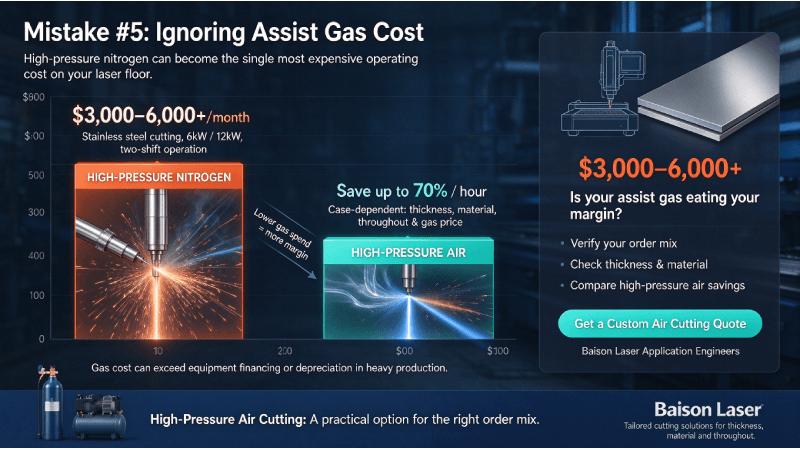
- The Reality: In a high-volume two-shift operating environment, cutting stainless steel with high-pressure nitrogen on a 6kW or 12kW system can easily cost $3,000 to $6,000+ per month in gas alone. Over the equipment lifecycle, total gas consumption costs can exceed the original purchase price of the machine.
- The Cost: Unbudgeted recurring costs that erode gross profit margins—sometimes exceeding the machine’s monthly lease or depreciation payment.
- The Solution: Evaluate whether your production mix qualifies for High-Pressure Air Cutting. Application engineers at Baison Laser can analyze your exact material thickness profiles to configure optimized air-cutting parameters, cutting hourly gas expenditures by up to 70% on medium-to-thick plate processing.
Wondering how much you could save with compressed air on your specific parts? Contact our technical sales team for a custom gas-cost breakdown.
Mistake #6: Purchasing Unnecessary Mechanical Complexity with Low Shop-Floor Utilization
- The Misconception: Buying complex features—such as 4-chuck tube cutting attachments or 3D bevel cutting heads—when 95% of your shop’s revenue comes from standard flat sheet or 2D profile cutting.
- The Reality: Added mechanical complexity introduces more potential failure points, requires higher operator skill, and complicates software programming and optical alignment.
- The Cost: Higher breakdown rates, longer operator training curves, and capital tied up in idle features.
- The Solution: Align your machine configuration strictly with your current and near-term order structure. If flat sheet processing dominates your business, choose a dedicated high-efficiency flatbed laser rather than a multi-axis machine that compromises core speed for secondary functions.
Mistake #7: Overlooking Localized Service Level Agreements (SLAs) & Overseas Spare Parts Availability
- The Misconception: Buying from a brand without local spare parts inventory or regional technical centers just to secure a low upfront purchase price.
- The Reality: When critical components like protective lens mounts, ceramic rings, cutting head drive modules, or controller cards fail under tight delivery deadlines, waiting 2 to 3 weeks for international freight halts your entire production line.
- The Cost: Lost key customer accounts, severe contractual delay penalties, and lasting damage to your market reputation.
- The Solution: Partner with established brands like Baison Laser, which maintain rapid-response service networks and localized spare parts inventories in key global markets to ensure immediate remote support and fast onsite intervention.
The 4-Step Verification Process Before Signing a Purchase Contract
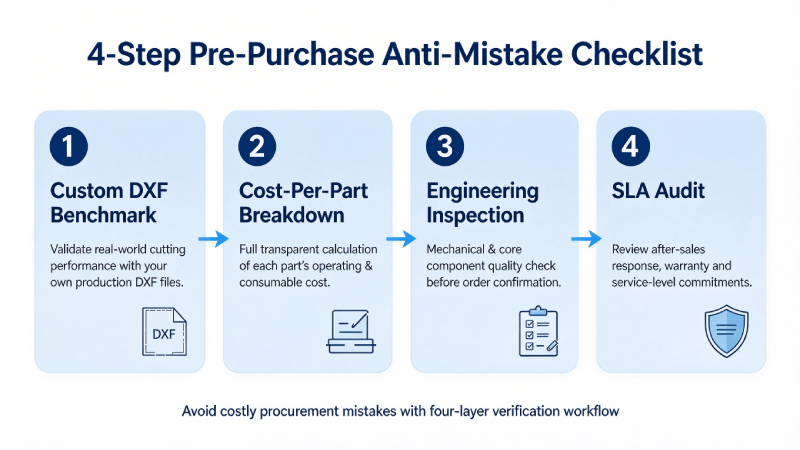
Before finalizing any procurement agreement for a fiber laser cutting machine, insist that your engineering and sourcing teams complete this 4-step audit:
- Custom DXF Benchmark Testing: Send your factory’s actual, complex DXF/CAD part drawings to the manufacturer for a timed cutting test, and request uncut, continuous video documentation.
- Itemized Cost-Per-Part Breakdown: Demand a granular breakdown of electricity usage, auxiliary gas consumption, and consumable wear (nozzles/protective lenses) for your specific parts.
- Engineering Specification Verification: Confirm total machine weight, bed annealing certification (including temperature hold times and cooling curves), and brand/tolerance classes for racks, pinions, servo motors, and linear guides.
- Service Level Agreement (SLA) Audit: Inspect contractual terms regarding local spare part delivery lead times, onsite technician response times, and warranty coverage details.
Frequently Asked Questions (FAQ)
Q1: Is machine bed stress-relief annealing really critical for fiber laser longevity?
A: Crucial. Welded steel beds accumulate massive internal stresses during fabrication. Without high-temperature stress-relief annealing (exceeding 600°C), the metal frame will naturally relax over 18 to 36 months, introducing micro-to-millimeter deformations. This results in an irreversible loss of repeatability that software calibration cannot fix.
Q2: What is the most frequently overlooked detail when buying an imported fiber laser cutting machine?
A: Beyond bed annealing, the most overlooked feature is the electrical cabinet sealing and active thermal management (such as independent industrial cabinet air conditioners). Inadequate sealing allows conductive metal dust to enter drive modules and mainboards, causing short circuits and costly electronics failure.
Q3: If my procurement budget is limited, should I prioritize higher wattage or machine frame stability?
A: Always prioritize mechanical stability and bed quality. Higher laser power can compensate for speed, but poor bed rigidity or drive inaccuracy ruins precision permanently. A machine with a deforming bed is scrap metal, no matter how powerful the laser source is.
Q4: How does Baison Laser support international buyers with post-sales service and parts delivery?
A: Baison Laser provides 24/7 expert remote diagnostics supported by regional spare parts hubs in key overseas markets. Furthermore, every machine undergoes rigorous continuous heavy-load testing prior to shipment and includes a curated wear-and-tear backup kit to eliminate unexpected downtime. Need specific SLA terms or local reference sites in your area? Reach out to our global service desk for full documentation.
Q5: How can I verify if a vendor’s advertised cutting speed is authentic?
A: Never rely on static PDF parameter charts. The most reliable method is to submit your actual DXF part files for a live stream test or unedited video benchmark (Live Streaming Cut Test). Be sure to track the total cycle time—from order load to finished part offloading—including positioning, piercing, and corner deceleration.
Procurement & ROI Evaluation Tools
Unsure whether your production mix requires 6kW, 12kW, or High-Pressure Air Cutting? Submit your material list and thickness distribution to receive a transparent Cost-per-part Breakdown and ROI Analysis prepared by Baison Laser application engineers.
👉 [[Request a Free Procurement Audit & ROI Analysis]]
Related Deep-Dive Resources
- Master Selection Guide: 2026 Fiber Laser Cutting Machine Buyer’s Guide: Specs, Costs, and ROI Evaluation
- Power Comparison: 6kW vs 12kW Fiber Laser Cutting Machines: Which Fits Your Shop Floor Best?
- Cost & Pricing Analysis: Real Fiber Laser Prices & Operating Cost Breakdown (2026 Edition)