In heavy steel structures, construction machinery, and pressure vessel manufacturing, the traditional multi-step workflow of “blanking + edge milling/planing + manual slag cleaning” comes with persistent pain points. These include slow process turnover, a shortage of skilled operators, and stubbornly high processing costs.
Baison Laser integrates independent bevel cutting solutions into its fiber laser cutting machines and professional laser tube cutting machines. Powered by ±45° five-axis linkage, high-temperature-resistant anti-ablation thermal protection beds, heavy-duty chuck dynamic compensation, and high-power intelligent gas flow technology, these systems achieve one-pass V/Y/X/K-type bevel forming. The solution covers large-format medium-thick plates as well as small-to-medium profiles and large-diameter, heavy-wall pressure piping intersectant bevels.
This drastically cuts down secondary grinding and edge milling workloads, boosting overall production cadence by over 60% and providing global heavy industry clients with a stable, controllable pre-weld bevel preparation solution.
Evolution of Pre-Welding Processing: From Multi-Process Transfer to One-Pass Forming
When welding thick plates and tubes, machining a designated bevel angle at the workpiece edge is essential to ensure full penetration in multi-pass welds and guarantee joint tensile strength (common types include V, Y, X, and K types).
Traditional Processing Pain Points
- Fragmented Workflows: Cutting and beveling are split into two separate stations, requiring frequent crane hoisting and workpiece transfer that swallows up valuable workshop hours and floor space.
- Deformation and Angular Distortion: Traditional thermal cutting or prolonged mechanical milling easily accumulates thermal stress, causing edge warping or twisting on plates and tubes.
- High Labor Dependency: Manual bevel grinding suffers from high angular variance, complicating subsequent automated welding or manual fit-ups.
Baison’s Scenario-Based Bevel Solutions
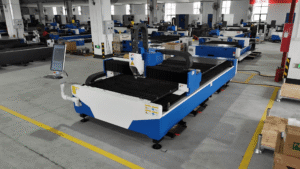
- Sheet Metal & Thick Plate Scenarios: Handled by laser cutting machines equipped with beveling functions, completing large-format nesting and edge beveling in one go.
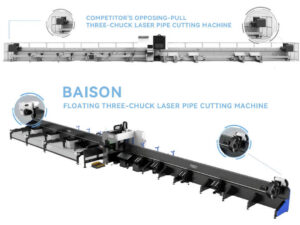
- Tube & Profile Scenarios: For small-to-medium round tubes, square/rectangular tubes, H-beams, and channels, the G24CP or K12CP tube cutting machines are recommended. For large-diameter, heavy-wall pressure pipes in petrochemical and pressure vessel applications, we recommend heavy-duty bevel tube cutting series such as the V36P, V24ESSP, or V36E free three-chuck series.
To learn more about how zero-tailing dynamic clamping works on heavy wall pipes, explore our detailed breakdown on transforming heavy tube fabrication margins with the Baison V36E free-floating triple-chuck solution.
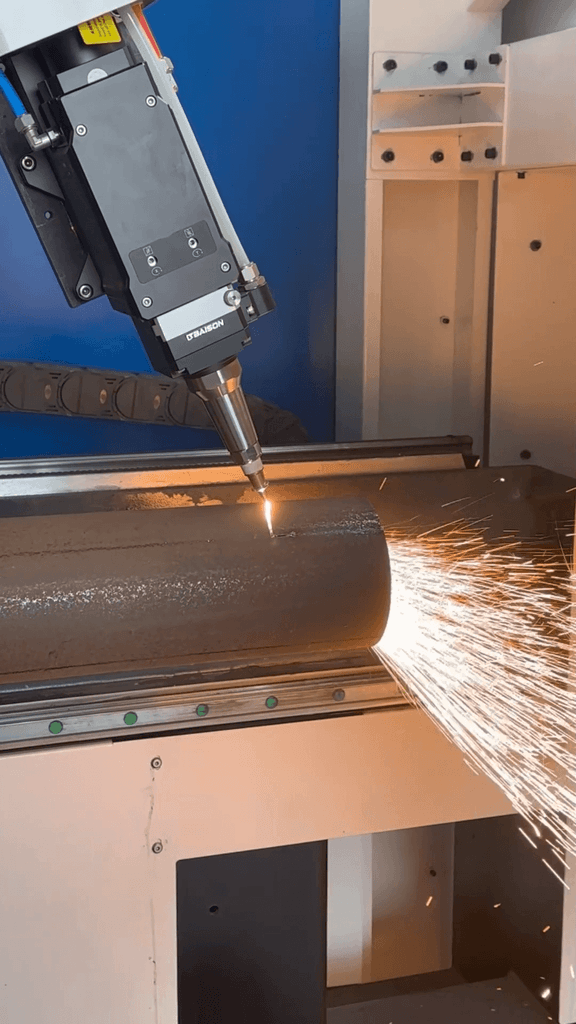
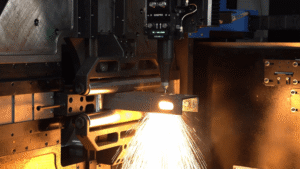
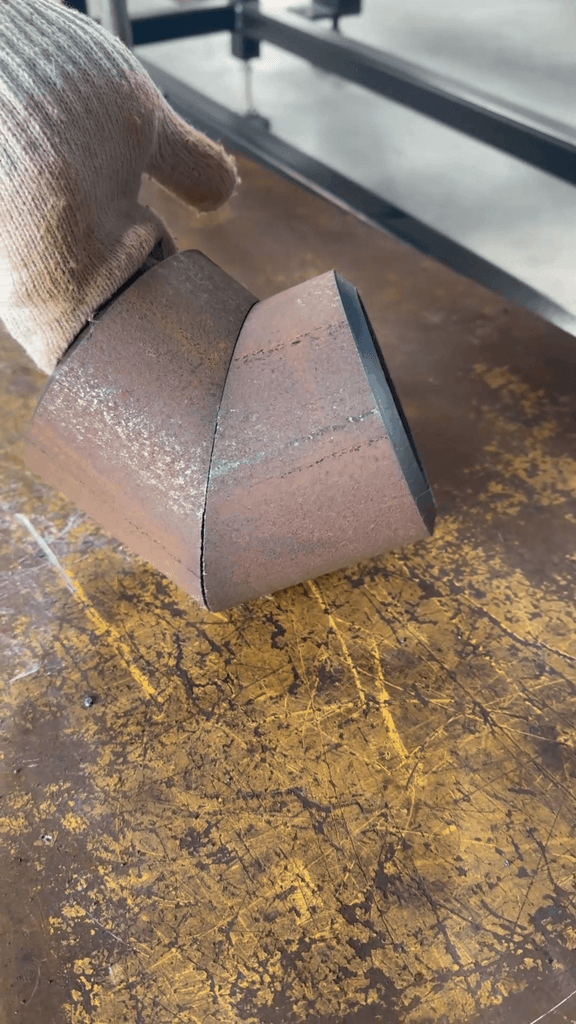
While cutting contours and intersectant lines, the equipment simultaneously executes arbitrary-angle oblique cuts up to ±45°. Once off the line, workpieces require only minimal cleaning before moving straight to fit-up and welding, stably controlling joint gaps and lowering welding preparation workloads.
Process Note: Actual production aims to stably control fit-up gaps, influenced by plate/tube material, thickness, and heat input. Bevel accuracy can be reliably controlled within tolerances permitted by welding engineering specifications. Laser beveling has an upper wall-thickness limit; submitting drawings for feasibility evaluation is recommended for specific workpieces.
Core Capabilities of Baison Plate & Tube Beveling: Software-Hardware Synergy for Processing Stability
To satisfy long-term, continuous medium-thick plate and tube beveling demands, our beveling models are supported by dedicated software and hardware architectures:
- Five-Axis Linkage Dynamic Following System: Utilizes an inclined cutting head paired with harmonic reducers and high-precision servo drives to compensate for capacitive height fluctuations in real-time during oblique cutting, preventing collision and distortion risks at the extreme 45° tilt position to secure long-term angular stability.
Such precision begins with machine construction. Read how Baison Laser’s vertically integrated manufacturing determines long-term laser cutting accuracy across all five-axis models.
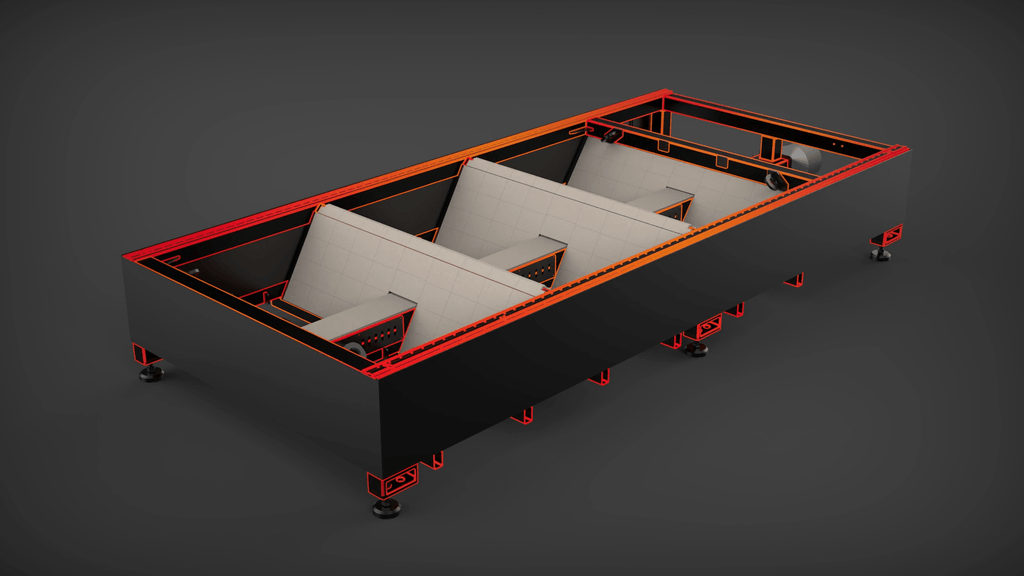
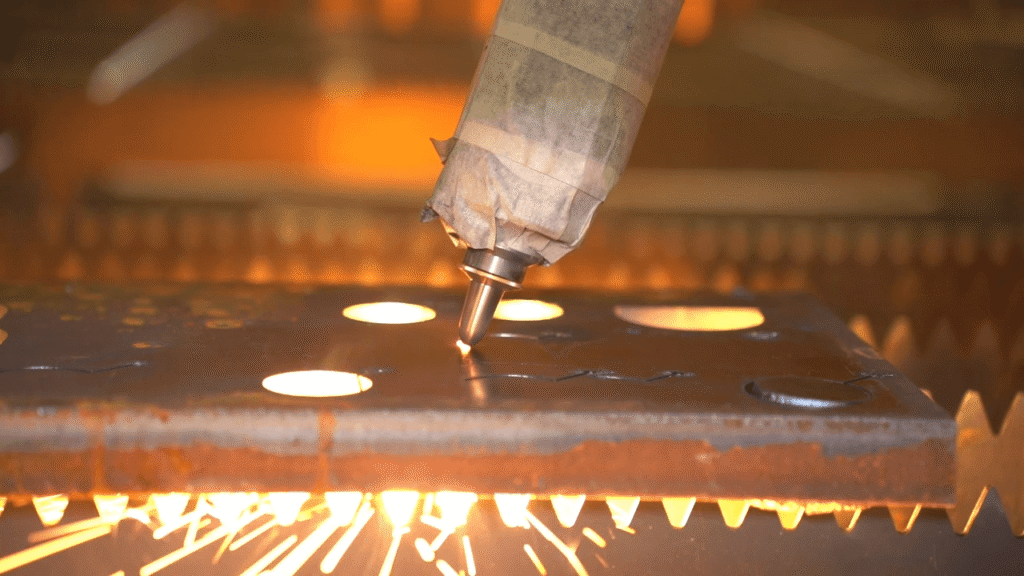
- Anti-Thermal Deformation Bed Structure (Plate Cutting Models): Engineered for high-heat input during high-power continuous thick-plate cutting, featuring a high-temperature-resistant anti-ablation protective structure combined with a strong cooling air curtain design to block heat transfer to the bed, compress the Heat-Affected Zone (HAZ), and minimize bevel angle deviation caused by thermal plate distortion.
- Heavy-Duty Chuck and Centerline Compensation (Heavy-Duty Tube Cutting Models): Tackles self-weight sagging and centerline eccentricity during rotary bevel cutting of large-diameter, thick-wall pressure pipes by integrating heavy-duty pneumatic chucks, multi-point intelligent following support systems, and CNC dynamic centerline compensation algorithms to secure high-precision fit-ups for large-angle intersectant bevels.
- Thick Plate & Heavy-Wall Tube Slag-Control & Anti-Adhesion Technology: For heavy bevel cuts on plates or thick-wall tubes over 20 mm, optical paths lengthen and auxiliary gas dispersion can hinder slag removal. Supported by high-flow composite gas nozzles and dynamic focus compensation technology, auxiliary air pressure is adjustable by 15% to 25%, enhancing slag ejection to yield clean, dross-free cutting cross-sections.
- Sharp-Edge Anti-Collapse Control Algorithm: At sharp bevel corners and tube intersectant acute angles, pulse power tapering and low-speed start logic are activated to maintain smooth thermal control during piercing and cornering phases, reducing burnout and collapse at acute points while preserving complete bevel contours.
Precision Benchmark: Bevel angle tolerance can be stably controlled within ±0.5°, and blunt-edge dimensions within ±0.2mm, matching conventional welding procedure specifications(WPS) in the heavy industry sector.
Cost and Efficiency Comparison: Turning Process Advantages into Production Revenue
For overseas steel structure plants, construction machinery manufacturers, and pipeline equipment makers, procurement evaluation hinges on process costs, labor input, and return on investment (ROI):
| Comparison Dimension | Traditional Edge Milling / Manual Bevel Grinding | Baison Laser Beveling (Plate / Tube Models) |
| Process Workflow | Blanking Transfer Gantry Milling/Planing/Tube Beveler Manual Slag Removal Welding | Contour + Bevel / Intersectant Line Synchronous One-Pass Forming → Simple Cleaning → Welding |
| Processing Efficiency | Multi-station transfers; substantial time lost in waiting and repetitive hoisting | Comprehensive production cadence boosted by over 60%, drastically cutting intermediate wait times |
| Bevel Quality | Heavy burrs and oxide scale; poor consistency in angles and blunt edges | Clean, dross-free cross-section; highly accurate and controllable angles and blunt-edge dimensions |
| Comprehensive Investment | Requires separate edge/tube milling machinery; high labor and floor space costs | Eliminates dedicated milling machine capital expenditure and reduces reliance on high-wage skilled operators |
The core value of this solution lies in aggressively eliminating intermediate transfers and secondary milling/grinding steps. Workshop floor space utilization jumps significantly, welder preparation and part-trimming hours drop dramatically, and overall unit manufacturing costs are fundamentally driven down.
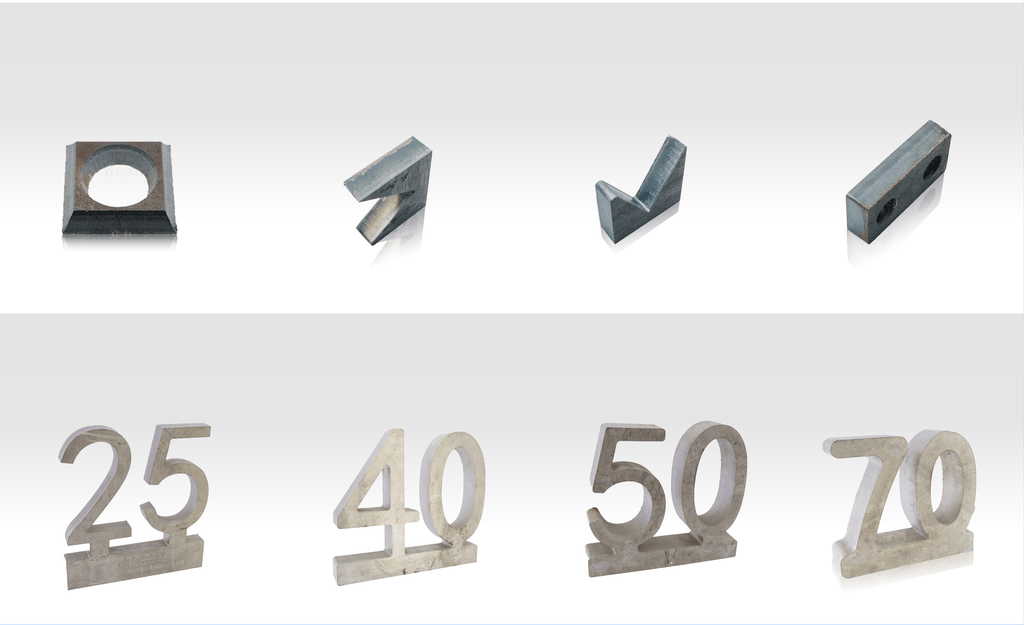
Workshop Application Case Studies
Case Study 1: Thick-Plate Structural Parts — Blanking and Beveling in One Go
An overseas construction machinery structural parts plant routinely processes 40mm thick carbon steel structural plates. Their legacy workflow involved standard laser blanking followed by transfer to a gantry mill for beveling, then manual slag removal and cleanup—a lengthy cycle plagued by a severe shortage of skilled milling operators.
- The Baison Solution: Integrating a 12000W Baison Laser Cutting Machine with beveling capabilities allowed thick plates to complete contour cutting and V/Y-type beveling on a single workbench simultaneously. Bevel dimensions remained stable with controllable deformation, and parts went straight to the welding station off the line. Workshop production cadence for such parts rose by over 60%, with exceptionally stable welding joint quality.
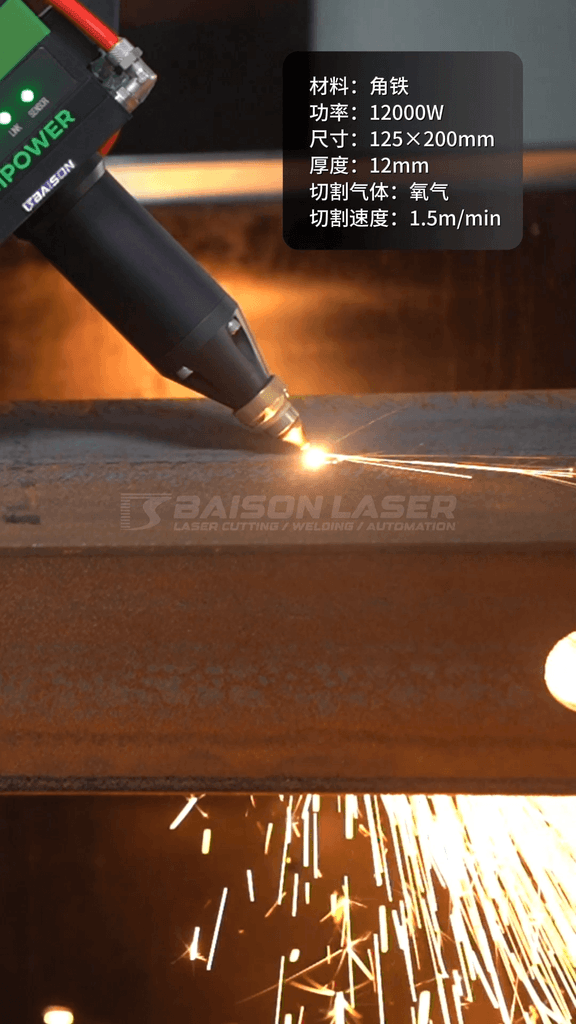
Case Study 2: Heavy-Duty Thick-Wall Pressure Pipe Intersectant Bevel Pre-Preparation
An energy equipment and pipeline engineering client needed to process heavy-wall carbon steel pipes and H-beam structural components.
- The Baison Solution: Deploying the Baison Heavy-Duty Bevel Tube Cutting series enabled integrated one-pass forming of circumferential and intersectant V/Y-type bevels on large-diameter, thick-wall pipes. This heavily reduced secondary trimming workloads before assembly and lowered multi-pass weld filler metal consumption alongside welding defect risks.
For a deeper look into selecting heavy-duty cutters based on pipe diameter, wall thickness, and ROI, check out our Comprehensive Guide to Heavy Duty Laser Pipe Cutter Selection.
Strategic Guidance for Buyers: Are your current structural materials pushing the limits of your legacy cutting equipment? Not sure whether your specific material thickness and complex joint types qualify for one-pass laser beveling? Don’t guess—send us your CAD drawings today. Our senior application engineers will run a free feasibility analysis and return a custom cycle-time and ROI report for your workshop!
Operational Note: Laser beveling suits standard materials like carbon steel and ordinary stainless steel. Following high-nickel alloy or special alloy bevel processing, surface oxide layers may require light post-treatment, and non-destructive testing (NDT) or weld inspection must comply with local welding codes (such as AWS, ASME, etc.).
Bevel Equipment Selection Checklist for Overseas Buyers
When sourcing laser beveling equipment, overseas buyers should rigorously verify the following criteria:
- Verify Full-Function Five-Axis Interpolation: Distinguish true five-axis systems from rudimentary bevel setups (pseudo-five-axis) limited to fixed-angle cuts. Complex contoured sheets and variable-angle tube intersectant bevels demand continuous five-axis interpolation.
- Inspect Bed Thermal Protection on Thick-Plate Models: Check for high-temperature-resistant anti-ablation structures and strong cooling air curtains to ensure tables remain resistant to thermal distortion under high-power continuous cutting.
- Verify Heavy-Duty Chuck and Support Precision on Tube Cutters: For large-diameter, heavy-wall pressure piping, inspect clamping force, following support load capacity, and concentricity compensation performance.
- Confirm CNC System Has a Built-In Comprehensive Process Database: Ensure the system allows pre-setting parameters by material, thickness, and bevel angle, supporting one-click recall for height, gas pressure, and power compensation profiles.
- After-Sales Support: Confirm the vendor provides complete bevel process packages, programming training, and support for sample cutting and test validation.Discover how we support international clients seamlessly through Baison Laser’s Global Support Network.
Frequently Asked Questions (FAQ)
- Q: Why choose laser beveling over traditional planers, gantry mills, or tube end-beveling machines?
- A: Traditional edge milling and tube beveling machines occupy large footprints with isolated workflows, struggling heavily with complex contoured profiles or tube intersectant bevels. Baison bevel plate/tube machines complete blanking and V/Y/X/K beveling synchronously within a single machine, slashing workpiece transfers and labor input while drastically boosting production efficiency.
- Q: What tube and plate specifications do Baison laser bevel systems support?
- A: Plates: Supports large-format medium-thick plate flat and profiled bevel machining. Tubes: Small-to-medium round tubes, square tubes, H-beams, and channels use the G24CP/K12CP; large-diameter, heavy-wall pressure pipes should use heavy-duty bevel tube cutter series like the V36P, V24ESSP, or V36E free three-chucks.
- If you are evaluating heavy-duty tube processing, compare models in our guide on why you shouldn’t blindly overpay for 3-chuck cutters—and when the V36 heavy-duty solution fits best.Specific wall thicknesses and upper diameter limits should be evaluated via submitted drawings.
- Q: What is the machinable bevel angle range?
- A: Plate bevel machines, G24CP/K12CP bevel tube cutters, and heavy-duty bevel tube cutters all support ±45° continuously adjustable bevel angles, covering mainstream V/Y/X/K bevel styles in heavy industries.
- Q: How are deformation and bottom dross controlled during large-angle oblique cuts on thick plates and tubes?
- A: Plate models rely on high-temp-resistant anti-ablation bed protection combined with strong cooling air curtains to suppress thermal deformation. Heavy-duty tube models utilize heavy-duty chucks and dynamic axis compensation to secure precision. Simultaneously, composite gas nozzles and dynamic focus compensation optimize slag removal to minimize dross formation.
- Q: How should a workshop choose models if it has both plate and tube beveling requirements?
- A: The two setups offer independent, specialized division of labor: prioritize laser bevel plate cutters for thick flat structural parts; use G24CP/K12CP for small-to-medium profile intersectant bevels; and choose heavy-duty bevel tube cutters for large-diameter, heavy-wall pressure piping. Equipment can be procured individually or configured in combination based on mainstream workpieces.
- For a full framework on allocating budget between flat sheet vs. tube cutters, refer to our Ultimate 2026 Sheet vs. Tube Laser Cutter Selection & ROI Guide.
Conclusion & Next Steps
Amid fierce global competition in heavy machinery and equipment manufacturing, a stable, controllable pre-preparation process is a vital lever for factories to optimize capacity, control yield rates, and drive down costs.
Baison Laser’s bevel cutting systems provide global clients in steel structures, construction machinery, and pressure vessels with an integrated pre-weld bevel solution, vastly streamlining cumbersome multi-step processing chains.
Ready to Eliminate Secondary Grinding and Supercharge Your Production?
Don’t let outdated multi-step workflows eat into your profit margins. Contact the Baison Laser international team right now to submit your workpiece drawings, claim your exclusive bevel process evaluation package, and schedule a live or virtual sample cutting test tailored to your factory needs!