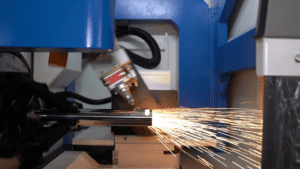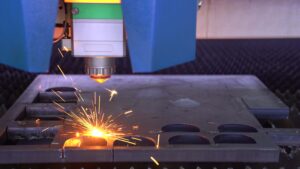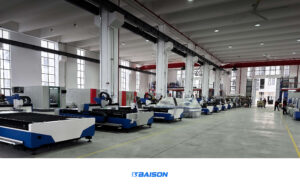
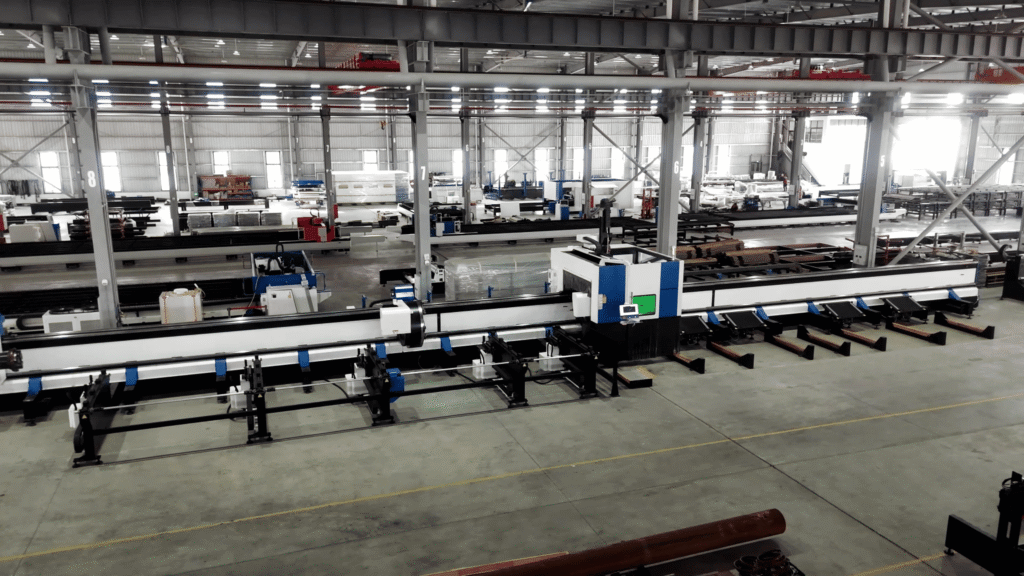
In today’s global heavy industry, large-scale steel structure bridge construction, and heavy-truck manufacturing, traditional sawing, flame cutting, and plasma cutting have long fallen short. They often struggle with large-diameter, heavy thick-walled steel pipes, H-beams, and channel steels—resulting in heavy burrs, severe thermal deformation, and high bevel angles that demand tedious, labor-intensive secondary grinding.
Selecting a heavy-duty laser tube cutting machine involves much more than blindly comparing laser power. Buyers must follow the “Golden Triangle” selection logic of tube diameter, wall thickness, and single-piece weight, evaluating machine capabilities across multiple dimensions.
As fiber laser technology advances into higher power brackets, high-power heavy-duty laser tube cutters (such as 12kW to 20kW+) are becoming the core weapon for overseas factories seeking to break through capacity and precision bottlenecks. However, facing a crowded market, many international buyers fall into common traps: blindly chasing the highest power or focusing solely on wall thickness while ignoring tube diameter and weight matching.
Selecting a heavy-duty tube machine is never a single-choice question. This guide relies on rigorous industrial manufacturing logic to deeply analyze power grading, the Golden Triangle selection rules, and real-world workshop case studies.
(If your facility also operates flat sheet metal lines alongside tube processing, you can benchmark your overall plant investment layout against our comprehensive Fiber Laser Cutting Machine Buying Guide 2026: Specs, Cost & ROI).
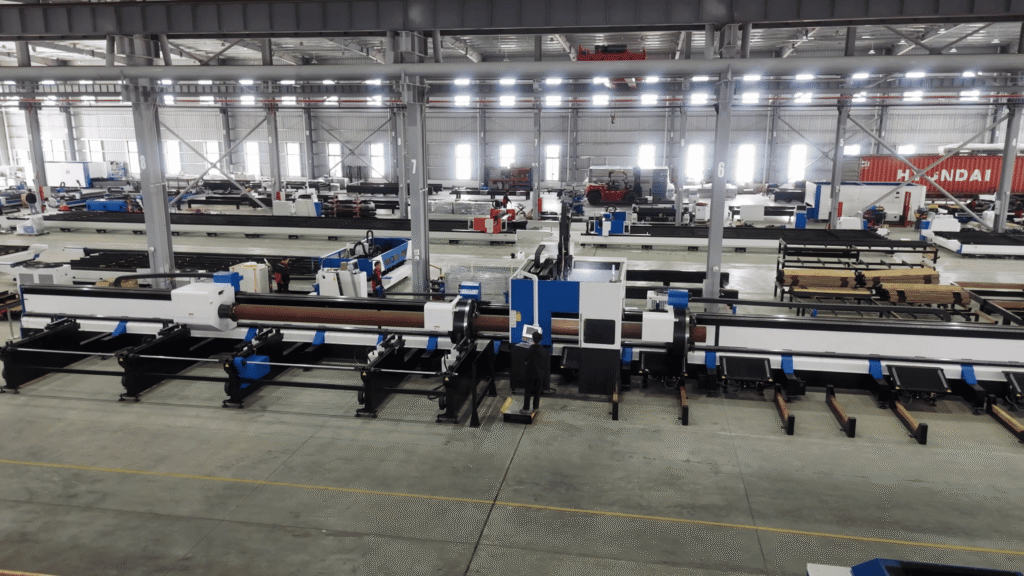
Core Insights: Heavy-Duty Tube Cutter Power Grading & Wall Thickness Matching
Note: The following cutting capacities are based on standard laboratory test conditions. Actual piercing and cutting performance will vary depending on material grade, assist gas purity, and pipe surface rust conditions.
In heavy-load pipe processing, blindly pursuing maximum power not only wastes equipment investment but can also trigger over-heating deformation in thin-walled sections. Conversely, insufficient power directly leads to slow piercing and incomplete cuts on thick walls. Scientifically matching the power bracket is the key to securing a high Return on Investment (ROI):
- 10kW – 15kW Power Bracket (The Efficient Balance for Medium-to-Thick Walls): Tailored for conventional engineering machinery brackets, architectural support pipes, and other medium-to-thick carbon and stainless steel tubes. This bracket perfectly balances cutting speed and surface finish, demonstrating exceptional stability when cutting 10mm to 20mm wall thickness. It yields slag-free kerfs and, with proper process parameters, drastically reduces secondary grinding.
- 20kW+ Ultra-High Power Bracket (The “Game-Changer” for Ultra-Thick Walls & Heavy Profiles): Engineered for oil transmission pipelines, massive bridge components, heavy-truck chassis side beams, and other ultra-thick walls (30mm+) and heavy industrial profiles. The high energy density of ultra-high power brings a quantum leap in thick-wall piercing speed, minimizes the heat-affected zone (HAZ), and ensures strict perpendicularity and penetration requirements for large cross-section cuts.
- To dive deeper into how lower wattage configurations stack up against heavy-duty tiers regarding shop floor efficiency and thickness boundaries, read our dedicated power analysis in 6kW vs 12kW Fiber Laser Cutter: Which Power Range Fits Your Shop in 2026?).
💡 Is your current power configuration holding back your heavy pipe throughput?
Don’t let mismatched wattage drain your margins. Click here to connect with Baison Laser experts to run a custom power-to-thickness simulation for your heaviest structural profiles.
The Golden Triangle of Heavy-Duty Tube Machine Selection: Breaking Free from Single-Point Blind Spots
Evaluating an industrial-grade heavy-duty laser tube cutter requires discarding the one-sided perspective of “how thick can it cut.” Instead, you must establish a three-dimensional Golden Triangle selection logic: Diameter + Wall Thickness + Single-Piece Weight.
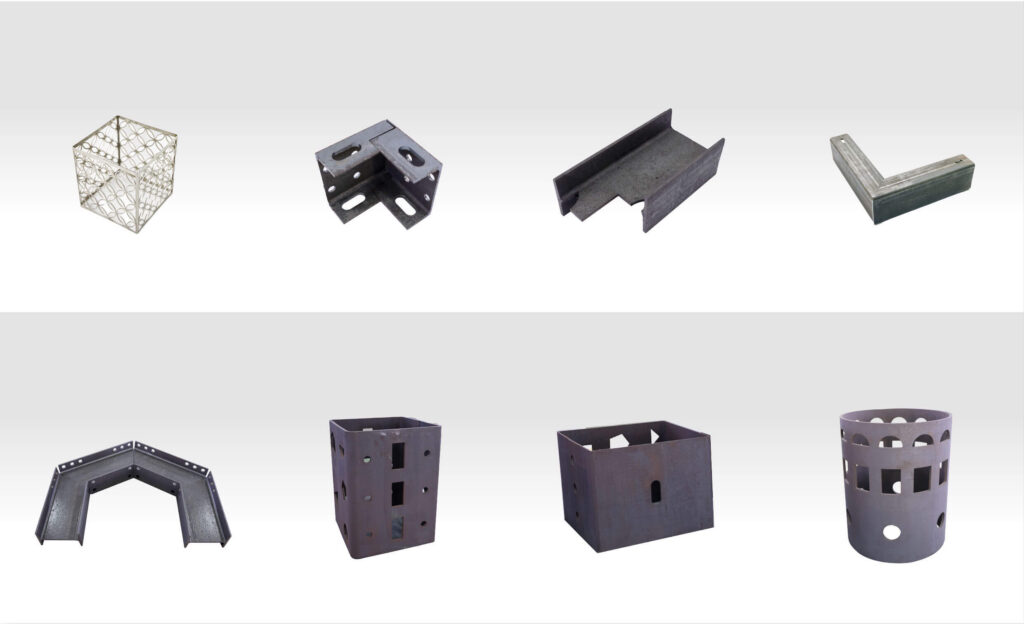
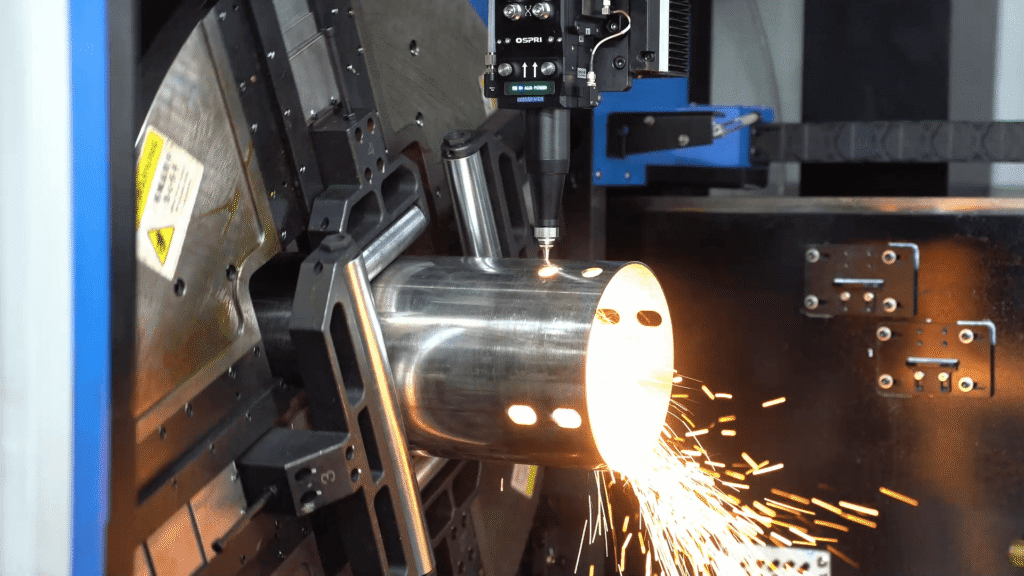
1.Diameter & Chuck Specifications: Tube dimensions (e.g., 360 chuck vs. 520 heavy-duty chuck) determine whether the equipment can ingest your largest workpieces. Taking the Baison Laser V52 series as an example, its 520 heavy-duty three-chuck design is specifically engineered for large-caliber, complex profile pipes, ensuring zero eccentricity during high-speed rotation of massive tubes.
2.Wall Thickness & Laser Power: Dictates piercing capability and cutting limits. The tiered scaling from 12kW to 20kW+ guarantees the optimal efficiency solution from standard thick-walled tubes to extreme heavy-load materials.
3.Single-Piece Weight & Anti-Heavy-Load Bed Structure: Heavy pipes often weigh several tons each and measure up to 12 meters long. The annealing process and overall structural design of the machine bed directly dictate whether the equipment can maintain structural precision after 5 to 10 years of full-load, high-frequency loading and operation.
Boundary Notice: The advantages of this series of three-chuck heavy-duty models are primarily geared toward 6 to 12-meter large-diameter, high-weight profiles. For high-volume processing of extremely short and small pipe materials, the structural advantages of the three-chuck layout cannot be fully utilized.
Before finalizing your heavy-duty procurement roadmap, make sure you aren’t committing costly blind spots that could compromise your shop’s profitability—review our detailed pitfall prevention checklist in 7 Costly Mistakes Sheet Metal Shops Make When Buying Fiber Lasers (2026 Buyer’s Guide) to protect your capital investment.
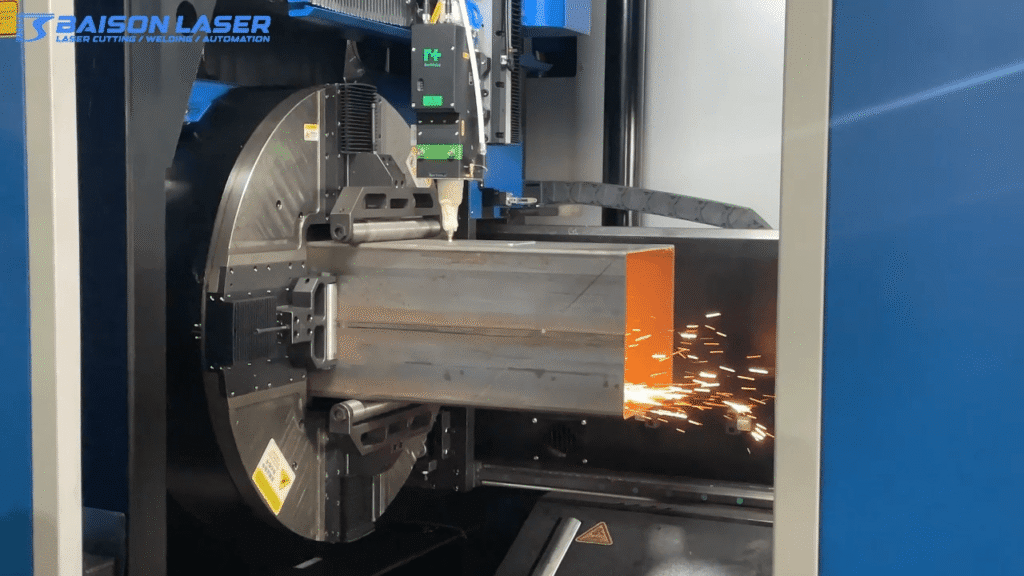
Recommended Power & Machine Configurations by Application Industry
- Automotive Manufacturing & Heavy Truck Chassis: Demands exceptionally high cycle efficiency and long-term continuous operation stability. We recommend configuring high-dynamic-response, high-power laser tube cutters to ensure efficient blanking of side beams and custom-shaped chassis profiles.
- Steel Structures & Construction Engineering: Dominated by large-diameter, thick-walled pipes with a primary focus on thick-wall piercing performance. We recommend large-chuck, heavy-load fully automatic loading and unloading solutions such as the Baison V52ETT floating (12+12) or V52ETS floating (12+6) systems.
- Agricultural & Construction Machinery: Features a diverse array of structural and profile tubes, requiring a balance between flexibility and heavy-load processing. We recommend medium-to-high power pairings equipped with intelligent auto-centering systems to seamlessly handle changing pipe geometries.
Comprehensive Comparison of Mainstream Heavy-Duty Tube Cutters
In the international market, heavy-duty tube cutter suppliers abound, but performance and stability gaps dictate corporate productivity and payback periods. Below is a comprehensive comparison between Baison’s V-Series three-chuck heavy-duty tube cutters, traditional dual-chuck cutting machines, and standard entry-level economic models:
| Comparison Dimension | Traditional Dual-Chuck Tube Cutters | Standard Economic Tube Cutters | Baison V-Series Heavy-Duty Tube Cutter (e.g., V52 Series) |
| Chuck Configuration & Stability | Dual-chuck design; cantilever ends tend to whip and sway during long pipe processing, limiting precision. | Single-chuck or basic dual-chuck with low load capacity; suitable only for lightweight, thin-walled pipes. | 520 heavy-duty three-chuck collaborative clamping; ultra-heavy pipes rotate at high speed as steady as a rock. |
| Power & Thick-Wall Adaptability | Mostly medium-to-low power; struggles with thick-wall piercing, resulting in low efficiency. | Power-constrained; completely incapable of handling ultra-thick industrial structural profiles. | Supports 12kW to 20kW+ high power; achieves high-speed piercing on thick carbon steel. |
| Tail Scrap Waste | Longer tail scraps (typically between 200mm to 400mm), causing heavy material waste. | Uncontrollable tail stock with extremely low scrap utilization efficiency. | Features “Zero Tail Scrap” collaborative cutting capability, squeezing maximum value out of raw materials. |
| Automation & Weight Capacity | Relies heavily on manual handling and auxiliary positioning; high safety risks. | Semi-automatic or purely manual loading/unloading; massive operator labor intensity. | Standardized 12-meter heavy-duty auto-loading rack, supporting single-tube weights up to 2000kg. |
* Performance metrics are based on standard operating conditions; actual performance is affected by raw material quality, operator proficiency, and machine maintenance status. The zero tail-scrap effect assumes that the raw pipe is straight and of sufficient length to support relay chuck clamping.
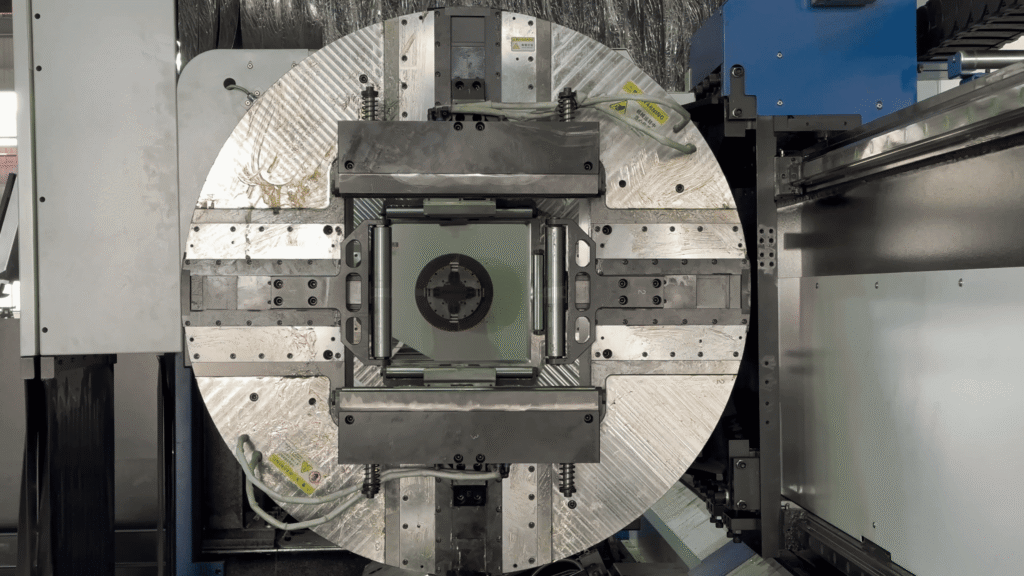
Real-World Commercial Case Study from an Overseas Customer
A large Middle Eastern heavy steel structure manufacturer primarily constructs bridges and industrial plant components, routinely processing high-strength carbon steel support pipes exceeding 400mm in diameter and over 20mm in wall thickness. Before introducing the Baison V52ETT equipped with a 12kW laser and a three-chuck floating system, their workshop faced two major pain points:
- High Rejection Rates: Using traditional dual-chuck cutters, the cantilever end of long pipes spun at high speeds, triggering violent centrifugal whipping and causing tube-end geometric dimensions to fall out of tolerance. The scrap rate hovered consistently high at around 7.5%.
- Severe Tail Material Loss: Tail scraps averaged up to 350mm, resulting in massive financial losses on high-strength steel remnants.
After introducing the Baison V52ETT, the workshop achieved a quantum leap in production data:
- Scrap Rate Plummeted to 0.4%: Multi-point synchronous collaborative clamping by the three-chuck system completely eradicated whipping and sagging during high-speed rotation of long pipes.
- Zero Tail-Scrap Technology Saved Massive Costs: Through three-chuck floating alternate feeding, tail scrap was compressed to its structural limit, boosting high-strength steel material utilization by nearly 10%.
- Comprehensive Capacity Doubled: The synergy of 12kW high-power piercing and a 12-meter heavy-duty automatic loading rack streamlined heavy material handling and cutting tasks—previously requiring multiple operators—into a single-operator, unattended workflow.
⚠️ Are high scrap rates and long tail remnants eating away at your project margins?
Discover how our Middle Eastern partner cut scrap from 7.5% to 0.4%. Talk to a Baison technical specialist today.
FAQs (Frequently Asked Questions)
Q1: When purchasing a heavy-duty tube cutter, should I prioritize laser power or chuck size?
A: Both must be perfectly matched. Chuck size (such as 360 or 420/520) is determined by your maximum tube diameter and single-piece weight, while laser power (such as 15kW or 20kW+) is dictated by your material type and maximum wall thickness. Neither can be overlooked.
Q2: How does the three-chuck floating technology achieve reduced tail scrap?
A: The three-chuck system uses intelligent alternate clamping and collaborative feeding during the cutting process. This breaks through the stroke dead zones of traditional dual-chuck setups, achieving minimal or near-zero tail scrap loss under specific working conditions.
Q3: Can overseas operators quickly master such high-power heavy-duty equipment?
A: Absolutely. The equipment is powered by an advanced professional bus CNC system supporting auto-centering, corner cutting process compensation, and intelligent nesting. With an intuitive user interface, standard technicians can operate it independently after short-term training.
Q4: What types of metal pipes does the Baison V-Series tube cutter support?
A: It supports carbon steel, stainless steel, aluminum alloys, and various other metal materials. It not only cuts standard round, square, and rectangular tubes but also efficiently processes channels, I-beams, angle irons, and H-beams and other heavy industrial profiles.
Q5: How does Baison guarantee after-sales service and technical support for overseas customers?
A: We provide comprehensive professional support, including detailed installation and commissioning guides, online remote technical response, and overseas engineer support. Core components utilize top domestic and international brands (such as Raycus lasers and CypCut systems) ensuring superior quality and stable operation.
Conclusion & Next Steps
Choosing the correct laser power and heavy-duty pipe cutter specification is the critical first step for your workshop to transition from “traditional contract processing” to “high-efficiency intelligent manufacturing”.
What type of large and heavy tubes is your workshop currently processing?
Feel free to contact the Baison Expert Team at any time with your maximum tube diameter, wall thickness, and material parameters. We will provide you with a tailored power-matching and ROI calculation proposal to help you outrun competitors in the global heavy industry market!