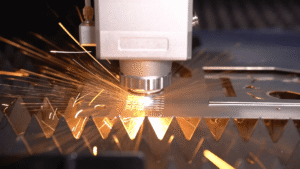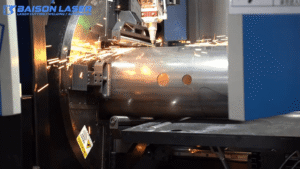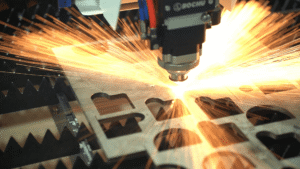
Laser cutting speeds continue to increase, but why doesn’t actual shop-floor output always keep pace?
For sheet metal fabricators, the bottleneck is not always the cutting process itself. Loading and unloading sheets, removing finished parts, preparing the next sheet, and switching between jobs can all add time to the production cycle. Even a high-speed fiber laser cutting machine cannot reach its full production potential if too much time is spent waiting between cutting operations.
Improving fiber laser cutting productivity means looking beyond cutting speed. It requires reducing non-cutting time, streamlining material handling, and choosing a shuttle table that matches the demands of your production workflow.
TL;DR:Fiber laser cutting productivity depends not only on cutting speed, but also on laser cutting loading and unloading, table exchange, part sorting, and job changeover. Optimizing workflows and deploying the right shuttle table fiber laser cutting machine minimizes idle periods and boosts overall throughput. Baison Laser’s SH3A (inclined shuttle table) and ST3A (heavy-duty horizontal shuttle table) offer tailored options based on sheet weight, exchange speed, and processing requirements.
Key Takeaways
- Minimize Non-cutting Time: Sheet loading, unloading, part removal, and job changeovers are often the primary bottlenecks limiting shop-floor output.
- Optimize Table Exchange: A dual-table configuration coordinates cutting operations with material handling, significantly reducing wait times between cycles.
- Streamline Part Handling: Properly configuring micro-joints, common-line cutting, and sorting routines prevents post-cutting backlogs.
- Match Equipment to Payload Needs: Evaluate laser cutting machine payload, exchange time, and repeat positioning accuracy based on your actual sheet specifications.
- Align the Entire Workflow: True machine utilization requires seamless coordination among equipment, operators, and upstream/downstream processes.
Why High Cutting Speeds Don’t Always Translate to High Output
On a busy fabrication floor, a complete production cycle involves far more than the laser head cutting metal. It encompasses loading raw sheets, unloading finished parts, clearing scrap skeletons, and preparing the next batch.
Consider a typical shop-floor scenario: cutting a single sheet may take only 45 seconds, whereas unloading finished parts, clearing scrap, and loading the next sheet can take up to 3 minutes. When a machine spends the majority of its cycle waiting on auxiliary tasks, simply increasing laser power or cutting speed will not resolve the throughput bottleneck. Fabricators must focus on maximizing active cutting time while eliminating avoidable delays through smarter equipment configuration and workflow design.
- Time-Consuming Loading and Unloading: Once a sheet is cut, operators must remove finished parts and skeletons before loading fresh material. If the laser sits idle throughout this manual process, laser cutting downtime accumulates across every cycle—especially in high-volume production. A shuttle table bridges this gap by allowing material handling and cutting to happen simultaneously.
- Complex Part Removal:Cutting the sheet is only one part of the production cycle. Finished parts—particularly small, intricate, or tip-prone geometries—often cannot be removed instantaneously:
- Micro-joints: Small tabs left uncut to prevent parts from tipping or colliding with the cutting head require manual separation and deburring afterward.
- Common-line Cutting: Sharing cut lines between adjacent parts reduces laser path length, but still requires organized sorting and separation strategies.
- Small Part Recovery: Tiny components can fall between support slats, increasing manual retrieval and sorting time. Without coordinated nesting and unloading plans, operators end up spending excessive time clearing the bed after cutting finishes.
- Frequent Job Changeovers: Switching between orders often means changing material grades, sheet thicknesses, dimensions, and CNC cutting programs. Without structured production scheduling, operators lose valuable time locating stock, verifying files, and adjusting parameters—a major challenge for high-mix, low-volume fabricators.
- Upstream and Downstream Bottlenecks: Laser cutting is just one stage in sheet metal fabrication. If upstream shearing/staging fails to supply sheets on time, or downstream bending and welding stations cannot clear finished parts fast enough, the laser will inevitably sit idle. Consequently, machine utilization relies heavily on synchronized material staging, unloading, and downstream logistics.
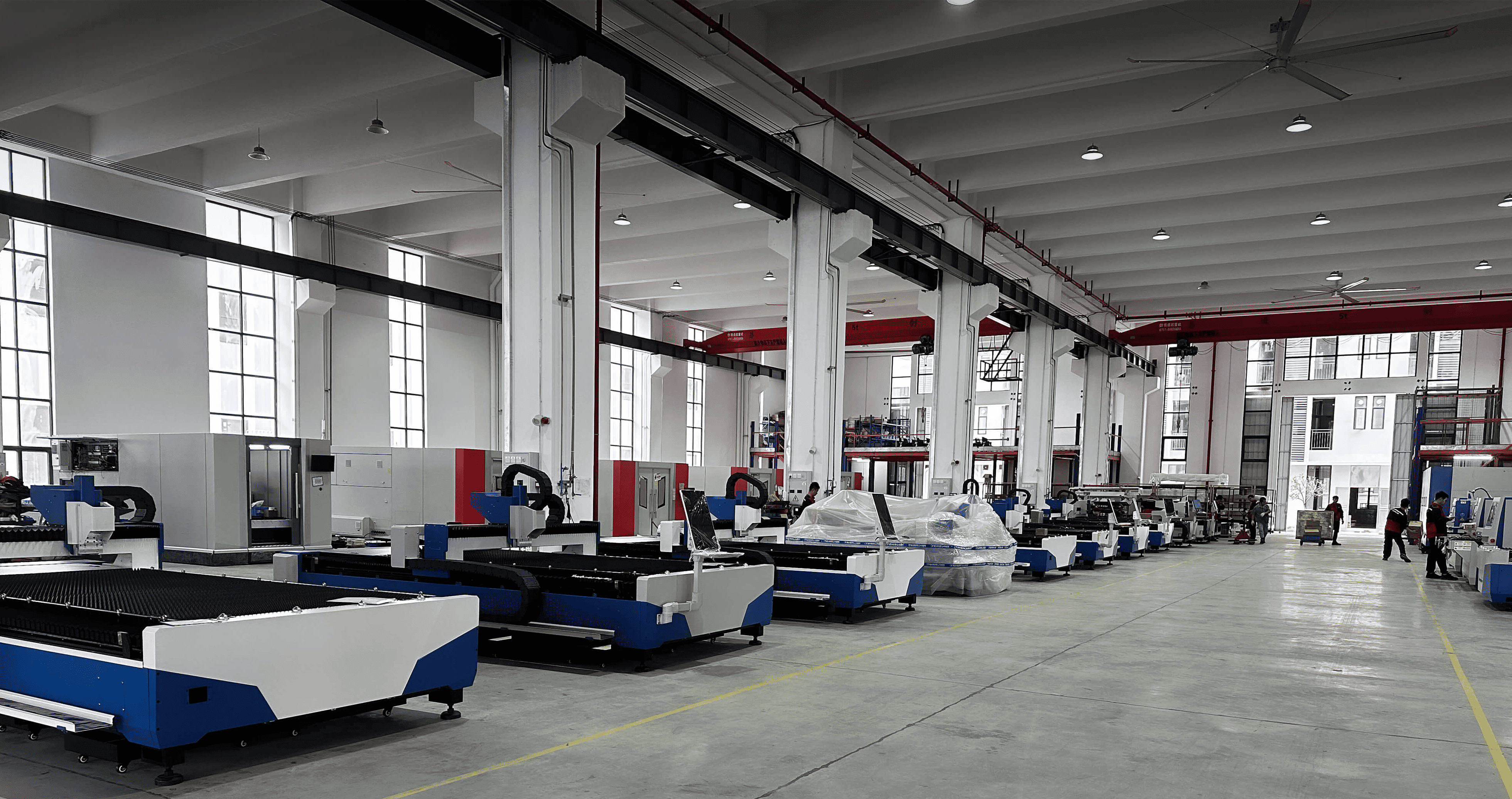
The Hidden Cost of Idle Capital: A fiber laser cutting machine represents a major capital investment. When a machine spends large portions of its shift waiting on loading, part sorting, or job setup, you continue paying for floor space, laser source depreciation, and operator labor without generating parts. Higher cutting speeds alone cannot offset the financial drain of idle equipment—which is why many shops see underwhelming output despite investing in high-speed machinery.
To evaluate a machine’s true economic impact beyond initial purchase prices, you can explore the Beyond the Price Tag: The Ultimate Sheet Fiber Laser Cutting Machine TCO & Evaluation Guide, which breaks down hidden operational expenses, energy consumption, and maintenance costs in detail.
How to Reduce Non-cutting Time in Laser Cutting Operations
Once you identify where time is lost on the shop floor, you can target those bottlenecks directly. Focus on four core areas to cut non-cutting time and improve shop-floor productivity:
1. Common Production Bottleneck: Waiting Until Cutting Finishes to Prepare the Next Sheet
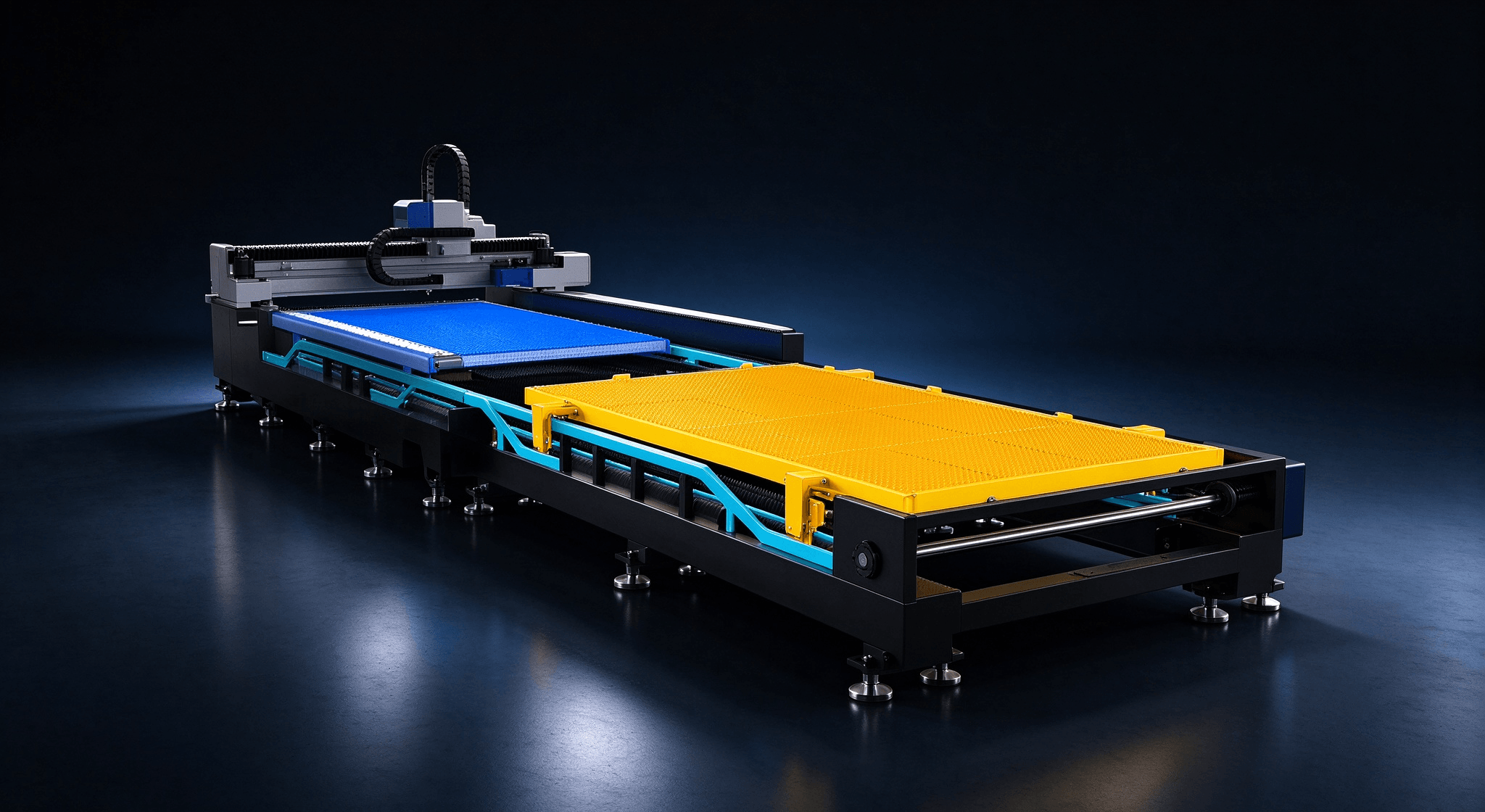
- How to Improve It: Stage materials in advance and deploy a shuttle table. In batch production, a dual-table system allows operators to load and unload sheets on the outer table while the laser actively cuts on the inner table. Once cutting concludes, the tables swap automatically to begin the next cycle immediately.
- What to Look For: When evaluating a laser cutting machine exchange table, consider:
- Shuttle table exchange time
- Maximum table load capacity
- Drive mechanism and structural stability
- Repeat positioning accuracy
- Ergonomics and ease of loading/unloading
- Note: Exchange speed is only one factor; matching the table’s load capacity and stability to your actual sheet weights and production rhythm is equally critical.
2. Common Production Bottleneck: Nesting Strictly for Material Yield While Ignoring Part Unloading
- How to Improve It: Integrate part removal into your nesting and process planning. Smart nesting affects not only material utilization, but also how quickly operators can clear the table. Apply micro-joints strategically to small or tip-prone parts based on geometry and downstream needs, and use common-line cutting where it streamlines both cutting and separation. Planning sorting bins, unloading tools, and transfer carts ahead of time prevents finished parts from piling up and delaying the next cycle.
3. Common Production Bottleneck: Processing Orders Ad Hoc Without Sequencing
- How to Improve It: Schedule jobs more strategically. For high-mix operations, group orders by material type, sheet thickness, and compatible cutting parameters to minimize changeovers. Staging the next batch of raw sheets and pre-loading CNC programs before the current job finishes eliminates last-minute searching and setup delays.
4. Common Production Bottleneck: Optimizing the Laser in Isolation from Adjacent Workflows
- How to Improve It: Coordinate cutting operations with material handling. Align raw material staging zones, finished-part buffer areas, and material transfer routes with your laser’s cycle time. Defining clear operator responsibilities for loading, unloading, and part sorting ensures the next sheet is always ready when the table swaps.
For fabricators looking to scale beyond standalone cutting lines and minimize lead times across multiple production stages, reading How an Integrated Cut-Bend-Weld Line Cuts Metal Fabricator Lead Time by 40% provides valuable insights into full-shop workflow automation.
Estimating Time Savings from a Shuttle Table Upgrade
You can estimate potential time savings during table exchanges using a straightforward formula:
Theoretical Time Saved = (Current Exchange Time – New Exchange Time) × Number of Exchanges
Shop-Floor Reference Calculation: Suppose manual sheet replacement currently requires 2.5 minutes (150 seconds) of machine wait time per cycle, and upgrading to an automated shuttle table reduces exchange time to 12 seconds. Based on 40 sheet exchanges per day across 250 working days per year:
- Time saved per cycle: 150 s – 12 s = 138 seconds
- Daily time saved: 138 s × 40 = 5,520 s = 92 minutes per day
- Annual time freed: ≈ 383 hours of potential active cutting time per year
(Note: These figures represent theoretical estimates for equipment comparison during procurement. Actual gains depend on nesting layouts, part complexity, operator proficiency, and order mix, and do not constitute a guaranteed output commitment.)
How to Choose the Right Shuttle Table Fiber Laser Cutting Machine
Selecting the right shuttle table goes beyond swap speed—it requires matching platform mechanics, laser cutting machine payload, and positioning performance to your daily workload:
- Choose the Baison SH3A if you prioritize an inclined shuttle table design, smooth synchronized motion, and verified repeat positioning accuracy for light-to-medium sheet metal.
- Choose the Baison ST3A if you regularly process thick, heavy plates and require high maximum table load capacity and heavy-duty structural support.
SH3A: Inclined Shuttle Table for Efficient Exchange and Precise Positioning
The SH3A features a self-developed, patented inclined shuttle table driven by a dual-chain four-drive system. This configuration enables synchronized table movement for stable exchange operations. The front and rear tables remain at the same horizontal level, providing a consistent working height for sheet loading and unloading.
The SH3A also delivers a repeat positioning accuracy of ±0.03 mm, making it a suitable option for manufacturers who place importance on positioning performance and table exchange efficiency. With a shuttle table exchange time of 10–15 seconds and a maximum table load capacity of 600 kg, the SH3A combines efficient table exchange with practical sheet metal processing capabilities.
For structural durability, the SH3A utilizes a one-piece plate-welded bed reinforced with cross-ribbed internal bracing and stress-relieved via segmented intermittent annealing in a CNC high-temperature furnace. Its patented aerospace-grade aluminum crossbeam, formed through ultra-high-pressure integral extrusion, balances structural rigidity with lightweight agility.
Additionally, the machine includes a full protective enclosure with CE-compliant safety viewing windows and an integrated container-loading design for streamlined shipping.
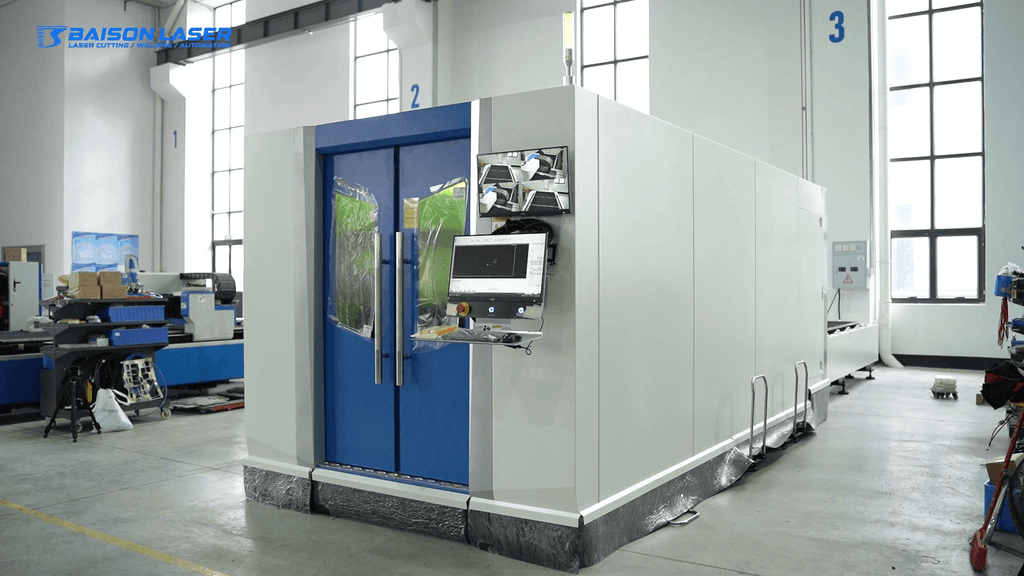
| SH3A Core Specifications | Details |
| Shuttle Table Type | Inclined Shuttle Table |
| Shuttle Table Exchange Time | 10–15 seconds |
| Maximum Table Load Capacity | 600 kg |
| Working Area | 3000 × 1500 mm |
| Laser Power Range | 1500W–12000W |
ST3A: Heavy-Duty Horizontal Shuttle Table for High Load Capacity
Designed for applications requiring greater table load capacity, the ST3A features a heavy-duty horizontal shuttle table with a maximum table load capacity of 1,500 kg. Its shuttle table exchange time can be as fast as 10 seconds, helping streamline the transition between sheet loading and cutting operations.
The machine also features a semi-hollow insulated bed and a follow-up zoned dust extraction system, which helps reduce smoke dispersion and improve dust extraction performance. An integrated electrical cabinet with independent air conditioning supports cabinet temperature management, while the detachable rear base frame provides greater flexibility for transportation and container loading.
| ST3A Core Specifications | Details |
| Shuttle Table Type | Horizontal Shuttle Table |
| Shuttle Table Exchange Time | As fast as 10 seconds |
| Maximum Table Load Capacity | 1,500 kg |
| Working Area | 3000 × 1500 mm |
| Laser Power Range | 6000W–40000W |
SH3A vs. ST3A: Which Model Fits Your Production Needs?
Select the SH3A if you prioritize:
- An inclined shuttle table with a dual-chain four-drive system
- Front and rear tables remaining at the same horizontal level for ergonomic loading
- A 10–15 second shuttle table exchange time and ±0.03 mm repeat positioning accuracy
- An integrated container-loading design for simplified logistics
Select the ST3A if you prioritize:
- A heavy-duty horizontal shuttle table built for demanding workloads
- A 1,500 kg maximum table load capacity
- Shuttle table exchange times as fast as 10 seconds
- Follow-up zoned dust extraction for cleaner high-power cutting
- A detachable rear base frame for convenient transportation and container loading
Quick Application Match:
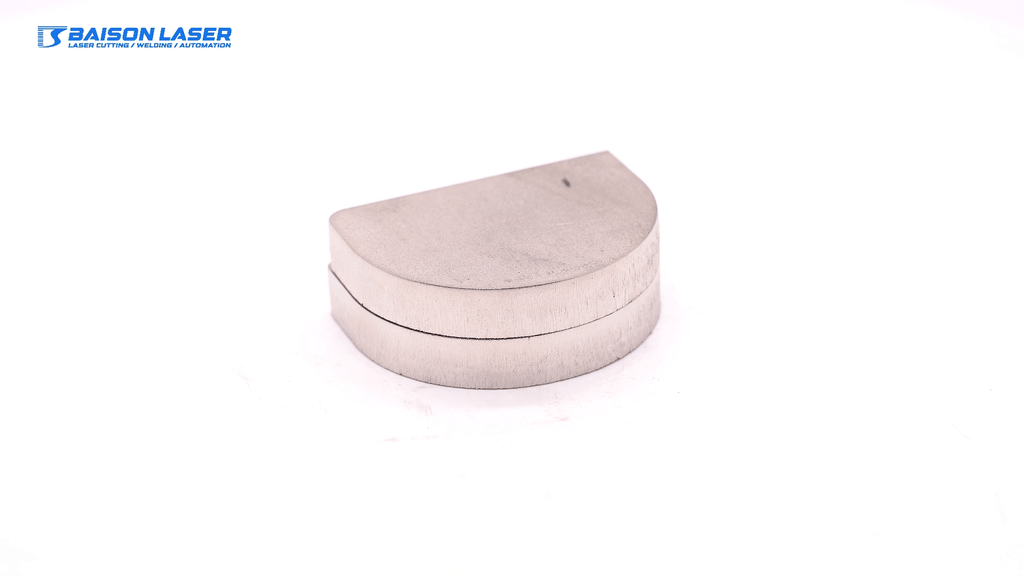
- SH3A Best Fit: Shops focused on thin-to-medium stainless steel and aluminum, high-mix/low-volume orders, frequent drawing changes, consistent dimensional repeatability, and straightforward container shipping.
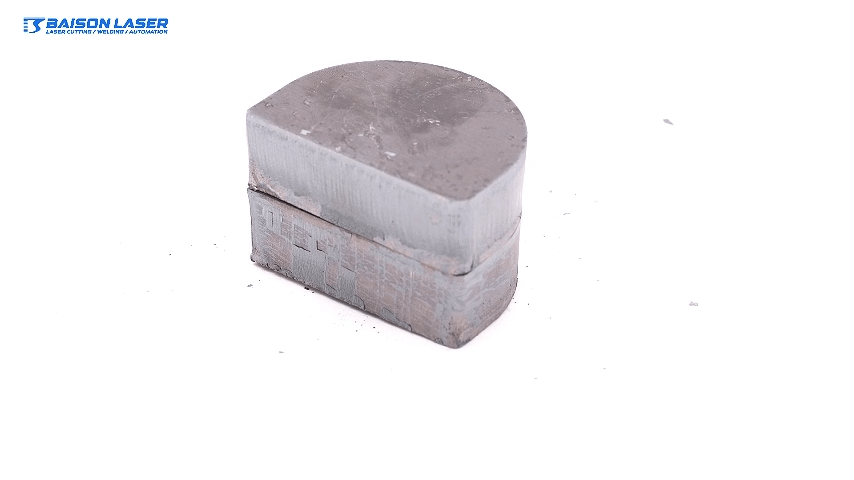
- ST3A Best Fit: Operations processing thick carbon steel and heavy plates in high-volume batches, utilizing 6kW+ high-power lasers under continuous, heavy-load conditions.
Important Note on Payload:Maximum table load capacity does not correspond to a single fixed sheet thickness limit. Always calculate total sheet weight based on material density, sheet length and width, and thickness when evaluating table capacity.
Factoring Shipping and Container Loading into Your Evaluation
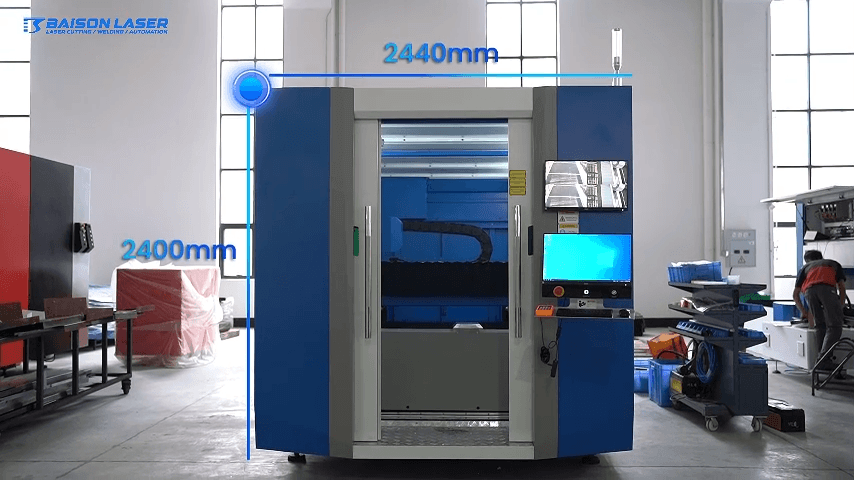
For international buyers, equipment procurement must account for overseas freight and facility installation alongside cutting performance. Because industrial fiber laser cutters have substantial footprints and weights, structural shipping features directly impact logistics planning.
The SH3A incorporates an integrated container-loading design for streamlined transport, while the ST3A features a detachable rear base frame to simplify container loading and transit. Confirming overall machine dimensions, disassembly requirements, container loading plans, and on-site rigging conditions early in procurement prevents delivery bottlenecks.
Pre-Purchase Checklist: Key Production Conditions to Evaluate
A shuttle table is one critical piece of the productivity puzzle, but optimal performance requires aligning machine specifications with your materials, order volume, and shop workflow. Gather the following data before finalizing your equipment configuration:
| Evaluation Factor | Key Details to Confirm |
| Material Types | Carbon steel, stainless steel, aluminum, brass, etc. |
| Sheet Thickness | Most frequently processed thicknesses and maximum thickness required |
| Sheet Dimensions | Standard sheet lengths and widths used in production |
| Sheet Weight | Single-sheet weight and total batch load per table |
| Production Profile | Part geometries, typical batch sizes, and daily/monthly throughput targets |
| Machine Configuration | Laser power, working area, and maximum table load capacity |
| Cycle Rhythm | Average cutting time, loading/unloading time, and shuttle table exchange time |
| Logistics & Installation | Container loading method, on-site unloading equipment, and floor layout |
If you already operate a laser cutter, time your current cutting, unloading, and part-sorting steps across a few representative jobs to pinpoint your biggest bottleneck before investing in new equipment or workflow changes. If you are planning a new fabrication line, share your primary materials, sheet dimensions, single-sheet weights, and target volumes with the Baison Laser team for a tailored configuration assessment.
Frequently Asked Questions (FAQ)
Does faster laser cutting speed always mean higher productivity?
No. Cutting speed is only one segment of the production cycle. Laser cutting loading and unloading, table exchange, part removal, job changeovers, and upstream/downstream coordination all impact total output. True shop-floor productivity must be measured across the entire cycle rather than by cutting speed alone.
What is non-cutting time in fiber laser cutting?
Non-cutting time refers to all periods during a shift when the laser is not actively cutting material—including shuttle table exchanges, sheet loading and unloading, part sorting, and job setup. Reducing wait times across these auxiliary tasks is the most direct way to improve machine utilization and lower laser cutting downtime.
Is faster shuttle table exchange speed always better?
While fast exchange speed is valuable, it should never be evaluated in isolation. You must also consider maximum table load capacity, drive stability, repeat positioning accuracy, and whether operators can physically unload and reload the outer table within the cutting cycle. A shuttle table delivers maximum value when its speed and payload match your actual sheet weights and workflow rhythm.
What are the main differences between the Baison SH3A and ST3A?
The SH3A uses an inclined shuttle table with a 10–15 second exchange time, a 600 kg maximum table load capacity, front and rear tables at the same horizontal level, and ±0.03 mm repeat positioning accuracy (1500W–12000W). The ST3A features a heavy-duty horizontal shuttle table with a 1,500 kg maximum table load capacity and exchange times as fast as 10 seconds (6000W–40000W). Both models offer a 3000 × 1500 mm working area.
How do I know which fiber laser configuration fits my shop’s needs?
Start by evaluating your core material types, sheet thicknesses, dimensions, single-sheet weights, order batch sizes, and downstream processes. Match those requirements against working area, laser power, maximum table load capacity, shuttle table exchange time, and positioning accuracy to select a machine built for your real-world workload.
Maximize Your Shop-Floor Productivity
Sustainable fiber laser cutting productivity comes from optimizing the entire fabrication workflow—not just chasing higher cutting speeds. By minimizing non-cutting time and coordinating cutting operations with material handling, your shop can unlock the full production capacity of its equipment. Whether your workload calls for the SH3A inclined shuttle table or the heavy-duty ST3A horizontal shuttle table, matching platform design, payload capacity, and exchange efficiency to your production needs is key.
Planning a new equipment purchase or looking to eliminate bottlenecks on your current line? Contact Baison Laser with your typical sheet materials, dimensions, daily job volume, and current changeover times. Our engineering team can prepare a customized shuttle table efficiency estimate to show how much active cutting time your shop can reclaim.