TL;DR Core Summary
To solve severe manufacturing challenges in ASEAN shipyards and North American offshore fabrication plants—such as 12-meter heavy pipe sagging, high-RPM vibration, cut deviation, and expensive tailing waste—Baison Laser introduces the V36ETS and V52ETS 3-Chuck Heavy-Duty Tube Laser Cutting Machines.
Powered by an advanced full-stroke free-moving 3-chuck architecture and a tri-point adaptive support system, this series achieves stable, jitter-free cutting for 12-meter long tubes while maximizing material utilization down to near-zero tailing waste, helping heavy industries slash production costs and boost structural weld compliance.
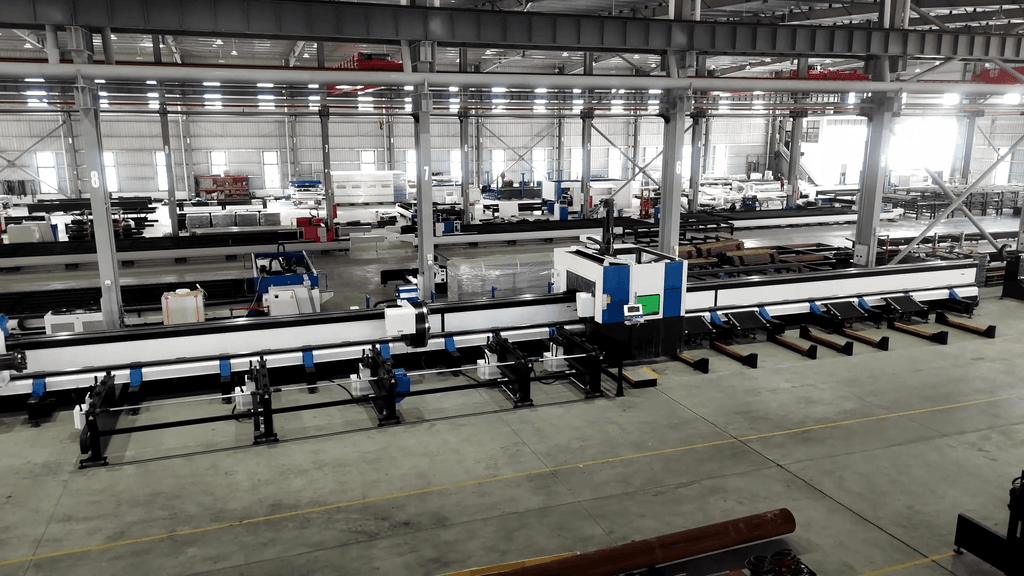
The Hidden Operational Bottleneck in 12-Meter Offshore Pipe Processing
In major shipyard fabrication bays across Southeast Asia and heavy structural yards in North America, 12-meter, thick-walled, large-diameter steel pipes serve as the backbone for offshore jackets, marine structures, and heavy machinery frames. Because these structural components must satisfy strict class-society inspection and welding standards (such as AWS and DNV/ABS compliance), the geometric accuracy and edge quality of every cut directly dictate whether a joint passes ultrasonic testing (UT) on the first try.
However, traditional 2-chuck laser cutters or manual processing methods struggle immensely with these massive tubes:
- Severe Sagging & High-RPM Vibration: When spinning long, heavy pipes at high speeds, inadequate mid-span rigidity causes the tube to sag and oscillate violently. This ruins dimensional accuracy, skews the laser kerf, and risks costly cutting-head collisions.
- Prohibitive Tailing Waste: Standard 2-chuck machines leave a massive 0.5-meter to 1.0-meter unusable tailing due to chuck physical clearance limits. Because offshore-grade alloy steels are exceptionally expensive and often require material traceability certificates, discarding these long tails creates a massive annual financial drain.
- Heavy Labor Dependency & Safety Risks: Manual rigging, alignment, and material positioning for multi-ton pipes drag down production pace and expose workers to serious heavy-industrial safety hazards.
The Engineering Breakthrough: Full-Stroke Free-Moving 3-Chucks & Tri-Point Adaptive Support
To eliminate heavy tube deformation, Baison Laser abandoned rigid fixed-chuck architectures, engineering a proprietary Full-Stroke Smart 3-Chuck System for the V-Series (V36ETS and V52ETS).
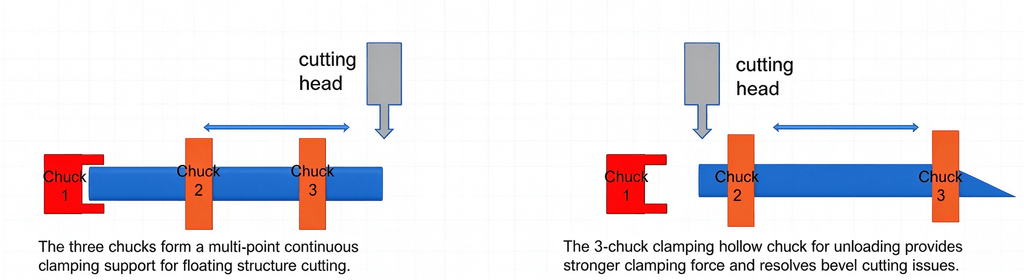
1. Full-Stroke Free-Moving Architecture
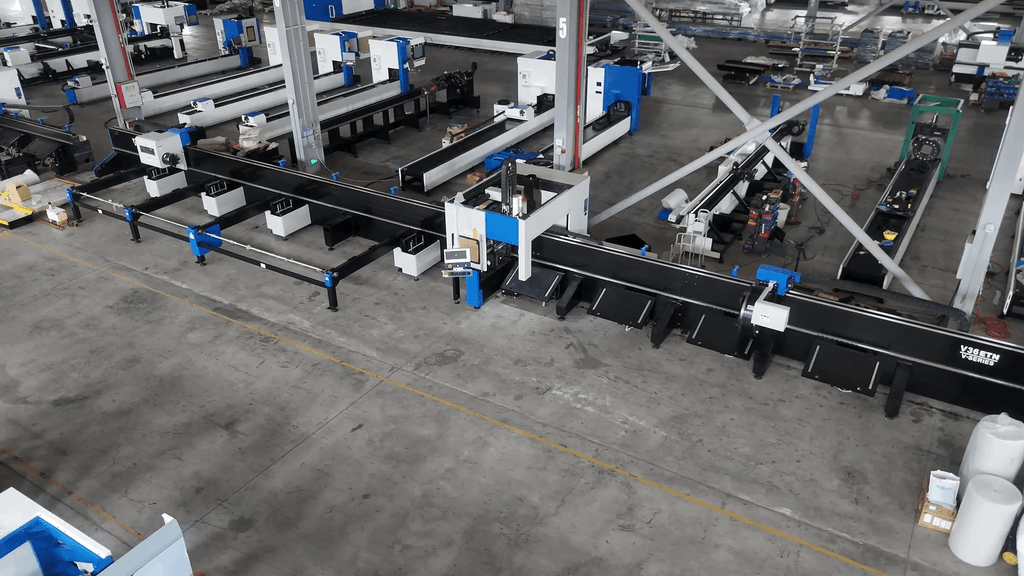
Unlike conventional machines with fixed-position chucks, all three chucks on the V-Series can travel independently along the heavy-duty side-hung bed. The third chuck features a specialized through-hole design that simultaneously provides powerful clamping traction and internal tube support, allowing seamless forward cutting, reverse cutting, and shuttle-feeding routines.
2. Tri-Point Adaptive Support System
To completely eradicate 12-meter tube sagging and vibration during high-speed rotation, the machine integrates a dynamic balancing network:
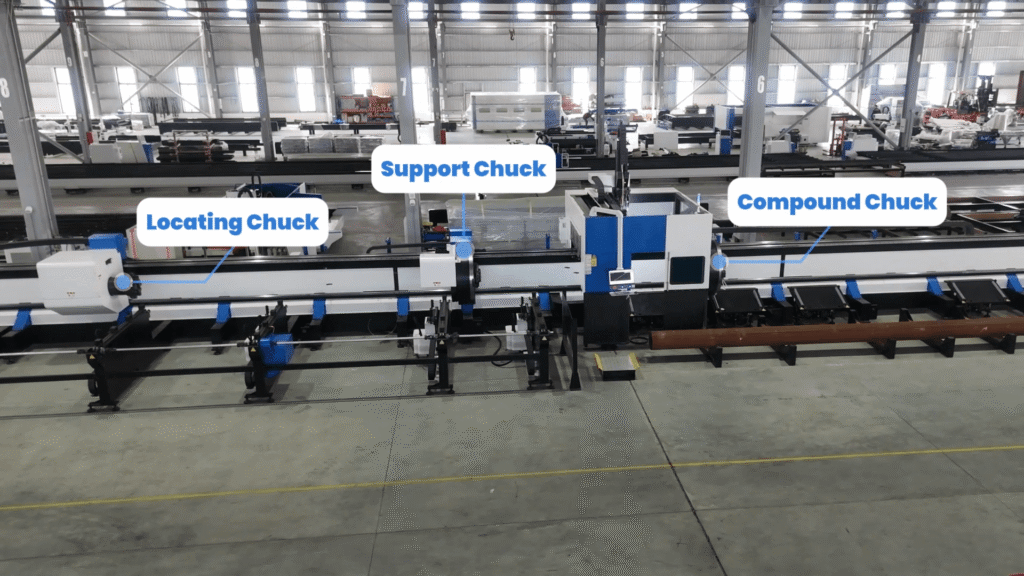
- Long-Tube Cutting: The feed-side servo follow-up support ensures precise initial centering. During cutting, the second chuck acts as a robust primary anchor, absorbing centrifugal forces and high-speed harmonic vibrations to keep long pipes completely steady.
- Short-Tube & Tail-End Machining: Adaptive support fixtures provide flexible, precise upward lift to prevent rigid clamping distortion. The third chuck coordinates with the front and rear chucks to shuttle and push the final section into the cutting zone.
3. Near-Zero Tailing Waste Control
Through synchronized multi-chuck movement and reverse-pull cutting strategies, the system minimizes the unmachined gripping blind spot. By utilizing the raw material down to the last millimeter, heavy industries can approach near 100% material utilization.
Note: While the 3-chuck mechanism technically eliminates tailing waste, achieving true 0mm waste on extreme profile shapes (such as asymmetric channels or custom offshore H-beams) requires specific nested toolpath strategies. [Contact Baison’s engineering team to request a custom toolpath simulation for your specific profile shapes.]
For a deeper breakdown of how multi-chuck kinematics eliminate grip-zone remnants, read our technical feature on [the Zero-Tailing Revolution in structural pipe laser profits]
Streamlining Your Fleet: V36ETS vs. V52ETS Selection Guide
To help procurement directors and chief engineers select the right configuration, the table below highlights the core performance differences between the two flagship models.
| Decision Metrics | V36ETS (Mid-Heavy Duty Model) | V52ETS (Ultra-Heavy Duty Model) |
| Max Single Pipe Weight | 1,200 kg | 2,000 kg |
| Processing Capacity / Profiles | Φ 20 ~ 355 mm (Covers standard marine pipes, I-beams, channels, H-beams) | Φ 50 ~ 500 mm (Handles extra-large offshore pipes, heavy H-beams, and structural profiles) |
| Tailing Control | Near-Zero Tailing (Achieves 0mm under optimized nesting) | Near-Zero Tailing (Achieves 0mm under optimized nesting) |
| Beveling Capabilities | Standard square cut / Optional ± 45°beveling | Standard square cut / Optional ± 45°beveling |
| Primary Application | Ship framing, marine piping, medium-heavy structural steel automation | Jacket structures, offshore wind turbine foundations, ultra-heavy rig components |
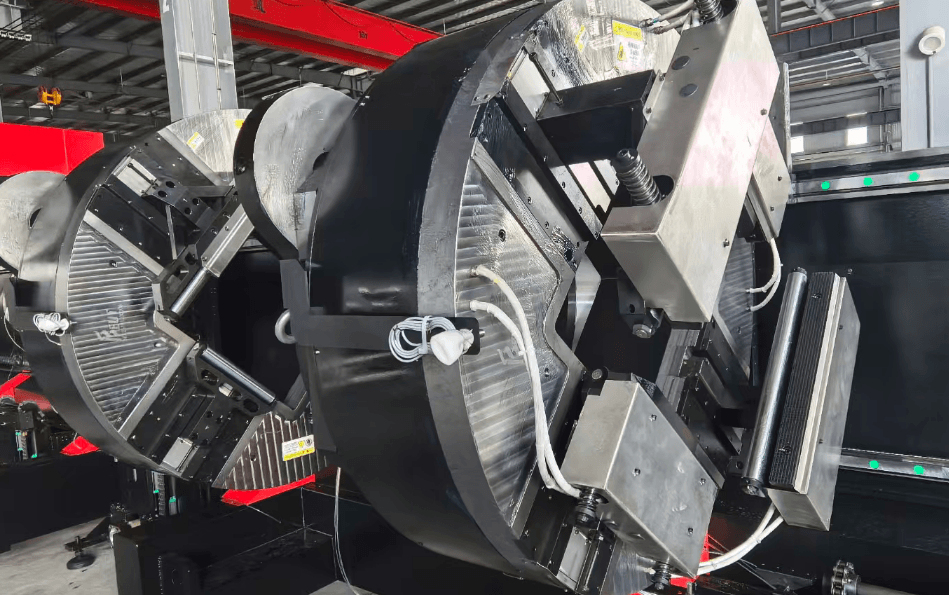
What Does This Mean for Your Plant?
- If your production focuses on ship frames, internal piping, or 1.2-ton structural profiles, the V36ETS delivers exceptional flexibility and near-zero material waste.
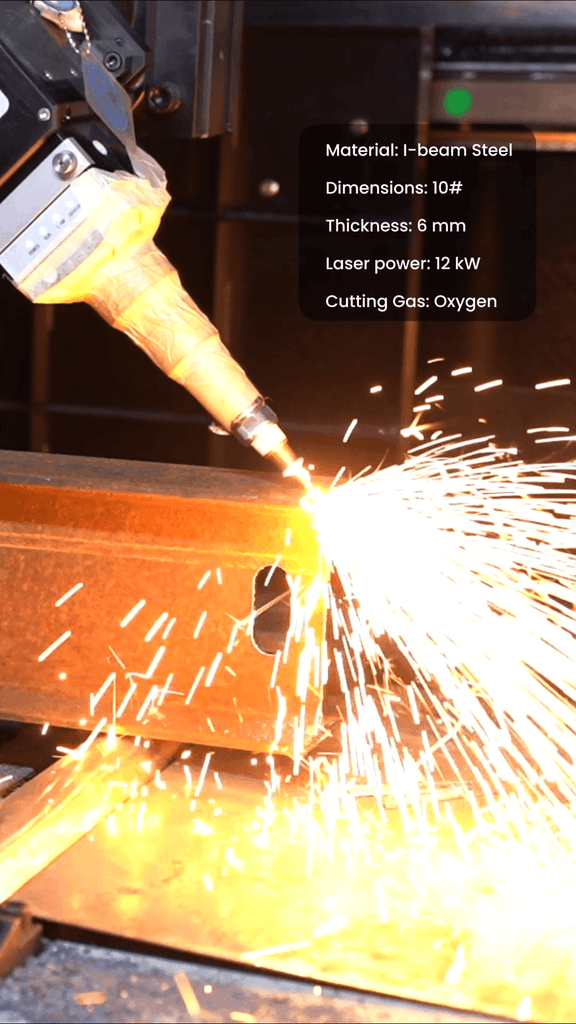
- If your facility builds offshore jackets or 2-ton, 500mm-diameter wind tower components, the V52ETS combines massive clamping force with ± 45° one-pass beveling, eliminating tedious secondary grinding and speeding up joint fit-up.
Selecting between the V36ETS and V52ETS goes beyond just pipe weight—it involves matching your wall thickness, laser source wattage (6kW to 20kW), and gas pressure to maximize cut speeds. Not sure which wattage fits your material mix? [Talk to a Baison Application Specialist for a tailored configuration match.]
Need help evaluating laser power, chuck diameter, and tonnage for your specific shop floor? Check out our ultimate [Heavy Duty Laser Pipe Cutter Selection Guide]
The Financial Breakdown: How Near-Zero Tailing & Automation Drive ROI
In heavy equipment capital expenditure, the machine purchase price is only the tip of the iceberg. Continuous material waste and labor overhead dictate your true return on investment (ROI).
Calculation Baseline (For reference only; actual payback depends on material grade, daily volume, and local labor rates):
- Traditional 2-Chuck Tailing Loss: Cutting 50 pieces of 12m pipe daily at 0.8m waste per piece equals 40 meters of scrapped alloy steel per day, amounting to $150,000 – $250,000 in annual raw material write-offs.
- Baison V-Series Near-Zero Tailing: Eliminating long grip-zone remnants recovers thousands of dollars in high-grade alloy scrap every month.
- Automated Chain-Feeding Systems: Reduces manual rigging labor by up to 80%, helping efficient plants recover their equipment investment within 18 to 24 months.
The ROI figures above are based on standard 12m offshore alloy pipes. Your actual payback period depends heavily on your local steel costs, active shifts, and specific scrap rates. Want to know your factory’s exact ROI? [Click here to use our free ROI Calculator & Nesting Benchmark tool for a personalized cost-benefit breakdown.]
Frequently Asked Questions (FAQ)
Q1: How does the system handle surface scale or minor bow/warp in heavy offshore steel pipes?
A: The V-Series features independent servo-driven adaptive follow supports and flexible lifting cradles that dynamically compensate for tube straightness variations. Smart self-centering chuck clamping pressure adjusts automatically to prevent crushing thin walls while maintaining rock-solid rotational stability.
Q2: Exactly how does the free-moving 3-chuck architecture achieve near-zero tailing waste?
A: Traditional 2-chuck cutters leave a large unmachined tail because the cutting head cannot pass the rear chuck. Baison’s three chucks move across the full bed length, with the third chuck featuring a through-hole design. By shuttling and exchanging clamp positions in forward and reverse cycles, the machine feeds the final segment completely through to the laser focal point.
Q3: What is the practical value of the optional ± 45° beveling feature on the V52ETS?
A: Offshore structural welding requires strict V, Y, or X-type weld prep. Traditional plasma or manual cutting leaves slag and requires extensive secondary grinding. The V52ETS cuts clean, dross-free ± 45° bevels in a single pass, allowing cut tubes to move straight to fit-up and welding.
To see how direct beveling eliminates edge-prep bottlenecks across both plate and pipe production, explore our guide on [eliminating secondary grinding with bevel laser cutting]
Q4: How does the heavy-duty bed withstand the impact shock of 2-ton, 12-meter pipes during loading?
A: The V-Series utilizes a side-hung heavy load bed structure with a lowered center of gravity. Annealed and stress-relieved to ensure high rigidity, the bed absorbs and disperses loading shock from chain-driven bundle loaders, preserving sub-micron mechanical accuracy under brutal 24/7 industrial operating cycles.
Discover how our in-house frame machining and annealing processes guarantee long-term machine accuracy in [inside Baison Laser’s vertically integrated manufacturing]
Q5: What global delivery and technical support does Baison provide for overseas manufacturing plants?
A: Baison Laser offers comprehensive global engineering support, pre-shipment factory testing, modular containerized delivery, and on-site commissioning. Remote diagnostic links and localized service networks ensure rapid response times to maximize plant uptime.
Take the Next Step in Heavy Pipe Fabrication
Continuing to accept tube sagging, cutting inaccuracies, and heavy material waste directly erodes your competitive edge in the global offshore and shipbuilding market. Baison Laser’s V-Series redefines heavy pipe processing through structural innovation.
Curious about your exact material savings and nesting efficiency on the V-Series?
[Click here to contact Baison’s Engineering Team] and submit your tube dimensions, wall thickness, and material grades to receive a Free Custom Nesting & ROI Simulation Report.