In the field of industrial manufacturing pursuing ultimate production efficiency, tube cutting is not only a basic process, but also the lifeline determining subsequent welding and assembly quality. For enterprises relying on high-strength, high-precision tube components, every minor deviation in cutting quality is exponentially amplified into high operating costs once production is scaled up.
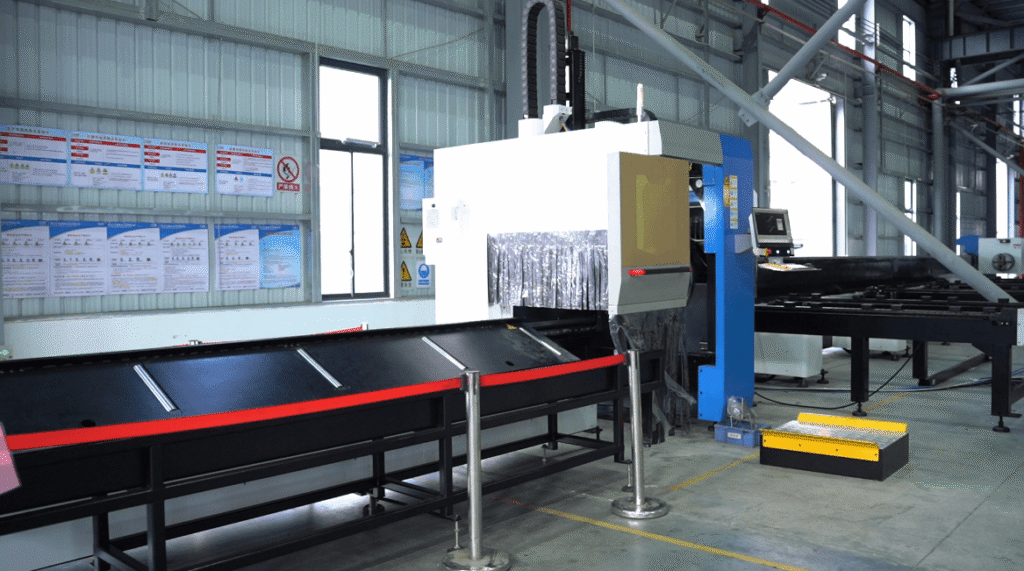
Many companies remain trapped in high scrap rates, severe dross on cut edges, and frequent secondary reprocessing caused by rough cutting; these non-apparent costs are silently devouring otherwise substantial gross margins. Baison heavy-duty laser tube cutting machines are more than just cutting tools—they are profit moats designed for high-value industrial manufacturing. Through our self-developed high-stability three-pneumatic chuck linkage system, we strictly lock the positioning accuracy within ±0.05 mm, completely eliminating tube runout and deviation during high-speed rotational processing from the root.
This performance upgrade directly targeting ROI (Return on Investment) is the core driving force for you to break away from low-quality homogeneous competition, significantly improve finished product pass rates, and achieve a qualitative leap in production capacity.
3 Hidden Profit Killers in Tube Processing
Before diving into the technology, we must directly confront the three core profit killers on the production line:
- Assembly Stagnation Caused by Accuracy Drift: In downstream automated welding or assembly stages, cutting errors (such as substandard section perpendicularity or out-of-tolerance dimensions) directly cause loose component fitting. This means your assembly line is forced into costly downtime waiting for adjustments, or even whole batch scrapping—a “hidden downtime cost” that far exceeds your procurement budget.
- Long-Term Hemorrhaging from Scrap Loss: For large tubes, traditional cutting methods are almost always accompanied by heavy scrap losses. With hundreds of millimeters of unusable length per tube, this accumulates into tens or hundreds of thousands of dollars in direct material waste annually, representing the most direct profit leakage.
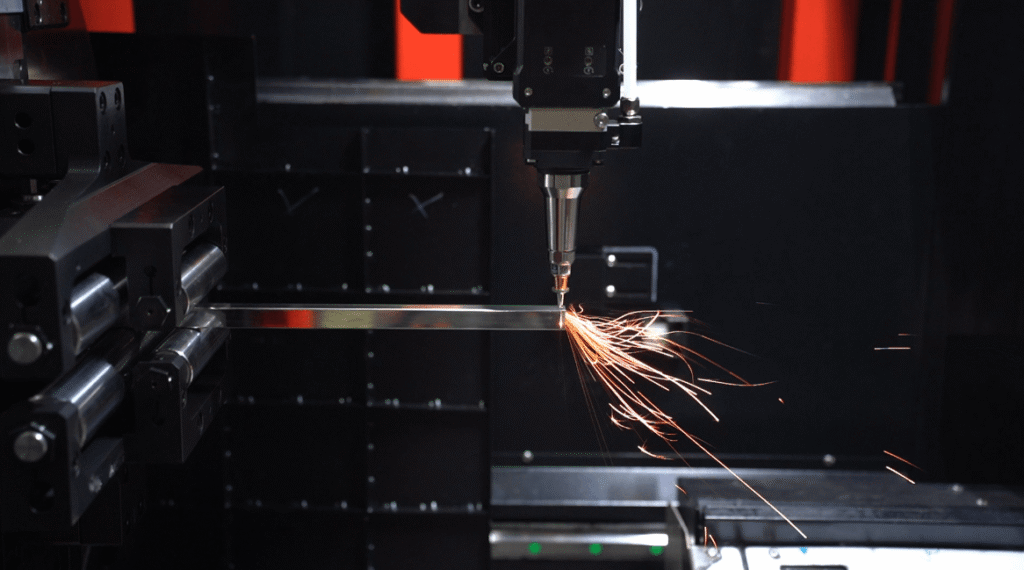
- Secondary Grinding of Complex Profiles: For I-beams, channel steel, or profile sections, general equipment struggles to control feeding force, leading to severe dross. Once dross forms, workers are forced to perform secondary manual grinding, which not only doubles labor costs but completely shatters the balance of efficient production.
Baison Heavy-Duty Cutting: The Commercial Value We Create for You
Baison’s core goal is exceptionally clear: to squeeze out more net profit space for you through ultimate process control. Specifically, we provide not just equipment, but a complete industrial solution for cutting costs and boosting efficiency:
- Physical-Level Three-Chuck Linkage Support: We broke through the traditional “single chuck + auxiliary” model by adopting a unique real-time linkage of three heavy-duty chucks. No matter how slender the tube is, or even under high-speed rotation, the system eliminates runout through physical mechanical balance, ensuring consistent cutting accuracy throughout the entire process.
- Customized Material Centering Algorithms: Tailored to different metal characteristics (such as high-strength carbon steel and stainless steel), we built in Baison’s proprietary centering and cutting parameter packages. This means that regardless of material switches, the equipment achieves optimal cutting parameters from the very first cut, eliminating tedious trial-and-error adjustments.
- Intelligent Near-Zero Scrap Management: Our control system accurately calculates cutting paths, enabling the front chuck to approach the limit position at the final cut, maximizing long tube utilization. This is not merely a technical indicator, but a direct recovery of material costs for every single meter of tubing.
- Full-Condition Rigidity Protection: Through dual ultra-long aging treatments and heavy-duty welded beds, our equipment possesses extreme vibration-resistance capabilities. Even under three-shift, full-load high-intensity production, it maintains solid geometric accuracy, eliminating subsequent maintenance and calibration costs caused by precision degradation.
Real Business Cases: Capacity Metamorphosis of Overseas Customers
Case I: A Turkish Construction Machinery Giant (Tube Processing Process Remodeling)
This enterprise previously used a European brand of equipment to process carbon steel square tubes with a wall thickness of 15 mm. Due to insufficient equipment rigidity, severe runout occurred during cutting, causing section perpendicularity to exceed standards and dropping the downstream robotic welding matching rate to only 91%.
By matching it with customized heavy-duty chucks and the V36ETTP cutting process package, Baison stabilized the cutting accuracy to ±0.03 mm while maintaining speed. This not only eliminated section dross (thereby saving subsequent manual grinding man-hours), but also pushed the robotic welding first-pass inspection pass rate to 99.5%. Annual feedback from the enterprise showed that in the single category of “manual grinding man-hour savings,” annual operating costs were reduced by approximately 120,000 USD.
Case II: A Mexican Automated Storage Racking Manufacturer (Profit Margin Remodeling)
Before switching to Baison equipment, this manufacturer faced a severe material waste crisis. The average scrap length after each process on the original production line reached up to 500 mm, with a material waste rate persistently as high as 8%. Baison deployed a customized production line with ultra-short scrap control functions, compressing the average scrap length to within 80 mm by optimizing feeding and cutting sequences.
This increased the finished product yield per ton of tubing by nearly 5%. In the increasingly competitive Mexican racking market, this customer directly captured a larger market share through cost advantages, and the additional revenue generated by the equipment itself through improved material utilization fully offset the equipment investment within 4 months of commissioning.
In-Depth Comparative Analysis of the Laser Tube Cutter Market
To help you evaluate asset allocation more clearly, the following is an in-depth multi-dimensional comparison of different solutions currently on the market, where Baison’s differentiated advantages are clearly visible:
| Dimension | Baison Heavy-Duty Series | Mainstream General-Purpose Equipment | Cheap Simple Equipment |
| Mechanical Machining Accuracy | ±0.03-0.05 mm | ±0.10 mm | ±0.20 mm+ |
| Long Tube Runout Control | Three-chuck active following | Dual-chuck passive auxiliary | Single-chuck prone to centrifugal runout |
| Scrap Control Capability | Near-zero scrap (within 80 mm) | 300-500 mm waste | 500 mm+ waste |
| Bed Vibration-Resistant Rigidity | Dual aging-treated heavy-duty casting | Single annealing welded | Untreated ordinary steel plate |
| Chuck Load Capacity | Heavy load / High torque | Medium load | Light load / Easy deformation |
| Manual Maintenance Demand | Automated compensation / Extremely low | Frequent manual calibration | High-frequency secondary grinding |
| Equipment Geometric Precision Life | Over 10 years of high stability | 5-7 years of noticeable decay | Major overhaul needed within 3 years |
| Cutting Process Applicability | Full material / Full profile adaptation | Limited to round/square tubes | Limited to light/thin materials |
| Machine Investment Payback Period | 4-8 months | 12-18 months | Extremely long (high maintenance costs) |
Summary: Comparative data shows that Baison equipment is not merely an improvement in cutting speed; rather, it establishes an absolute moat in production consistency, material utilization, and Total Cost of Ownership (TCO). Choosing Baison means choosing an industrial asset capable of automatically correcting errors, rejecting material waste, and maintaining high geometric precision day after day for a decade.
Securing Productivity: How Baison Transforms Industrial Tubing into Sustainable Profit Assets
In the red ocean competition of industrial manufacturing, the Baison heavy-duty laser tube cutter has long transcended the definition of ordinary cutting equipment—it is a precisely calibrated “profit amplifier”. Through an ultimate three-chuck linkage structure and deep process algorithms, we completely eradicate the most fatal accuracy drift and centrifugal runout in tube processing.
This not only means your products can pass rigorous quality inspections on the first try, but also means you completely eliminate subsequent tedious manual grinding and rework steps. For business owners pursuing ultimate yield rates, Baison provides not just equipment, but an industrial solution capable of maximizing the value of every single meter of raw material—utilizing industry-leading near-zero scrap control technology to directly convert what would otherwise be wasted scrap into tangible net profit.
Choosing Baison means choosing a hard-core asset capable of withstanding three-shift, high-intensity, full-load shocks while maintaining high geometric precision for a decade. Do not let outdated, low-efficiency equipment continue to erode your market share and gross margin; contact the Baison team immediately to customize an automated production upgrade plan powerful enough to deliver dimensional-reduction strikes in fierce overseas markets, completely reversing your production cost structure and rapidly entering a new stage of high-output profitability.
FAQs
Q1: Why do general-purpose equipment generate dross when processing thick-walled tubes?
A: The laser head linkage response speed of general-purpose equipment cannot match the melting dynamics of thick materials. Baison’s system utilizes self-developed pressure compensation algorithms and specialized centering programs to dynamically adjust cutting pressure in real-time, eliminating dross from the physical source.
Q2: What is the core difference between your equipment and cheap models?
A: Cheap models suffer not only from insufficient rigidity, but also from uncontrollable later-stage precision decay. Baison equipment ensures geometric stability throughout the entire lifecycle of the equipment via heavy-duty aged beds and high-precision industrial chucks. This means you are buying an asset, rather than a hassle that requires continuous capital maintenance.
Q3: How does Baison handle long tube runout if it occurs during processing?
A: Through our “three-chuck active following technology,” the three chucks maintain dynamic balance throughout processing, ensuring that no matter how the tube deforms or eccentricates, the axis remains locked to the laser center, completely eliminating deviations caused by centrifugal force.
Q4: How does Baison handle deep processing of complex profiles (channel steel, angle steel)?
A: Baison equipment has built-in clamping and cutting parameter packages targeted at profile sections. You only need to select the material, and the system automatically optimizes the centering logic, truly realizing smooth production of profile shapes.
Conclusion: Making the Right Investment for Your Enterprise Assets
Competition in the industrial manufacturing field ultimately boils down to efficiency and yield rates. If you are still weighed down by scrap rates, grinding man-hours, and equipment precision decay, then you need a tool capable of creating profits for you right now, rather than a liability that adds maintenance troubles.
The Baison tube laser cutter is designed to double your production capacity and sharply reduce costs. This is not just a piece of equipment procurement, but a wise commercial upgrade.
If you want to discuss in depth how to optimize your production processes, please contact our technical team, and we will provide you with detailed, data-driven analysis.