Various industries use multiple cutting techniques to create aesthetically pleasing and strong products. Bevel and miter cutting are unique methods that enable you to accomplish numerous projects. You can use them for cutting various materials, including metals and wood.
In this blog post, we’ll uncover the differences between bevel and miter cuts. You’ll also explore the pros and cons of each cut and the various techniques to create them. So, let’s get into it.
What are Bevel Cuts?
Bevel cuts are sloped cuts made at the workpiece’s edges. In regular cuts, the cutting angle between the border and the material surface is 90°. However, in bevel cuts, this angle is made less than 90°, turning a square cut into a sloped edge employed for multiple purposes.
The unique bevel angle enables you to make intricate patterns and consistent connections. Moreover, you can go with any angle less than 90° to create a bevel cut that suits your projects. Bevel-cutting can also give life to your new project by strengthening its structure and design.
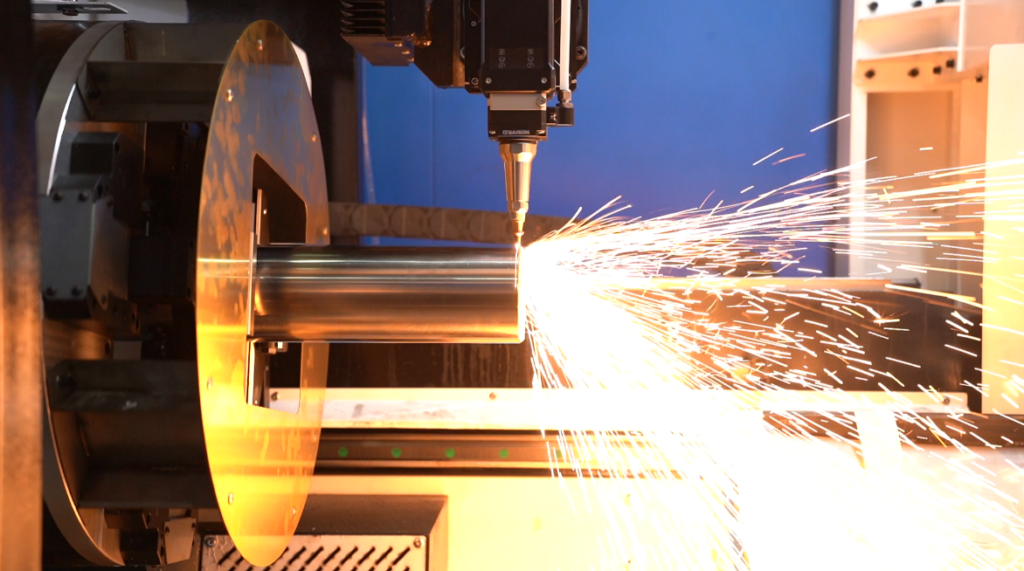
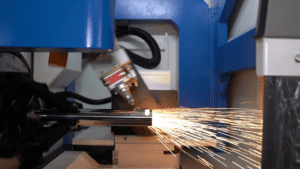
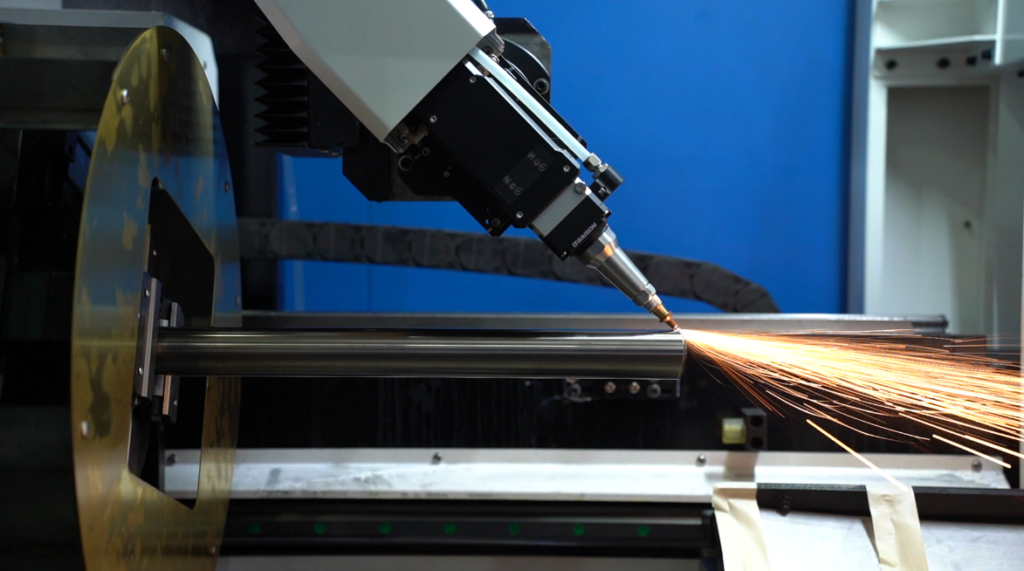
In fiber laser tube cutting, welding bevels and frame-jointing miters are often confused, yet true industrial-grade miter cutting efficiency relies entirely on robust hardware. The Baison G24CP universal laser tube cutter proves this with real-world data:
- Golden Control Structure: Its beveling system combines a vertical cutting head, high-precision harmonic reducer, and servo motor to deliver exceptional angle control.
- Heavy-Duty Clamping: Equipped with a standard 240mm fully enclosed square-hole chuck, it expands the square tube clamping range from the traditional 150mm to 240mm, supporting up to 300kg per tube to eliminate deformation-induced errors during steep-angle cuts.
- Intelligent Protection: To prevent chuck damage during beveling, it features an exclusive automatic chuck anti-burn avoidance function.
- Precision & Efficiency: Fully sealed, dustproof Class 6 ground gears eliminate gear jamming from dust, while ultra-short tailings of 90mm or less maximize material utilization.
Technologies for Bevel-cutting
Bevel cutting is a versatile method and utilizes various cutting techniques. The following is an overview of the technologies that are used for bevel cutting:
1. Portable Tools
Portable bevel cutting employs portable tools like circular saws, jigsaws, and table saws. You can carry these tools to the working site due to their lightweight. This technique is effective compared to manual cutting and can be used for small to medium projects.
However, you have to invest in quality cutting tools and sharp blades for smooth cuts. Moreover, the maintenance cost of these tools is also high, as they require frequent blade replacement.
2. Plasma Technology
Employing ionized gas is an efficient cutting technique. The high energy from plasma makes it a perfect option for creating bevel cuts on hard-to-cut materials like metal. This technique is suitable for industrial use and can handle large, heavy-duty projects. However, working with plasma requires proper training and safety measures to minimize the risks of any accidents.
3. Laser Cutting Technology
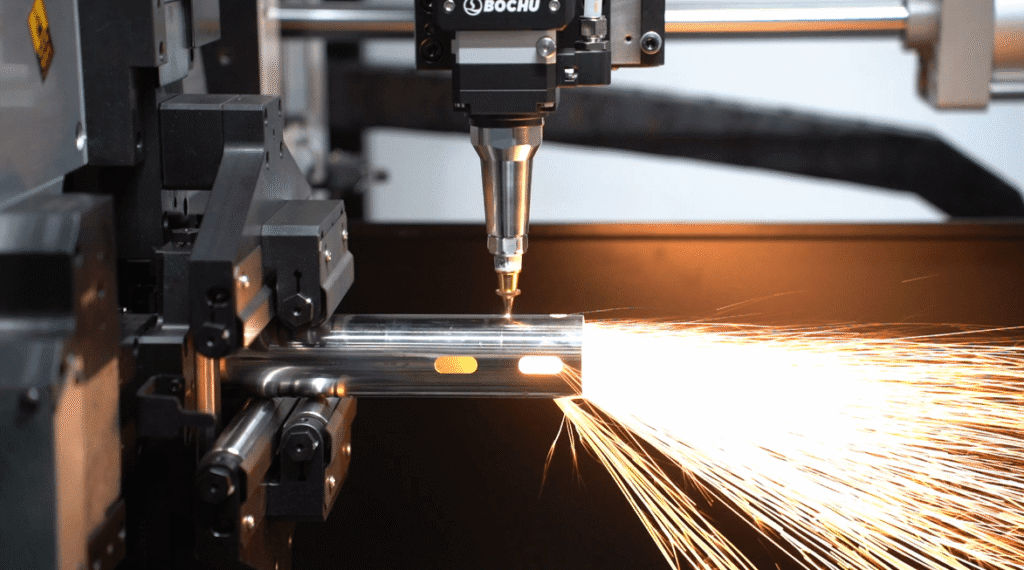
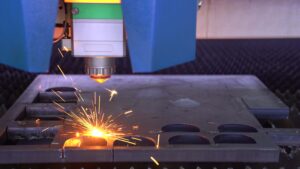
Laser cutting is becoming popular due to its precision and versatility. This technique utilizes a high-energy laser beam to make a bevel cut of different materials, including wood and metal. The intense laser beam melts and vaporizes the material as it moves along the cutting pattern.
It offers you precise cuts without any material wastage. However, the laser beam can be damaging and requires training and safety measures to avoid accidents.
4. Water Jet Cutting
Water jet cutting is a safe and effective technique. It employs a high-pressure water stream to cut through metal, wood, and stone. This technique allows you to create intricate patterns and precise bevel cuts without distortion. The water jet cutter is environmentally friendly as it releases no toxic fumes.
You can learn the specific difference between water jet cutting and laser cutting from this blog post.
5. Ultrasonic Cutting Technique
Ultrasonic bevel-cutting is another alternative to traditional bevel-cutting methods. It uses high-frequency vibrations to make a bevel cut on materials.
This technique is suitable for cutting delicate materials like glass and ceramics. Ultrasonic Cutting Technique provides smooth and precise cuts, making it the best choice for delicate materials.
What is Miter Cuts?
Miter cuts are precise angled cuts made along the face or width of the material. The miter angle is also less than 90°.Typically, the miter cut is made at 45°, though you can also go with other angles according to your project’s requirements. However, the edge of the material is still perpendicular to its face. According to Toolstop, making a 45° miter angle on two workpieces enables you to join them together to create a 90° corner.
Technologies for Miter Cutting
Like bevel cutting, several technologies are employed for miter cutting that make the process more efficient and accurate. The following are some popular technologies used for miter cuts:
1. Miter Saw
Miter saws are commonly used to make precise miter cuts. The rotating cutter cuts the material at 45° angles or other specified angles. These cutters make clean and accurate cuts, saving time and minimizing waste. According to the University of Waterloo, a miter saw can make a compound miter cut.
2. Table Saw
A table saw is an effective cutting tool that enables you to make miter cuts precisely. The groove on the table allows you to fit the material and cut it perpendicularly. You can also adjust the angle of the blade according to your requirements. Here are some expert tips for tight miters.
3. Water Jet Cutting
A water jet is another useful technology for making miter cuts. Utilizing a pressurized water stream gives you smooth cuts.
The movement of the water jet is controlled by a computer, making the process highly accurate and efficient. Moreover, you can employ this technique on various materials, allowing you to create miter cuts on multiple materials for any project.
4. Laser Cutting
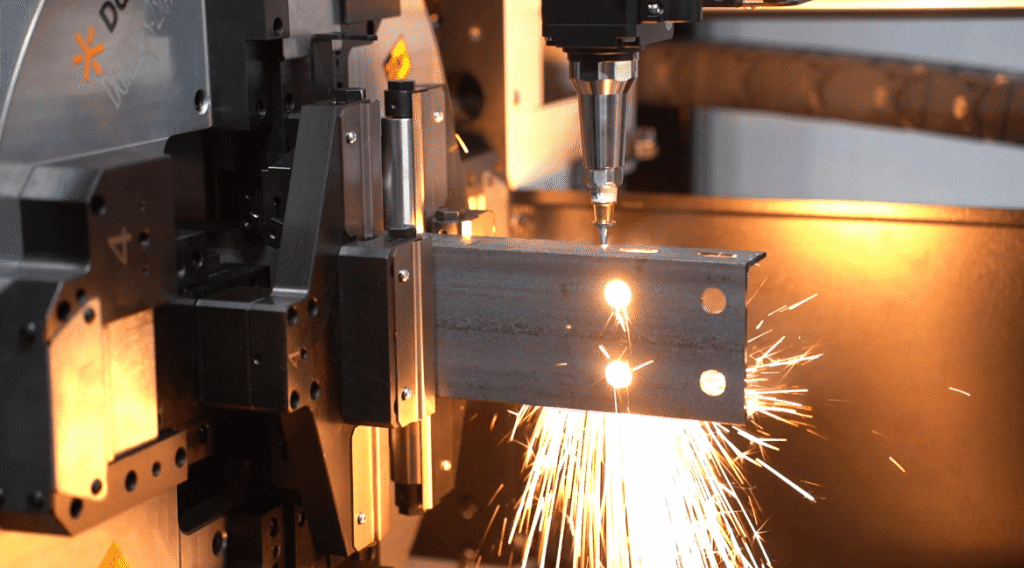
Like bevel cutting, you can use laser cutting for miter cutting. The focused laser beam melts and vaporizes the material, creating a clean and precise cut. However, you need to wear safety gear for extra protection.
For safety, you can learn more about the laser classes and safety assurance measures.
5. Circular Saw
Like other portable tools, circular saws can also create smooth miter cuts. To use a circular saw, you have to adjust the orientation of the saw and blade angle to achieve a specified cut. Though it is primarily used for bevel cuts, you can make miter cuts.
In heavy industry and steel construction, traditional manual cutting and sawing fail to guarantee miter and bevel precision, while dragging down workshop efficiency with tedious multi-step processing and high labor costs.
As an industrial leader, the Baison 3D 5-Axis Bevel Laser Cutter integrates raw cutting and beveling into a single, high-efficiency step:
- Versatile Beveling: Its high-precision swing-head system supports ±45° to ±50° angles, easily forming V, X, Y, and K-shaped weld preparations on thick carbon steel or stainless steel.
- Unmatched Precision: Powered by advanced dynamic compensation, the machine limits angular deviation to under ±0.5°, delivering clean, dross-free bevel edges that completely eliminate secondary grinding.
- 3x Efficiency Boost: By sending parts straight to the welding line, it increases overall processing throughput by more than 300%.
Ready to upgrade your workshop’s productivity and cut quality? Send us your most challenging part drawings today for a custom, 1-on-1 test-cutting and beveling consultation.
Pros and Cons of Bevel Cutting
Now let’s look at the advantages and disadvantages of Bevel Cutting.
Pros of Bevel Cutting
Bevel cutting is an effective cutting technique and offers several benefits. Here are some pros of making bevel cuts:
- Bevel cuts distribute the stress on the material, reducing the weak tension points. It improves the structural stability of the material for further processing. According to The Fabricator, beveled edges produce a sturdier type of weld needed to support the massive weight and loads on such heavy-duty equipment.
- Bevel cuts offer strong joints that are crucial for various projects. The inclined edges of a bevel cut offer you a better connection as it increases the joining area between the two workpieces.
- The slop in a bevel cut improves the aesthetic appeal of the material. It gives the edges a fine and elegant look, which is desirable for many projects. According to the Voortman Steel Machinery, about 30% of your projects require bevel cuts for aesthetic and functional purposes.
- Unlike regular cuts that involve cutting straight through the material, bevel cuts are made at an angle. It minimizes material wastage, making it a perfect fit for projects dealing with expensive materials.
Cons of Bevel Cutting
In addition to providing several benefits, bevel cutting also has some drawbacks. Here are a few cons of making bevel cuts:
- Bevel cutting often leads to inaccurate cuts. A slight deviation in the angle can ruin your project. This inefficiency can delay the process and lead to financial losses.
- Creating the required bevel angle is time-consuming as it involves adjusting the angle, cut length, and various parameters. It demands precision and expertise, which can be challenging for beginners.
- Safety hazards are another downside of bevel cutting. Dealing with sharp blades and heavy machinery can be dangerous, especially for inexperienced individuals.
- Bevel cutting is limited to certain materials. You can’t use bevel cuts on all types of materials.
In heavy industry and high-load steel structure welding, traditional “straight-edge welding without bevel” easily leads to lack of penetration or weak welding, failing to withstand high-strength dynamic loads.
Baison 3D five-axis bevel laser cutting machine cuts precise V, X, or Y-shaped bevels in one pass, multiplying the metal contact area and weld deposition space at the weld joint, which enables the welding pool to reach the root deeply, ensuring a 100% weld penetration blunt-edge fusion effect and fundamentally eliminating internal stress concentration to achieve true “equal-strength welding.”
Compared with the tedious steps of “circular saw cutting + edge milling machine beveling” in traditional craftsmanship, Baison laser bevel cutting achieves one-time forming of cutting and beveling, directly eliminating the heavy manual deburring and secondary grinding in post-processing, instantly boosting the overall preparation and processing efficiency by 3 to 5 times. Furthermore, traditional mechanical edge milling often leaves rough chatter marks on the cut surface due to tool wear, whereas the miter bevel surface cut by Baison laser presents micro-fine ripples with extremely low surface roughness (Ra value); this excellent smoothness allows the shielding gas to cover the molten pool more uniformly, preventing welding porosity and satisfying the strict standards of rigorous engineering procurement with impeccable process depth.
Pros and Cons of Miter Cutting
Although we have a basic understanding of Miter Cutting, it is necessary to recognize its significant points and shortcomings.
Pros of Miter Cutting
Miter cutting is a versatile technique that allows you to create various projects. Here are some benefits of miter cutting:
- Miter cuts allow you to create strong joints at the corners. The angled cut offers you greater surface area for joining during welding and other types of bonding. This increased surface area gives you a stronger bond.
- This type of cut also improves the aesthetics of various projects. Unlike straight cuts that offer a plain look, miter cuts add an artistic touch.
- You can create various designs, shapes, and patterns by making miter cuts at various angles. This feature is especially useful in woodworking, where you need to design intricate patterns.
- It also limits the material wastage. By cutting a sloped face along the width of the material, you can use maximum material and save your resources.
Cons of Miter Cutting
Miter cutting also has some drawbacks. The following are some cons of miter cuts:
- The process of creating an accurate miter cut is not easy. You need training and practice to learn the right technique to create a perfect miter cut.
- Setting the required angle for the miter cut is a crucial step. A small deviation can damage your entire workpiece. It can be costly and time-consuming to rectify the error.
- The tools used for miter cutting require expensive maintenance. Neglecting the maintenance can result in inaccurate cuts, leading to the wastage of your efforts.
Bevel vs. Miter Cuts: What’s the Difference?
Both a bevel and miter cut share several similarities, but they have prominent differences. The following are the key differences between bevel and miter cuts:
| Core Industrial Metrics | Standard Miter Cutting | Baison 3D 5-Axis Beveling |
| Primary Processing Goal | 45°/90° geometric splicing of doors, windows, trusses, and tube frames | Pre-welding preparation for heavy industry, steel structures, and pressure vessels |
| Equipment Control Axes | Basic 2D/3D linkage (vertical surface cutting) | Hardcore 3D 5-axis linkage (3D 5-axis) |
| Laser Head Trajectory | Cutting head remains always vertical to the surface, cutting along the angle path | A/B axis large-amplitude dynamic swing to cut metal obliquely |
| Maximum Swing Angle | 0° (cutting head itself does not swing) | ±45° / ±50° large-angle arbitrary swing (based on machine configuration) |
| Bevel Type Coverage | Limited to straight-edge bevel (I-type groove) | Full series of welding bevels including V-type, X-type, Y-type, and K-type |
| Thick Plate Processing Limit | Suitable for conventional thin-walled tubes and medium-thin plate splicing | Specializes in 12mm – 30mm+ thick carbon steel and thick stainless steel |
| Baison Ra Roughness | Conventional cutting smoothness | Extremely low Ra value micro-fine ripples, no grinding required, direct welding |
1 – Adjusting The Cutting Angle
Adjusting the cutting angle differentiates a bevel and miter cut. While making a bevel cut, the blade is adjusted at the material edge. On the other hand, a miter cut is made by adjusting the blade at a specific angle across the width of the material.
2 – Cut Orientation
A bevel cut is made at an angle across the thickness of the material. It enables you to make joints at the edges. In contrast, a miter cut is made at an angle across the width. It enables you to join the two faces of the board at a corner.
3 – Orientation of The Blade
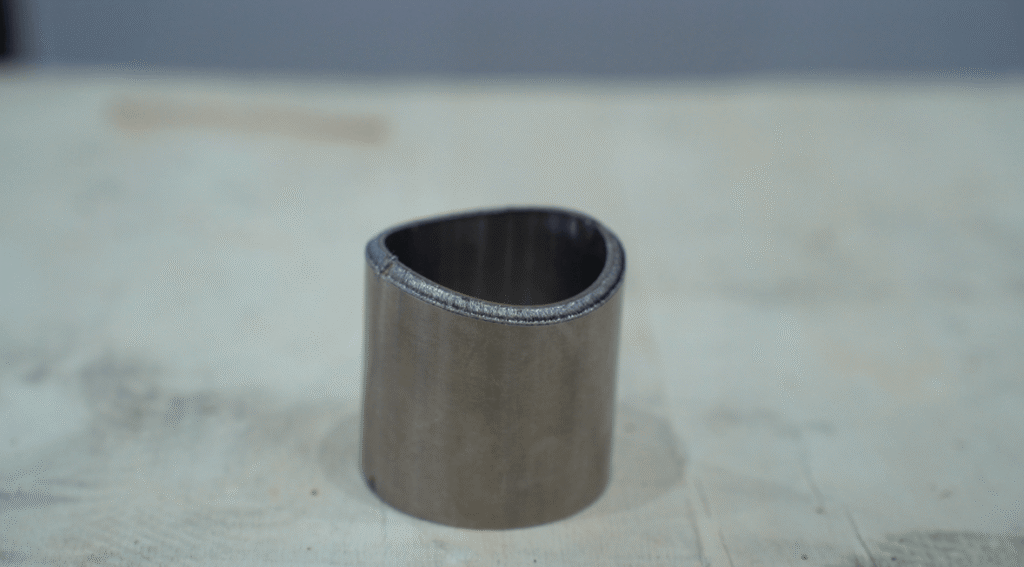
The blade orientation is another crucial difference between the two types of cuts. The blade is tilted at an angle less than 90° for bevel cutting. It gives you an angled cut at the edges. In contrast, the blade remains straight and at 90° for miter cutting. It provides a clean cut across the width of the material.
Factors to Consider When Choosing a Cutting Method
Various factors influence the cutting techniques for each project. The following are some factors for choosing the right cutting method:
- The material you use for your projects affects the cutting methods. Different cutting techniques are designed for different types of materials. Not all blades are suitable for cutting wood, metals, or plastic. Therefore, you should consider the material you are working with and choose a cutting technique specifically designed for it.
- The thickness of the material also influences the cutting method you should choose. If you are working with hard-to-cut materials, you need heavy-duty cutting tools like laser cutters or plasma cutting technology. Wanna know the limit thickness of laser cutting? Click here.
- The required precision level is another considerable factor affecting the cutting tool choice. If you need high precision, laser cutters will be best. However, if accuracy is not a significant concern, you can opt for less precise tools like jigsaws or circular saws.
Which One Should I Choose?
The choice of cutting technique depends on your projects. Determine what type of pattern you want to create and what level of accuracy you need. Miter cutting enables you to cut the face of material to make a frame with a corner of 90°. You can utilize it for box manufacturing, where you need durable and aesthetic connections.
Bevel cutting enables you to cut the edges. An angle of less than 90° is employed for various purposes, including welding and carpentry. It also enables you to create a sloping edge on the surface of your material.
So, if your project involves creating framing structures, miter cuts are best for you. However, for creating seamless joints, you should opt for bevel cuts.
FAQs
Q1: Which industries are suitable?
A1: Steel structures, shipbuilding, and construction machinery heavy industries.
Q2: Is customization supported?
A2: Yes. Chuck, power, and travel are modular. Special steel parameters need environmental fine-tuning; click for a custom solution.
Q3: What is the common buying mistake?
A3: Choosing standard 2D cutters which cannot process complex V/X bevels.
Q4: What is the cutting accuracy?
A4: Controlled within ±0.5°via 3D 5-axis dynamic compensation.
Q5: How to prevent chuck burns?
A5: Baison’s standard automatic chuck anti-burn avoidance prevents damage.
Conclusion
Miter and bevel cuts are effective cutting techniques that allow you to fabricate exclusive products with precision. These cuts also add a touch of elegance to your work, making them perfect for high-end projects.
However, you need to ensure you create the right cut for your project. Consider the differences to choose the best cutting technique for your specific needs. Employ a top laser cutting machine from top manufacturers to create a unique project with miter and bevel cuts.
Get a Laser Cutter for Your Projects From Baison Laser!
Laser technology offers an effective way to create miter and bevel cuts with precision. Baison Laser provides high-end laser-cutting machines to cater to your needs. You can also explore several other laser solutions at Baison Laser. Ask for a quote to get the best laser solution for your projects and start making precise cuts.