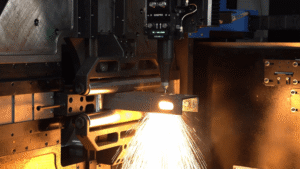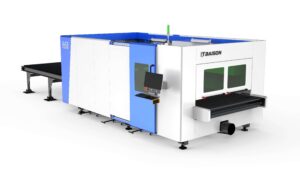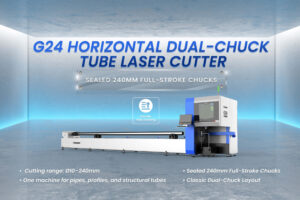
Processing 12-meter extra-long tubes, heavy structural steel (H-beams, channel steel), and large-diameter thick-walled pipes presents significant cost challenges for overseas metal fabricators. Traditional two-chuck tube laser cutting machines leave 150–300 mm of clamping remnant per pipe, creating significant material waste annually.
While some market alternatives feature cylinder-extension (sleeve-type) 3-chuck designs, their cantilever structures inherently suffer from structural stress and clamping interference during heavy-load or beveling operations.
If you are still evaluating different machine categories for your facility, explore our comprehensive Heavy Duty Laser Pipe Cutter Selection Guide to align power and diameter specifications with your operational scale.
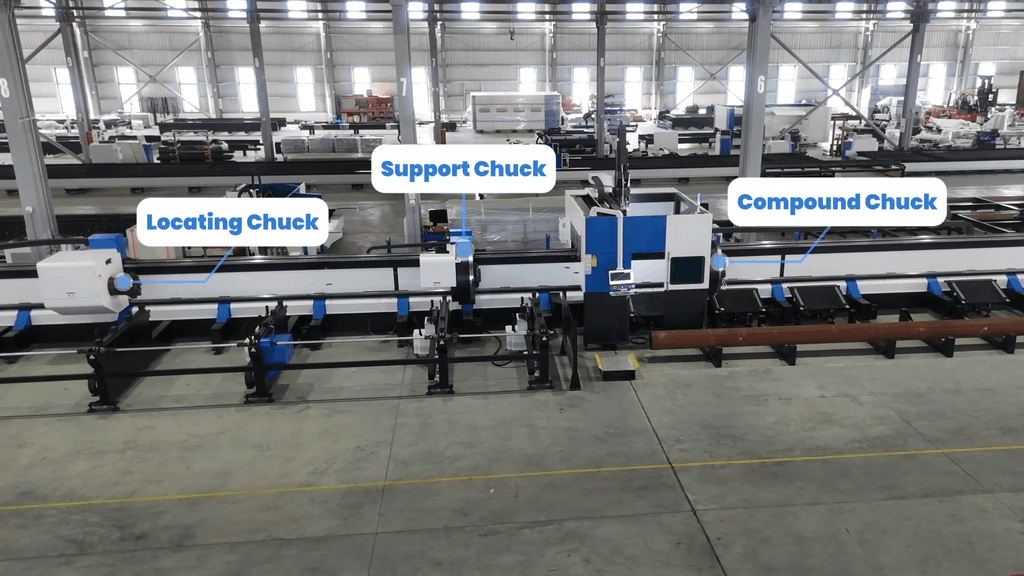
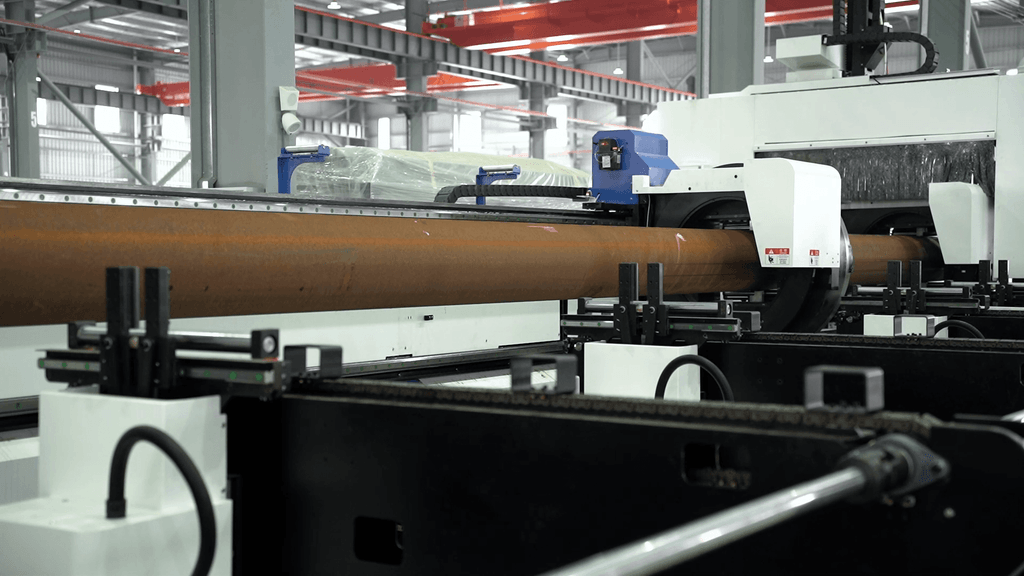
To overcome these structural limitations, the Baison Laser V36E and V52E feature proprietary full-stroke Floating 3-Chuck technology. Utilizing through-hole hollow chucks combined with dynamic multi-point follow-up supports, this architecture enables ultra-short tailing cutting in both forward and reverse directions. Supporting single-pipe loads up to 1,200–2,000 kg with optional ±45° one-pass beveling, this system helps fabricators minimize raw material waste and streamline secondary operations.
The Hidden Cost: How Traditional Two-Chuck Systems Drain Profits
Profitability in custom contract tube fabrication depends heavily on raw material utilization and overall process efficiency. Facilities relying on legacy two-chuck laser cutters face critical operational bottlenecks:
- Remnant Waste Eats Net Margin: In job shops billing by tonnage, physical chuck structures require 150–300 mm of clamping waste on every raw tube. For a shop consuming 100 tons of structural steel monthly, this results in 3 to 5 tons of scrapped clamping waste every month—creating substantial hidden material losses annually.
- Long-Tube Sag & High-Speed Vibration: When cutting 12-meter long pipes or heavy profiles without mid-section support, natural sagging causes violent rotational whipping. This leads to dimensional deviations, nozzle collisions, and piercing failures.
- Secondary Operations Extend Lead Times: The traditional workflow—Laser Cutting → Manual Material Handling → Mechanical Beveling/Grinding—increases labor time by 40% to 60%. Inconsistent manual beveling negatively impacts downstream robotic welding quality.
Simply adding a third chuck to an existing bed does not solve these issues. True efficiency requires a fundamental redesign of the mechanical chuck architecture and motion control logic.
Technical Analysis: Floating 3-Chuck vs. Cylinder-Extension 3-Chuck Systems
Several 3-chuck laser pipe cutting machines on the market use a cylinder-extension (sleeve-type) 3-chuck design. While this approach reduces tailing to a degree, it reveals structural drawbacks when handling heavy structural profiles and complex bevel angles.
Baison Laser’s proprietary full-stroke Floating 3-Chuck system re-engineers clamping dynamics and follow-up motion logic from the ground up:
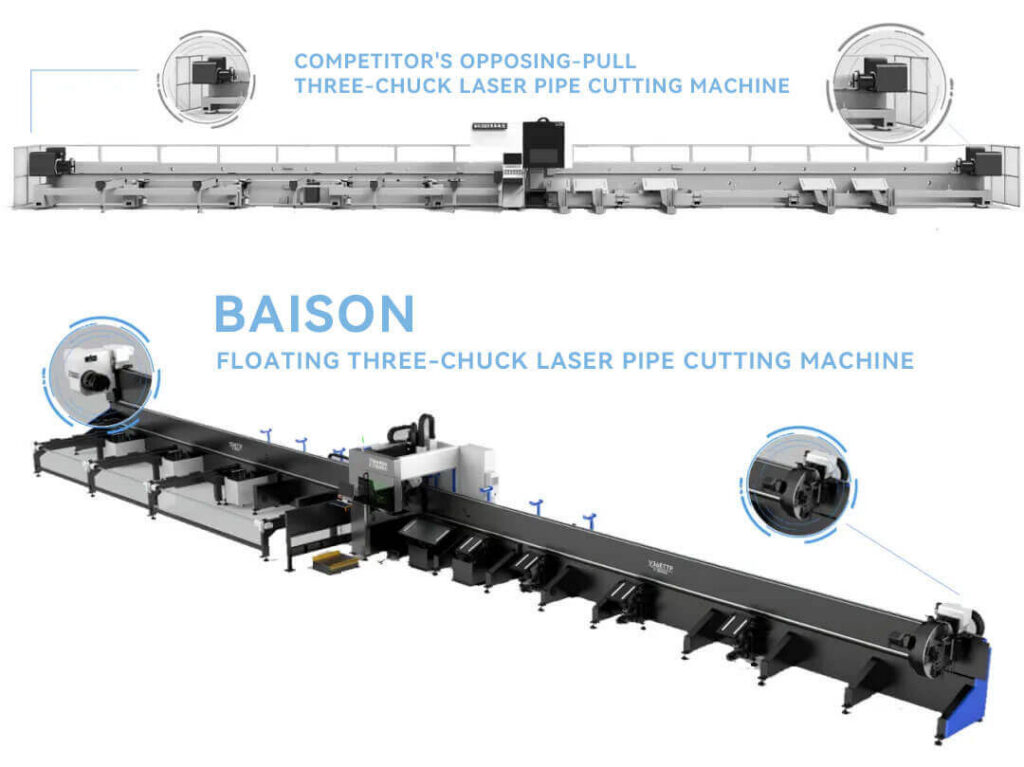
1. Beveling & Angular Clamping Clearance
- Cylinder-Extension 3-Chuck: The third chuck relies on a long, extending cylinder shell. During angled or bevel cutting, the outer sleeve often interferes with the cutting head and workpiece, limiting bevel angle flexibility.
- Baison Floating 3-Chuck: Features a large through-hole hollow chuck supporting over-travel (pass-through) clamping. The laser cutting head moves freely across the front and rear zones of the chuck, making it suitable for complex oblique cuts.
2. Dynamic Multi-Point Support & Structural Profile Handling
- Cylinder-Extension 3-Chuck: As pipes feed forward, unsupported center spans constantly change length. Asymmetric open profiles like channel steel and H-beams wobble under high rotational torque, causing accuracy drift in bevels and hole patterns.
- Baison Floating 3-Chuck: The second and third chucks feature dynamic synchronized movement, providing continuous multi-point support right at the cutting zone. This minimizes structural sagging and dampens rotational vibration on asymmetric profiles.
3. Bed Mechanics & Load Distribution
- Cylinder-Extension 3-Chuck: The extended cantilever sleeve places the clamping center far from the base mounting surface. Heavy rotating pipes exert high lever torque directly onto the flange connection, raising long-term fatigue and alignment concerns.
- Baison Floating 3-Chuck: The floating hollow chuck flange rides directly on heavy-duty bed guide rails. Operational loads transfer straight down to the rigid machine frame, eliminating cantilever stress forces during 24/7 continuous heavy-duty processing.
💡 Is Your Current Setup Wasting Tens of Thousands in Material Every Year?
Unsure how much raw material you can save on your specific pipe profiles?
Mechanical design is only half the equation—software algorithms and nesting strategies dictate real-world yield. [Contact Baison’s Application Engineers Today] to submit your CAD files for a Free Material Yield & Cutting Nesting Analysis.
Business Value: Performance Metrics vs. Practical Output
Baison has integrated this floating 3-chuck technology into the V36E and V52E heavy-duty fiber laser tube cutting machines, turning mechanical precision into quantifiable workshop ROI.
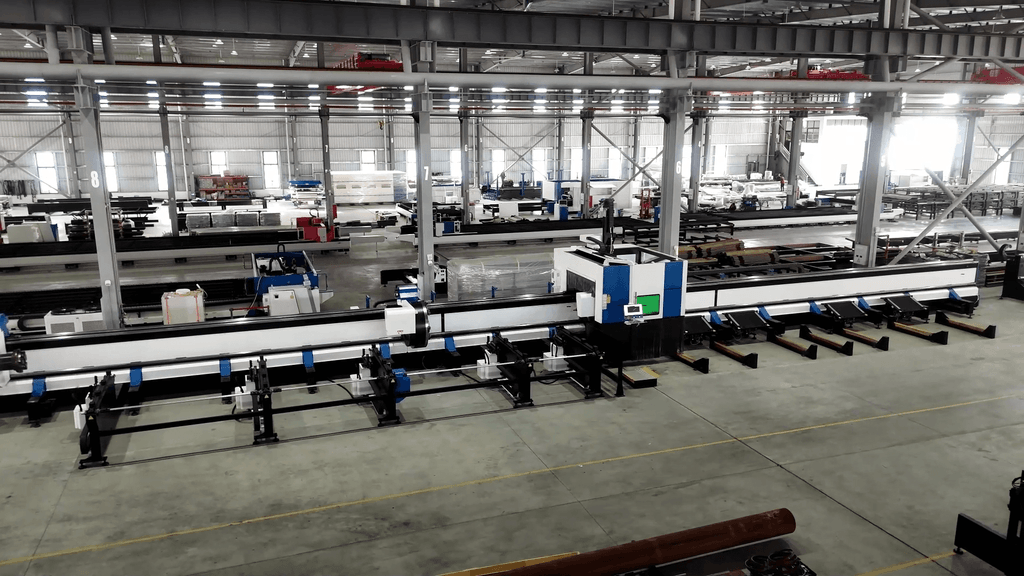
Note: Performance parameters below are based on standard testing conditions. Actual output varies based on tube straightness, wall thickness, and cutting speeds.
| Performance Metric | Legacy 2-Chuck Cutter | Cylinder-Extension 3-Chuck | Baison V36E (Floating 3-Chuck) | Baison V52E (Heavy-Duty Flagship) |
| Chuck Architecture | Fixed Dual Chucks | Extended Cylinder 3-Chuck | Full-Stroke Floating 3-Chuck | Heavy-Duty Floating 3-Chuck |
| Tailing Control | 150–300 mm waste | Reduced tailing (limited conditions) | Ultra-short tailing (Forward/Reverse) | Ultra-short tailing (Forward/Reverse) |
| Pipe Diameter Range | Φ20−220 mm | Φ20−350 mm | Φ20−355 mm | Φ50−500 mm |
| Max Single-Pipe Weight | ≤300 kg | ≈800 kg | 1,200 kg | 2,000 kg (2 Metric Tons) |
| Bevel Clamping Support | No pass-through | Interference risks from sleeve | Pass-through hollow chuck (±45∘) | Pass-through hollow chuck (±45∘) |
| Profile Handling (H/Channel) | High rotational wobble | Mid-span deflection | Synchronized multi-point support | Heavy-duty dynamic support |
| Repeatability | ±0.15 mm | ±0.08 mm | ±0.05 mm | ±0.05 mm |
Application Suitability:
- V36E: Designed for general heavy-duty applications including structural steel frames, construction machinery chassis, and architectural curtain walls.
- V52E: Engineered for ultra-heavy industrial manufacturing, such as wind turbine towers, heavy infrastructure components, and large-diameter thick-walled pipes. Combining a 2,000 kg load capacity with automated loading, it transforms multi-step heavy pipe processing into a single automated setup.
To see how this technology reshapes profit margins in real-world job shops, read our case study on Transforming Tube Fabrication Margins with the Baison V36E Solution.
Process Breakthrough: One-Pass ±45∘ Beveling Eliminates Secondary Grinding
In heavy structural pipe fabrication, bevel quality determines weld strength and compliance inspections. Traditional processing relies on manual oxy-fuel cutting or mechanical edge milling—methods known for low throughput and inconsistent bevel angles.
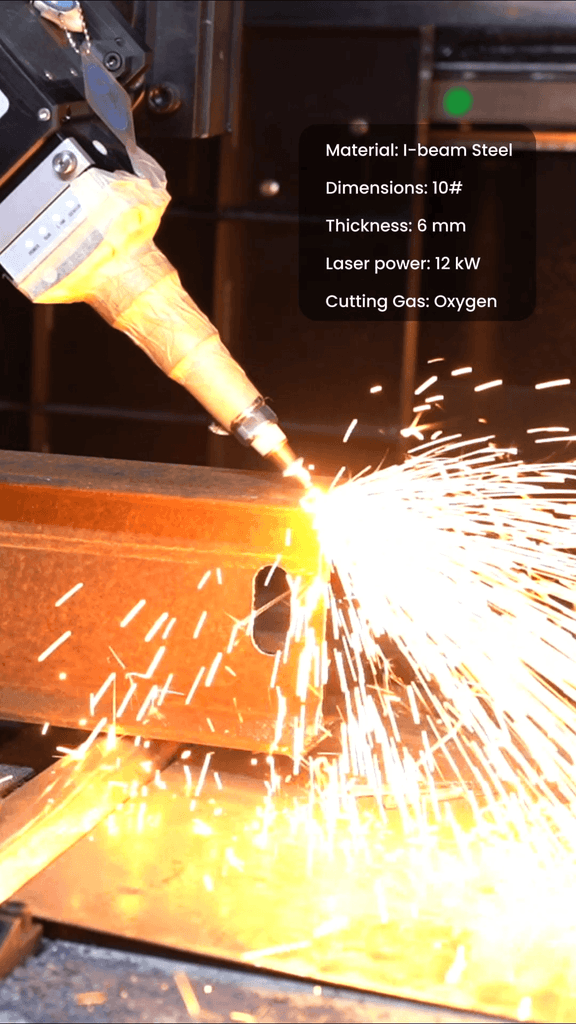
The Baison V36E / V52E offers an optional high-precision oscillating 3D bevel head, achieving V, Y, and X-type bevel cuts up to ±45∘ in a single pass.
- Dross-Free Cut Surfaces: High energy-density fiber laser cutting delivers clean, slag-free edges ready for direct robotic or manual welding.
- Consistent Batch Precision: Backed by ±0.05 mm positioning repeatability, bevels and cutouts stay uniform across entire 12-meter lengths, reducing rework rates.
ROI & Financial Calculations
Disclaimer: The financial model below uses USD values for illustrative purposes. Overseas fabricators should apply local steel prices (e.g., USD/EUR per ton) and labor rates. Calculations represent payback efficiency on equipment upgrade premiums under full-capacity operations (processing 100 tons/month).
1. Direct Raw Material Savings
- Legacy 2-Chuck Scrap: 3% – 5% material waste due to clamping remnants = 3.5 tons scrapped monthly.
Monthly Material Loss=3.5 Tons×$750 USD/Ton=$2,625 USD/MonthAnnual Hidden Scrap Loss≈$31,500 USD/Year
- Floating 3-Chuck Solution: Minimizes clamping waste, helping recover tens of thousands of dollars in raw steel costs annually.
2. Labor & Setup Optimization
- Equipped with semi-automated or fully automated bundle loading systems and one-touch auto-centering, setup times are reduced by up to 70%, boosting overall cutting throughput by over 40%.
- Enables single-operator monitoring across multiple machines, reducing overall labor requirements compared to traditional multi-operator setups.
3. Elimination of Secondary Workstations
- One-pass beveling eliminates standalone beveling stations and secondary material handling, lowering total per-part production costs by up to 30%.
Summary: Under full-load production, most heavy tube processing facilities recover the investment premium of a floating 3-chuck upgrade within 12 to 15 months through material and labor savings.
For a broader financial and technical framework when planning your capital expenditure, explore the complete 2026 Fiber Laser Cutting Machine Buying Guide: Specs, Cost & ROI.
Frequently Asked Questions (FAQ)
Q1: How does a floating 3-chuck laser achieve ultra-short tailing?
Baison’s system uses a full-stroke dynamic linkage architecture. As the laser reaches the end of the pipe, the second and third chucks alternate between holding, shifting, and over-traveling to feed the final segment directly into the cutting zone. Combined with bi-directional cutting logic, scrap is minimized. (Note: Absolute zero-millimeter waste is physically restricted by raw tube end squareness and safety margins).
Q2: Why is a floating 3-chuck system better for asymmetric profiles like H-beams and channel steel?
Asymmetric profiles create eccentric centrifugal forces when rotated. Cylinder-extension 3-chuck designs leave large un-supported center gaps, amplifying vibration. Baison’s floating design combines dynamic multi-point follow-up support with through-hole pass-through chucks, maintaining rotational stability even under 1,200–2,000 kg heavy loads.
Q3: How do I choose between the V36E and V52E models?
Selection depends on your maximum pipe diameter and unit weight requirements:
- V36E: Handles diameters from Φ20−355 mm with max loads of 1,200 kg. Suitable for structural steel frameworks, heavy machinery chassis, and curtain wall engineering.
- V52E: Handles diameters from Φ50−500 mm with max loads of 2,000 kg. Designed for wind towers, bridge girders, and large-diameter thick-walled industrial piping.
Q4: Can these machines integrate with existing CAD/CAM software for complex pipe designs?
Yes. Baison machines come equipped with specialized tube CNC and nesting software supporting standard 3D CAD formats (.STEP, .IGES). Features include automatic center-finding, intelligent nesting, and common-line cutting, allowing operators to convert complex 3D pipe assemblies into cutting programs quickly.
Learn more about our overseas service protocols in Never Fear Machine Failure Again: Inside Baison Laser’s Global Support Network.
Q5: How are installation, training, and field service handled for international factories?
Baison provides modular pre-assembled machine delivery, complete English documentation, and a pre-tested cutting parameter library. Global service teams offer remote telemetry diagnostics and on-site commissioning/training, supported by heavy-duty frames and top-tier fiber laser sources for continuous operation.
Q6: What hidden variables determine whether a 3-chuck system achieves zero-tailing on custom job orders?
While mechanical capability provides the foundation, parameters such as tube straightness tolerances, wall thickness variations, and software nesting algorithms dictate the final remnant outcome on complex cut lists.
Want to test your exact part drawings? [Request a Confidential Engineering Consultation] to run your specs through our nesting software.
Unlock Your Factory’s Profit Potential
In an industry with fluctuating raw material costs and tightening margins, machinery capabilities define your profit margins. The Baison V36E and V52E Floating 3-Chuck Heavy-Duty Tube Laser Cutting Machines help fabricators reduce clamping scrap while expanding into high-margin structural profile work.
Ready to calculate your exact annual material savings?
Contact a Baison Application Engineer today to submit your pipe specifications. Receive a customized ROI report, software nesting preview, and free sample cutting demonstration.