In today’s pursuit of high quality and efficiency in metal processing and smart manufacturing, the precision of laser cutting is the very foundation of a company’s success. However, in high-volume medium-to-thick plate production—such as in heavy machinery, shipbuilding components, high-end sheet metal, and light-luxury furniture manufacturing—the traditional “nozzle coaxial alignment” process has long been a hidden bottleneck squeezing factory capacity and yield rates.
Many factories focus blindly on stacking laser output power while overlooking the fundamental damage that micron-level coaxial deviation inflicts on processing quality. Once the laser beam deviates from the geometric center of the nozzle, the auxiliary gas flow field becomes severely disrupted. This leads to persistent issues during medium-to-thick plate processing, such as frequent blowouts during piercing, edge collapse during cutting, severe dross at the bottom, and out-of-spec bevel tapers.
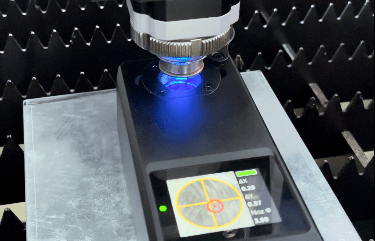
Leveraging deep technical expertise and industry pain point insights, Baison Laser has introduced the MCD100 laser visual coaxial alignment tool—a brand-new, integrated, handheld precision calibration instrument. Equipped with an industrial-grade, high-resolution image sensor and professional telecentric optical components, this device perfectly replaces traditional manual visual inspection or cumbersome external phone-connected calibration methods. It provides a zero-threshold, high-precision, and absolutely stable standardized alignment solution for the metal processing industry.
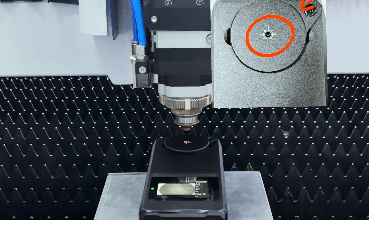
Why Choose the MCD100 Visual Alignment Tool to Replace Traditional Alignment Methods?
In the face of tight delivery cycles and stringent micron-level quality inspection standards, modern processing centers are under immense pressure to reduce costs and increase efficiency. Traditional alignment and calibration processes involve numerous unstable variables, which not only severely drag down the effective operating rate of machine tools, but also lead to unnecessary scrap loss of high-value metal plates during the trial cutting phase due to the subjective errors of manual adjustment, directly eroding the comprehensive profit margins of enterprises.
Those processing pain points caused by fragmented workflows, network latency, or experience gaps are invisibly devouring factory budgets and eroding brand reputation. The Baison MCD100 visual alignment tool is specifically engineered to solve these real-world workshop challenges, transforming what was once a setup bottleneck directly into an efficiency barrier for the enterprise through technological iteration.
Traditional Tape-Dot Shooting Method: A Low-Efficiency Process Disconnect
The alignment of traditional pipe and plate cutting heads relies heavily on manual experience, typically involving 8 to 9 fragmented and disordered steps such as applying tape, laser dot shooting, visually inspecting burn marks, and repeatedly fine-tuning by feel. Each alignment takes an average of 5 to 6 minutes, and the visual judgment varies drastically among different technicians, resulting in extremely poor cross-sectional consistency across batch workpieces. Consequently, up to 30% of setup time is wasted in vain on repeated trial cutting.
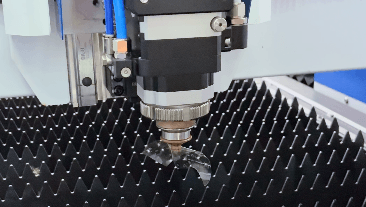
Existing Market Phone-Connected Solutions: Stability Hazards on the Industrial Shop Floor
While some manufacturers promote external smartphone camera solutions as a digital attempt, the workflow still requires around 9 tedious steps, including mounting fixtures, connecting the phone, opening the app, and manually adjusting the Z-axis elevation. On industrial shop floors where electromagnetic interference is severe and Wi-Fi signals are easily shielded by the machine bed, wireless connections are highly prone to screen lag and network latency. More critically, these setups frequently suffer from alignment interruptions caused by sudden incoming calls or system incompatibilities, failing to meet the hard-core stability requirements of continuous factory mass production.
Baison MCD100 Solution: Ultra-Simple 3 Steps, Locking in High Precision in 30 Seconds
Utilizing an industrial-grade, all-in-one hardware design, the Baison MCD100 breakthroughs traditional complexity by streamlining the cumbersome process into a 3-step standardized workflow: “Align, Follow, and Adjust”. The setup preparation time has plumetted from the traditional 90 seconds down to under 30 seconds. Even a complete novice can easily master it after just 10 minutes of training, achieving fully de-skilled, standardized operations.
Hard-core Technical Configurations and Core Selling Points of the MCD100 Visual Alignment Tool
As a precision instrument engineered for high-intensity industrial mass production, the MCD100 is no mere patchwork of consumer-grade cameras; it features deep, industrial-grade hard-core customization from the underlying optics to the electrical architecture.
- Core Routing: A 1920×1200 telecentric lens captures the image, routing the signal to a zero-delay self-processing chip for localized data computation, which then outputs directly to a 4.5-inch integrated screen for visual guidance.
- Underlying Architecture: Powered by a 4500mAh 21700 lithium battery, the entire system is fully enclosed in an IP64-rated protective, 0°C–60°C temperature-resistant housing to guarantee standalone, stable operation in harsh industrial environments.
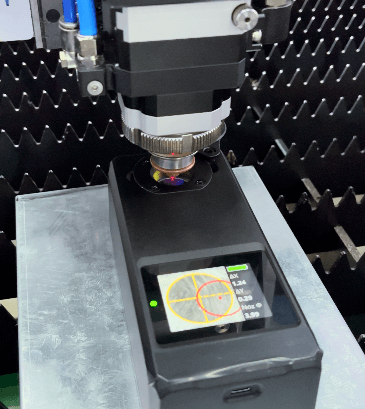
1920×1200 Telecentric Optical Lens and Standalone Display System
The device features a built-in 1920×1200 high-resolution image sensor and is equipped with a professional telecentric optical lens. This lens incorporates a mechanical tilt tolerance algorithm of up to 1.5°, requiring minimal leveling for placement; even if the plate or machine tool surface is slightly tilted, repeated leveling is eliminated. The integrated 4.5-inch standalone display ensures that data processing runs entirely locally with zero delay, completely breaking free from reliance on smartphones, laptops, or local area networks.
Pure Standalone Operational Unit and IP64-Rated Protection
To ensure long-term stable service in harsh workshop environments, the MCD100 built-in high-capacity 4500mAh 21700 industrial-grade lithium battery keeps overall power consumption under an ultra-low 4W, supporting fast charging via USB and adapters. The entire machine features an IP64 dustproof and waterproof design, capable of continuous operation in extreme ambient temperatures from 0°C to 60°C and humidity environments of 0%–70% RH non-condensing, completely immune to high-frequency electromagnetic interference and metal dust in the workshop.
Green Visual Feedback and Universal Brand Compatibility
The MCD100 not only achieves crosshair-centered visual guidance but also introduces a “yellow-to-green” dynamic color dual-feedback prompt via its algorithm. When the X-Y adjustment knob is turned to the absolute center, the screen reticle flashes green, eliminating any human misjudgment. Furthermore, the instrument utilizes a broad-spectrum visual recognition solution, offering universal compatibility to seamlessly adapt to all mainstream fiber laser cutting head brands on the market.
Core Process Data Comparative Analysis
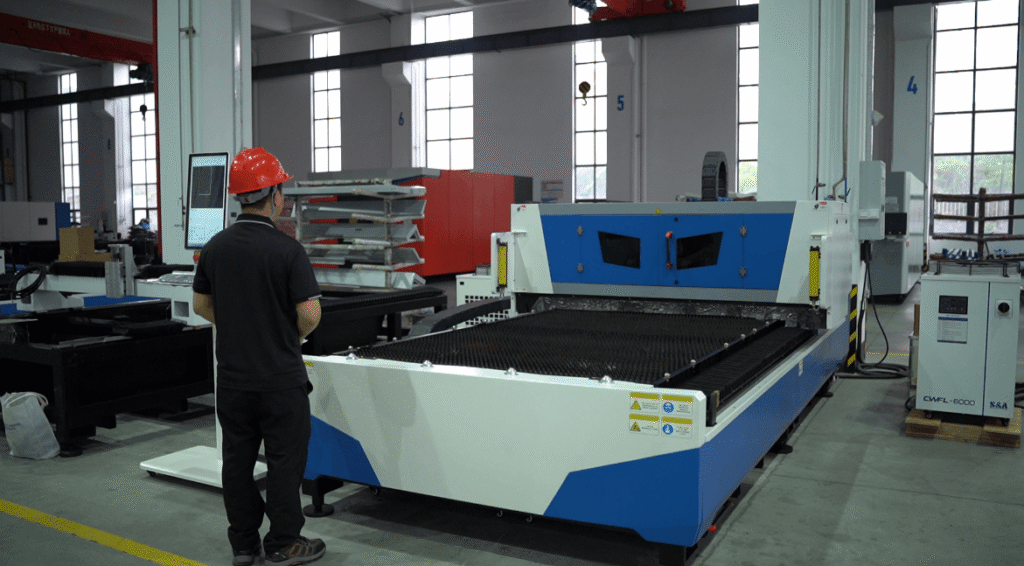
To enable manufacturing enterprises to clearly evaluate the Return on Investment (ROI) of introducing the MCD100, the following is a deep, horizontal dimensional comparison of the three current alignment processes used in the industry, based on actual factory test data:
| Comparison Dimensions | Traditional tape dot injection method | Competitor’s external mobile app solution | Baison MCD100 Visual Alignment System |
| Operating Procedures | Apply tape → Apply laser to designated spots → Visually inspect burn marks → Make repeated fine adjustments by touch | Mount the fixture → Connect your phone via Bluetooth/Wi-Fi → Open the app → Manually adjust the lifting height → Adjust the video feed | Place the instrument → One-button activation of automatic tracking → Observe the built-in screen and adjust the X-Y knob |
| Single core latency | Approximately 5-6 minutes | Approximately 90 seconds | ≤30 seconds (efficiency increased by more than 5 times) |
| Standard operating procedures | There is no fixed procedure; it relies entirely on the personal experience of senior employees. | Approximately 9 steps (complex process with low tolerance for error) | Only 3 steps (standardized and extremely simple operation) |
| Centering absolute precision | ≈0.1mm (large subjective error in visual inspection) | ≤0.1mm (affected by screen scaling and distortion) | Less than or equal to 0.02mm (5 times more accurate than traditional methods) |
| Process consistency | Extremely poor results; the outcomes varied greatly among different operators. | Generally, it is susceptible to the influence of industrial site environment and interference. | Extremely high repeatability with deadlock accuracy ≤0.02mm |
| Typical processing consequences | The cross-section has uneven quality on all four sides, slag buildup at the bottom, and severe taper. | Network latency and lag, wireless interruption, fragile equipment during setup | The crosshair turns green for double objective confirmation, and the cross-section is mirror-smooth. |
| Workshop personnel requirements | Requires more than 2 weeks of costly training and relies on experienced technicians. | Familiarity with smartphone app operation is required, so there is still a certain learning curve. | Zero learning curve, even beginners can get started in just 10 minutes of training |
| External scene dependency | Purely manual, no electronic dependence, but high consumption of consumables. | Highly dependent on phone battery life, system compatibility, and Wi-Fi environment | Integrated design, independent hardware and software operation, no external dependencies |
Baison MCD100 Alignment Tool’s Industrial Breakthrough Performance in Actual Mass Production
In ultra-high-power (3kW – 20kW) medium-to-thick plate cutting operations, a leap in alignment precision directly delivers a revolutionary leap in processing quality to the workshop. By locking the coaxial deviation to≤0.02mm, the MCD100 serves as the ultimate weapon for conquering processing bottlenecks in medium-to-thick plates.
Perfecting Efficiency in Ultra-High-Power Stainless Steel and Aluminum Plate Cutting
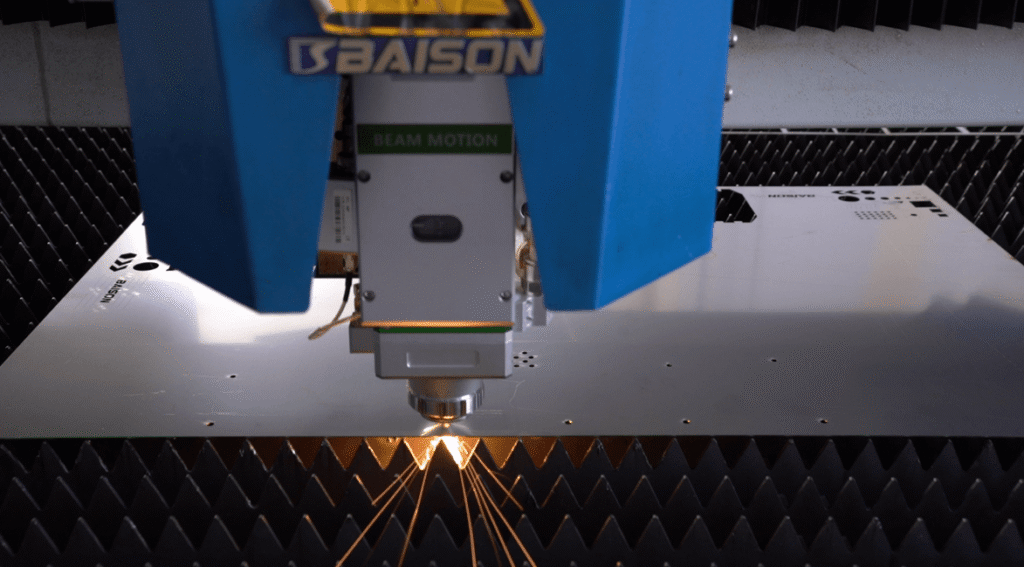
During the high-volume processing of highly reflective metals like 16mm stainless steel or aluminum plates, nozzle coaxiality is highly susceptible to micron-level drift caused by the thermal accumulation of high-energy lasers. The MCD100 ensures that the auxiliary gas flow remains perfectly coaxial with the laser beam. When paired with high-pressure air compression solutions or the MAP Series gas mixing systems, it precisely controls the high-speed gas flow field. This not only achieves mass-production “gas savings and cost reductions,” but also perfectly eliminates edge collapse, allowing the cut sections of ultra-thick metals to achieve a top-tier, mirror-smooth, dross-free texture.
Conquering the Persistent Bottleneck of “Piercing Blowouts” in Medium-to-Thick Carbon Steel Plates
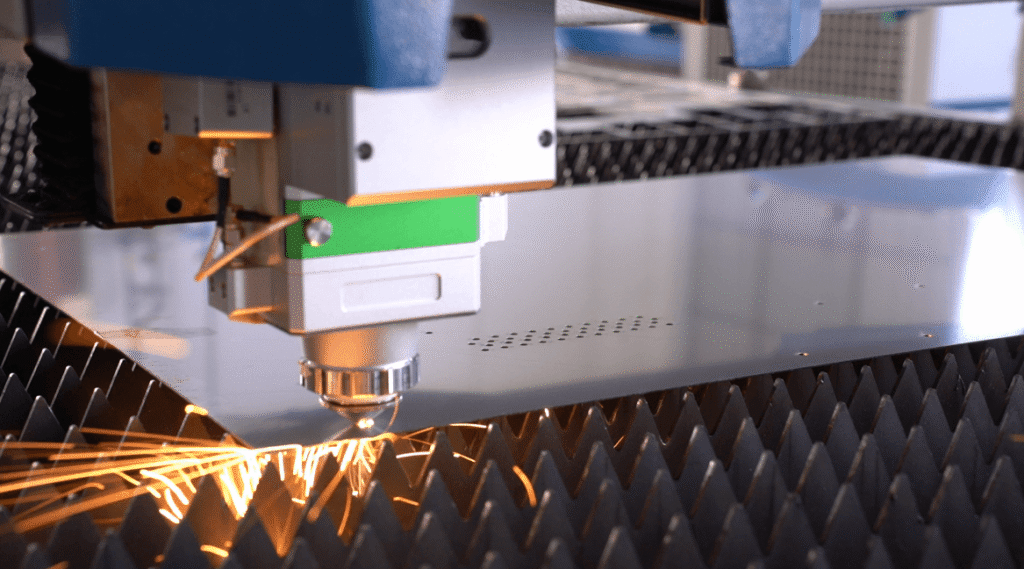
When processing thick carbon steel plates of 20mm or above, the stability of the piercing stage is the critical factor determining the yield rate of the entire sheet. When the coaxiality reaches the ultimate state of≤0.02mm as measured by the MCD100, it works in tandem with specialized double-layer nozzle systems to achieve perfect, layer-by-layer progressive flow field control of positive-pressure oxygen during piercing. Through stable and precise seamless gas pressure switching, phenomena like piercing blowouts caused by laser-gas misalignment are completely eliminated, guaranteeing the continuity of automated, long-run mass production.
Product technical specifications
- Recognition Resolution: 1920×1200 High-Definition Telecentric Vision
- Optimal Follow Height: 1mm Automatic Follow and Anti-Gap
- Repeat Accuracy: ≤0.02mm
- Absolute Accuracy: ≤0.05mm
- Power Supply: Industrial-grade 21700 Power Lithium Battery
- Charging Mode: USB, Independent Power Adapter
- Nominal Battery Capacity: 4500mAh @ 0.2C
- Power Consumption: <4W @ 4.2V DC
- Dimensions: 180mm×80mm×82.5mm (L×W×H)
- Display Size: 4.5-inch Industrial-Grade High-Definition Screen
- Net Weight: 1000±50g (Lightweight Handheld Design)
- IP Rating Code: IP64 High-level dustproof, oil-repellent, and waterproof
- Extreme Operating Temperature: 0℃ – 60℃ (resistant to high workshop temperatures)
- Ambient Humidity Range:0% – 70% RH (non-condensing)
- International Standard Certification: CE EU safety certification
Intelligent Optimization Industrial-Grade FAQ
Q: How does the MCD100 improve factory ROI?
A: Traditional machine setup is time-consuming and wasteful, heavily reliant on highly skilled technicians. The MCD100 reduces centering time to 30 seconds, increasing efficiency by 5 times. Apprentices can learn to operate it in 10 minutes. By increasing uptime, saving labor time, and reducing waste, the purchase cost can be recovered within a few months.
Q: How does the automatic “follow” function work?
A: Traditional manual Z-axis adjustment easily leads to head collisions and lens failure. The MCD100 has a built-in high-precision chip. After aligning with the window, a one-click “follow” button automatically lowers the cutting head and precisely hovers at the optimal 1mm detection height, completely eliminating the risk of head collisions.
Q: How does it perform when processing highly reflective metals (aluminum, copper)?
A: Highly reflective materials have large thermal deformation; even slight coaxial misalignment can burn out expensive lasers. The MCD100 boasts a high-frequency sampling accuracy of ≤0.02mm, ensuring coaxiality of the photomask and gas, quickly dissipating reflective heat, and eliminating edge collapse and backlight damage.
Q: Why is integrated hardware superior to a mobile app solution?
A: In workshops with strong electromagnetic fields and severe shielding from the steel bed, wireless transmission via mobile phone is prone to lag and delays leading to misadjustments, and is susceptible to interference from incoming calls or app crashes.The MCD100 uses integrated hardware components, operates independently with zero latency, withstands temperatures from 0℃ to 60℃, and is more stable and ready to use right out of the box.
Summary: A Generational Leap Forward Speaks Through Data
Perfect cutting requires not only the formidable power of a 10,000-watt laser, but also precise control over the three dimensions of light, air, and mechanics.
Baisheng’s MCD100 vision alignment system completely replaces subjective visual experience with digital and objective optical measurement algorithms, ensuring that every alignment adjustment is based on data, thereby fundamentally guaranteeing end-face consistency in the mass production of medium and heavy plates.
Want to significantly improve the effective uptime of multiple fiber laser cutting machines in your workshop and reduce the scrap rate of heavy plates?
If your production line is facing technical bottlenecks such as rough cut end faces, inconsistent perpendicularity of four sides, or insufficient capacity due to frequent machine adjustments, provide our application engineering department with your existing laser cutting head model, mainstream processed plate thickness, and current uptime data.
Our process experts can then provide you with a precise on-site machine adjustment process integration analysis report, using data to lock in the quality of every processing step.