Introduction: The Invisible “Profit Black Hole” in Modern Metal Fabrication
For mid-to-large-scale manufacturers in regions like North America, Europe, and Southeast Asia, global market demand for high-end tubular metal components is at an all-time high—ranging from ergonomic office furniture and heavy-duty commercial fitness equipment to medical carts and architectural railings. However, behind this booming order volume lies a headache-inducing operational bottleneck: traditional tube cutting methods are severely eroding factory profit margins.
If your workshop still relies on traditional band saws, manual plasma cutters, or entry-level laser equipment with cumbersome loading and unloading processes, you are likely silently bleeding money due to excessive labor costs, severe material waste, and continuous production delays. In today’s fiercely competitive global market, winning orders depends not only on pricing competitiveness, but crucially on your agile manufacturing speed to deliver strict quality on time.
This is where advanced intelligent laser technology completely changes the game. Let us walk through a real overseas manufacturing scenario to see how leading global component manufacturers are completely reshaping their production lines using next-generation fully automated tube laser cutting technology.
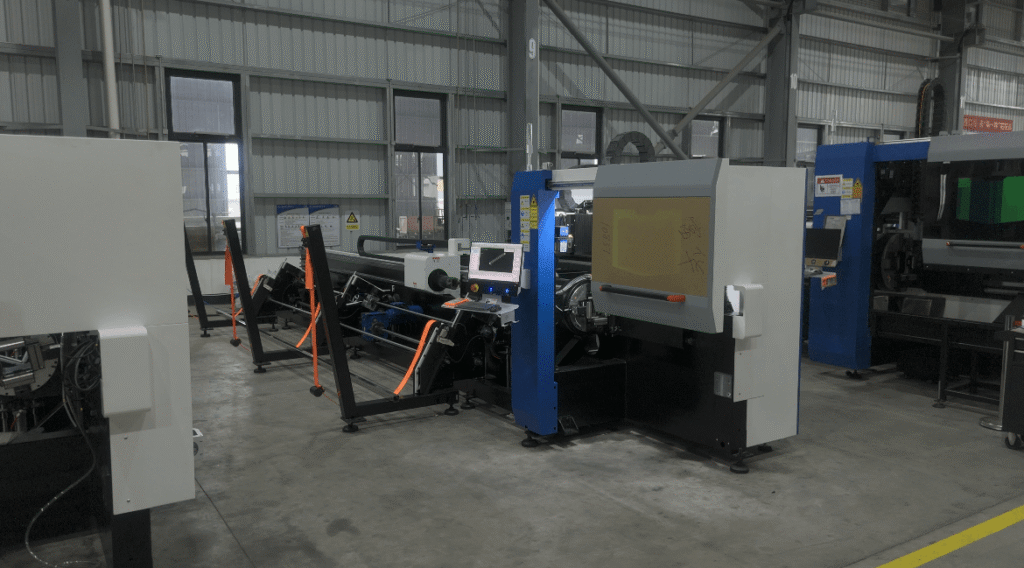
Case Study: Inside a High-Capacity Furniture & Fitness Plant
Imagine this scenario: A medium-sized contract manufacturer supplying premium tubular steel frames to international office furniture brands and commercial fitness chains is recently facing a severe operational crisis.
Daily Chaos on the Workshop Floor
It is a Tuesday morning, and Plant Manager Mark is staring anxiously at a growing backlog of orders. The company has just secured a lucrative export order requiring the production of complex, nested square and rectangular steel tubes for 5,000 sets of multi-angle commercial training benches.
However, three lingering bottlenecks on the workshop floor are bringing production to a standstill:
- 1. The Loading Nightmare: Operators must use overhead cranes to laboriously transport 6-meter-long heavy steel tube bundles, manually feeding the tubes one by one into an aging tube cutter. Preparing and loading just a single batch of tubes takes two workers nearly 15 minutes, which is not only inefficient but also easily triggers workplace injuries and fatigue.
- 2. The Tail-End Scrap Penalty: Because legacy equipment leaves tail scrap as long as 150mm or more, tens of thousands of dollars worth of high-grade stainless steel and carbon steel tubing are thrown straight into scrap bins every week.
- 3. The Precision Disconnect: Due to minor deviations in straightness and surface twist across tube batches, legacy equipment cannot automatically correct them, leading to misaligned cutting dimensions, rough bevels, and heavy manual deburring afterward. Because joints cannot align perfectly during welding, the final assembly line suffers from frequent shutdowns.
Long before order volumes reach their peak, the profits on these export orders have already been completely eroded. Mark urgently needs a solution that can eliminate manual friction, drastically cut scrap, and ensure absolute cutting precision, without relying on a large team of skilled workers.
Why Traditional Tube Cutting Fails Modern Manufacturers
To understand why hundreds of forward-thinking overseas factories are upgrading their infrastructure, we must examine the structural flaws of traditional metal cutting technologies.
1. Over-Reliance on Skilled Labor: Traditional and low-end cutting equipment demands heavy manual intervention. From manual loading and clamping to measuring and sorting, facing the severe skilled labor shortage in regions like North America and Western Europe, finding and retaining operators capable of handling dangerous, repetitive physical labor is not only nearly impossible but astronomically expensive.
2. High Scrap Rates and Massive Tail-End Loss: In traditional equipment, long sections of unprocessed tail stock are taken for granted as standard loss. When processing stainless steel or special alloy tubes, a 10% to 15% scrap rate caused by clamping limitations directly translates to the vanishing of tens of thousands of dollars every year.
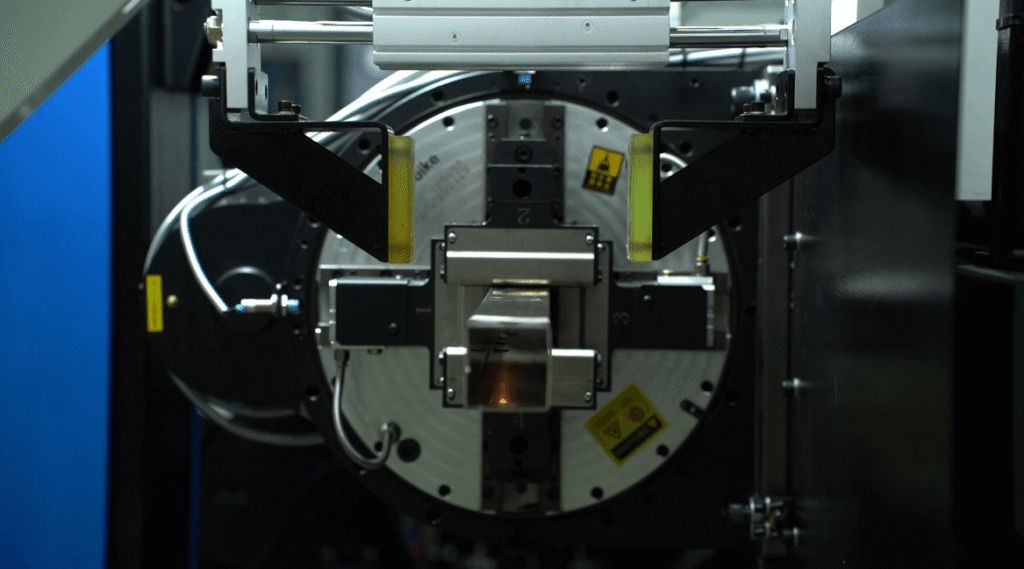
3. Vulnerability to Material Imperfections:In reality, metal tubes are rarely 100% perfect, often featuring slight surface rust, minor bends, or thermal deformation from prior processing. Legacy cutters lack adaptive intelligence, meaning any minor deviation results in cutting failure, workpiece scrapping, and costly downtime.
Baison K12C Core Advantages: Built for Market Dominance
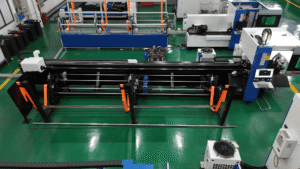
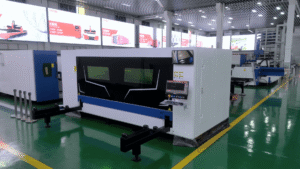
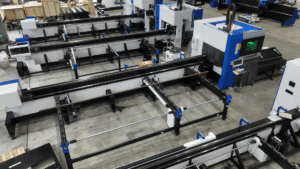
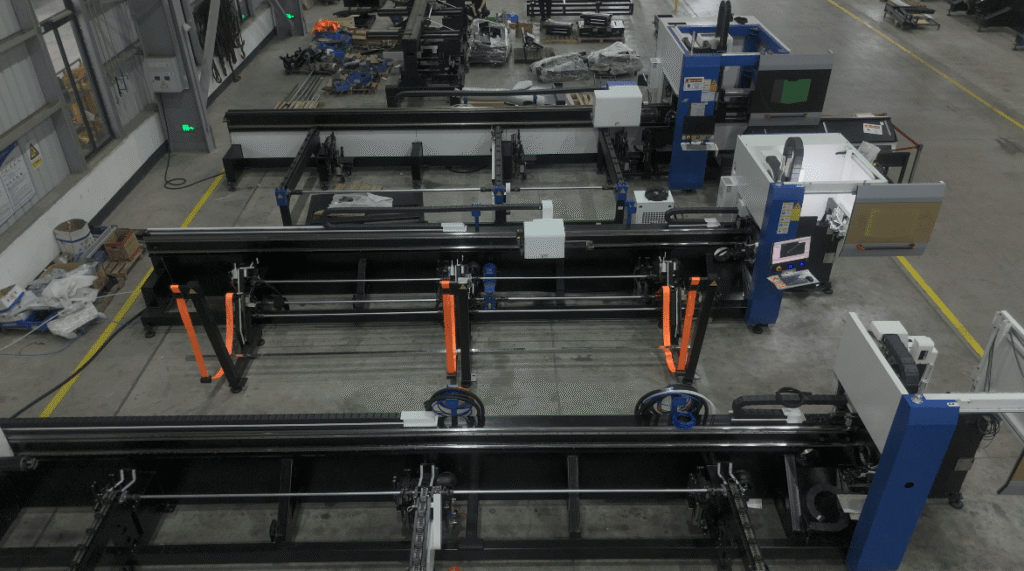
When deciding to completely overhaul their production line, the company chose Baison Laser, a trusted pioneer in global metal fabrication integrated solutions since 2004. By introducing the Baison K12C professional tube laser cutting machine equipped with an automatic loading system, they completely reshaped their capacity ceiling.
Baison Laser comprehensively outperforms market alternatives across the following core dimensions:
| Performance Metrics DOCX | Conventional Tube Cutters on the Market DOCX | Baison K12C Professional-Grade Solution DOCX | Commercial Value for You DOCX |
| Loading Efficiency | Manual or semi-automatic; requires 2+ operators and overhead crane assistance. | Fully automatic loading magazine (up to 2,000 kg load capacity) + pneumatic dual-row roller chuck. | Zero manual intervention throughout feeding; reduces labor costs by 70% and completely eliminates workplace safety hazards. |
| Material Utilization & Tail Scrap Control | Longer tail scrap (typically >=100mm to 150mm). | Ultra-optimized high-precision cutting, extremely short tail scrap (>=65mm). | Saves huge raw material costs annually, maximizing the material yield of every bundle of tubes. |
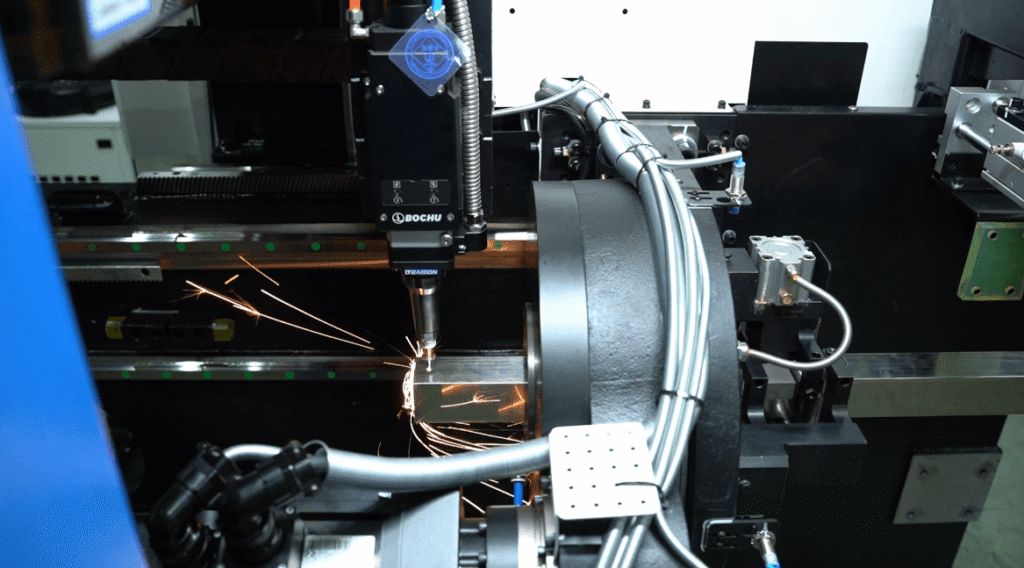
| Optics & Sealing Protection | Basic single-layer protection; prone to lens contamination and water-cooling leaks during long-term use. | Triple optical protection, equipped with IP65-grade dustproof and waterproof, corrosion-resistant water-cooled cutting head, and real-time temperature monitoring. | Significantly extends core component lifespan, eliminating unexpected downtime and costly emergency repairs. |
| Intelligent Adaptability | Requires frequent manual calibration; powerless against bent or defective tubes. | Intelligent CNC system featuring automatic centering, dynamic error correction, and high-speed pneumatic clamping. | Ensures an ultra-high cutting precision of +/-0.03mm even when facing common industrial tube tolerances and minor surface deformations. |
As demonstrated in the comparison table above, compared to conventional tube cutters on the market, the Baison K12C professional-grade solution has achieved a leapfrog upgrade across four core dimensions: loading efficiency, material utilization & tail scrap control, optics & sealing protection, and intelligent adaptability. It not only achieves zero manual intervention throughout feeding, reduces labor costs by 70%, and completely eliminates workplace safety hazards, but also substantially saves raw materials, extends core component lifespan, and maintains an ultra-high cutting precision of ±0.03mm when facing tube tolerances and minor deformations, thereby delivering remarkable commercial value and return on investment (ROI) for enterprises.
Global Success: How Baison Empowers Industry Leaders
Baison Laser’s exceptional engineering prowess is never just on paper—it has been battle-tested in the world’s most demanding factory floors. Renowned international enterprises consistently choose Baison to drive productivity and market competitiveness:
- Furniture and Desk/Chair Manufacturing: Industry leaders such as Xingyuan Industry, Shengfang Chaona Laser Processing, and Langfang Huiju Furniture all rely on Baison’s high-speed, high-precision cutting to flawlessly achieve high-repeatability batch delivery of complex commercial and residential tubular parts.
- Electric Vehicles and Micro-Mobility Industry: High-volume manufacturers such as Langfang Sadi EV and Zhumadian Lima EV leverage Baison systems to mass-produce lightweight, high-strength tubular frames at unprecedented speeds, effortlessly handling seasonal order surge peaks.
- Elevators and Heavy Steel Structures Sector: Elite brands like Oulida Elevator, Meilun Elevator, Hengrun Steel Structure, and Fast Elevator maintain exceptionally strict standards for structural integrity and dimensional accuracy, which is the promise Baison steadily delivers day in and day out.
FAQs
Q1: How does the Baison K12C reduce reliance on skilled labor?
Answer: Automated loading and unloading handle feeding, centering, cutting, and discharging. One operator manages multiple machines, eliminating manual labor bottlenecks.
Q2: Can the K12C handle slightly deformed or imperfect local tubes?
Answer: Yes. Its intelligent CNC system with auto-centering and pneumatic chucks automatically compensates for bends and twists, ensuring high precision without expensive straight imported tubes.
Q3: What ROI can factories expect after upgrading?
Answer: 12 to 18 months. Driven by lower labor costs, material savings from ultra-short tail cutting ($\ge$ 65mm), and eliminated deburring.
Q4: How does Baison support overseas installation, training, and service?
Answer: Backed by 200+ global service outlets and 150+ engineers, offering layout planning, remote diagnostics, and 24-hour fast on-site response.
Conclusion: Upgrade Your Manufacturing Competitive Edge Now
In today’s climate where supply chain pressures and labor costs squeeze manufacturing profits from every dimension, clinging to outdated metal cutting equipment is a risk enterprises cannot afford to bear.
By introducing the Baison K12C advanced tube laser cutting solution, you acquire more than just a piece of equipment—you inject a battle-tested, powerful engine for business growth, operational resilience, and unshakeable market leadership.
Ready to outperform competitors and completely reshape workshop efficiency? Contact Baison Laser immediately to schedule a virtual showroom tour or request a free sample test for your specific application.