In modern sheet metal fabrication and medium-to-heavy plate manufacturing, businesses are no longer competing on cutting speed alone. Success requires a comprehensive evaluation of total operating costs, workshop safety and environmental compliance, long-term machining accuracy, and automation rates.
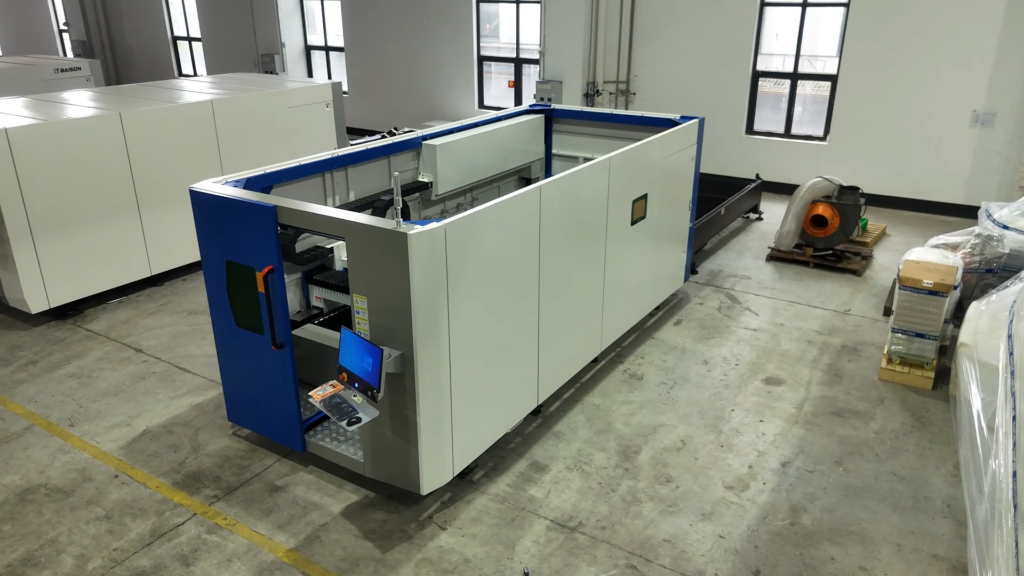
Enclosed shuttle fiber laser cutting systems—such as the Baison Laser CT3A series—effectively resolve critical pain points like thermal deformation during heavy-load continuous operations, smoke pollution, and slow table switching.
Rather than a blind rejection of traditional models, this represents a high-end upgrade tailored for modern factories pursuing high compliance, exceptional stability, and scalable efficiency.
The Hidden Pain Points of Modern Sheet Metal Shops: When Speed Is No Longer the Only Bottleneck
Stepping into modern sheet metal fabrication shops worldwide, plant managers and production directors face shifting challenges. Historically, the core criteria for evaluating a laser cutter were limited to “laser power” or “instantaneous idle speed.”
However, with tightening global environmental regulations, rising labor costs, and increasingly intricate orders, many facilities discover that even with high-power lasers, overall output and profitability remain choked by several “invisible bottlenecks.”
- Workshop Environment and Safety Compliance: During batch processing of medium-to-heavy plates or high-pressure auxiliary gas cutting, open or semi-open structures generate massive sparks and smoke. This threatens operator health and risks failing stringent compliance audits in overseas markets focused on labor safety and environmental protection.
- Long-Term Precision Stability: High heat generated by continuous laser generator operation can transfer to the machine bed, triggering micron-level thermal deformation and dimensional drift in precision parts over multi-shift operations.
- Loading/Unloading Auxiliary Delays: Sluggish shuttle table exchange speeds lead to frequent operator idle time, silently dragging down overall production line OEE (Overall Equipment Effectiveness).
Consequently, modern factories are shifting toward system-level optimization during equipment evaluation—demanding not just fast cutting, but stable cutting, clean operation, and predictable delivery.
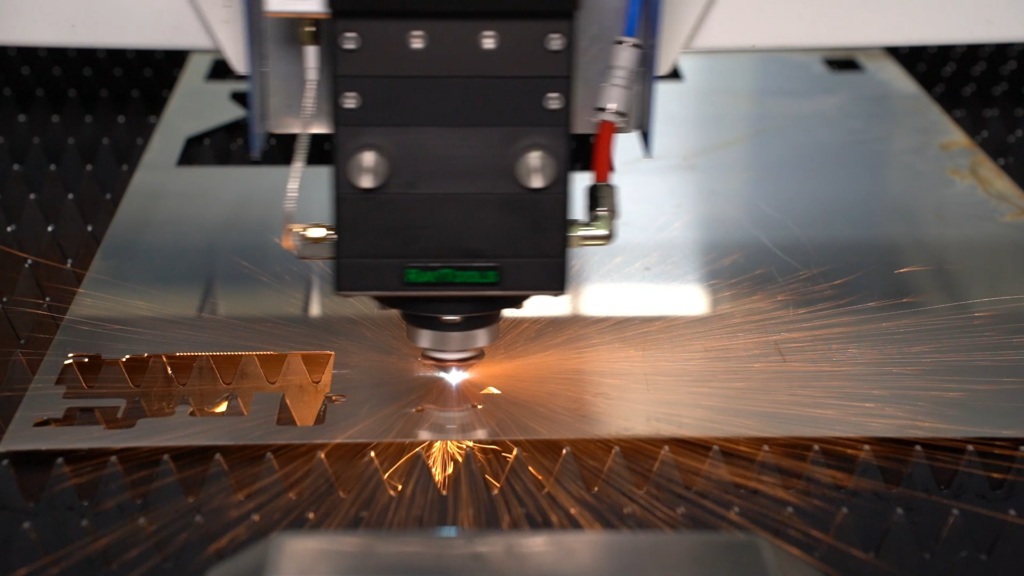
Core Architecture Breakdown: How Enclosed Shuttle Systems Reshape Machining Certainty
To engineer a solution for these pain points, enclosed shuttle laser cutting machines undergo profound innovations in mechanical structure and control logic.
Structural Innovation: Hollow Anti-Deformation Bed and Aviation Aluminum Crossbeam
The bedrock of machine precision lies in its structural rigidity. The CT3A series adopts an independently developed heavy-duty, high-strength reinforced hollow bed structure.
This bed undergoes rigorous manufacturing processes, including frame welding, vibration aging, high-temperature annealing, sandblasting, primer coating, rough machining, resting, secondary vibration aging, finish machining, topcoat painting, and final assembly.
This multi-stage stress-relief design minimizes the heat-affected area during prolonged heavy-load, high-temperature processing, preventing thermal bed deformation and ensuring long-term ultra-stable accuracy.
Meanwhile, the crossbeam utilizes premium aviation aluminum fused with an ultra-high-pressure integrated extrusion molding process and lightweight design, offering low weight, fire/heat resistance, and superior dynamic response to guarantee near-perfect cutting precision.
Efficiency Leap: Shuttle Exchange Dual Platforms and Intelligent Bus Control
To boost production continuity, the equipment is equipped with shuttle-type exchange dual platforms, completing a flash exchange within 10s -15s and drastically compressing manual loading/unloading wait times.
Powered by mature high-power bus laser cutting systems (such as the CypCut EtherCAT real-time bus solution) and dedicated plane cutting software, it achieves precise motion axis, laser, and assist gas coordination.
Built-in process databases with features like senseless piercing and one-stroke fly-cutting algorithms optimize thin-sheet high-speed nesting while elevating medium-to-heavy plate piercing quality and curbing vibration during high-speed processing.
Environment and Safety: Enclosed Protective Housing and Constant Temperature Electrical Cabinet
An enclosed protective housing seals the entire processing zone, trapping sparks and routing smoke through partitioned exhaust systems to keep the external workshop clean and safe. Dedicated laser-proof viewing windows—with optional real-time camera monitoring—keep operators updated on machine dynamics.
Electrically, the control cabinet upgrades from a traditional rear-mounted style to an integrated side-mounted design equipped with a standard constant-temperature air conditioner, ensuring electrical components remain thermally stable against harsh, high-temperature, or dusty industrial environments to eliminate downtime risks.
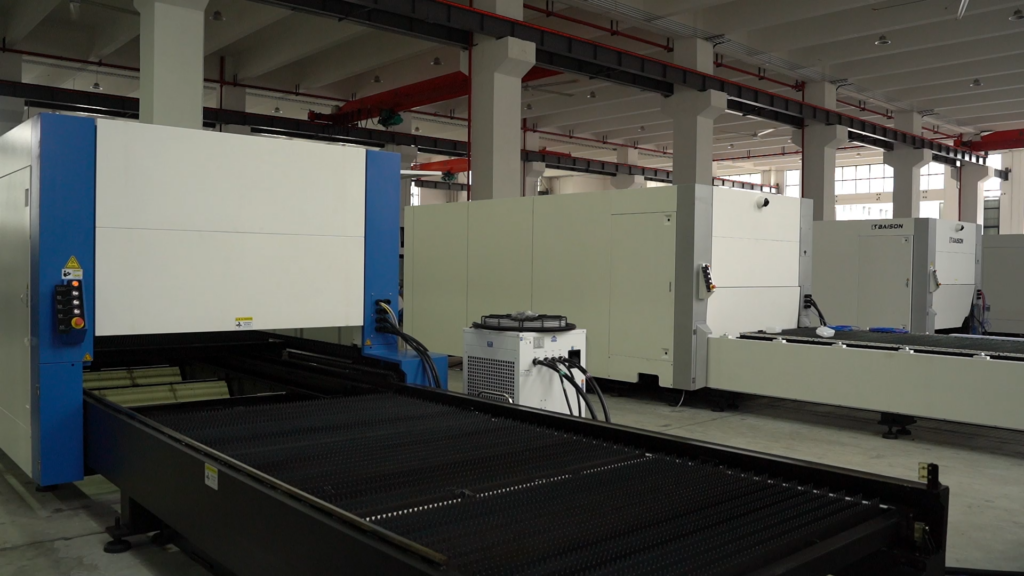
Decision Matrix: Enclosed Shuttle Systems vs. Open General-Purpose Models
To help overseas procurement teams select the optimal equipment for their factory layouts, environmental regulations, and order profiles, the table below provides an objective comparison of mainstream machine types (Note: Baison Laser offers both mature product lines to match diversified scenarios):
| Comparison Dimension | Enclosed Shuttle Fiber Laser Cutting Machine (e.g., CT3A) DOCX | Open / Traditional Fiber Laser Cutting Machine DOCX |
| Workshop Eco & Smoke Control | Fully enclosed design + internal directional partitioned extraction, zero smoke leakage, meets strict international environmental standards. | Open or semi-open operation, relying on independent large workshop dust collectors or general factory ventilation. |
| Loading/Unloading Efficiency | Standard shuttle dual platforms, 10s -15s flash exchange, drastically minimizing manual waiting. | Single table or basic exchange formats; auxiliary wait times vary by configuration. |
| Electrical & Thermal Stability | Integrated cabinet with standard air conditioning; heavy hollow bed features high thermal-deformation resistance. | Standard electrical layout for normal industrial environments; requires general workshop temperature control. |
| Best Suited Applications | Modern standard sheet metal shops pursuing high automation, multi-shift continuous production, and strict labor safety compliance. | Specialized factories with extreme space constraints, frequent lifting of oversized non-standard blanks, or pre-existing dust-collection setups. |
Enterprises do not need to choose an absolute “winner”; instead, they should select production tools aligned with their order mix, environmental compliance pressures, and automation roadmaps. Are you certain your current open-frame setup is keeping up with tightening eco-audits and multi-shift demands?
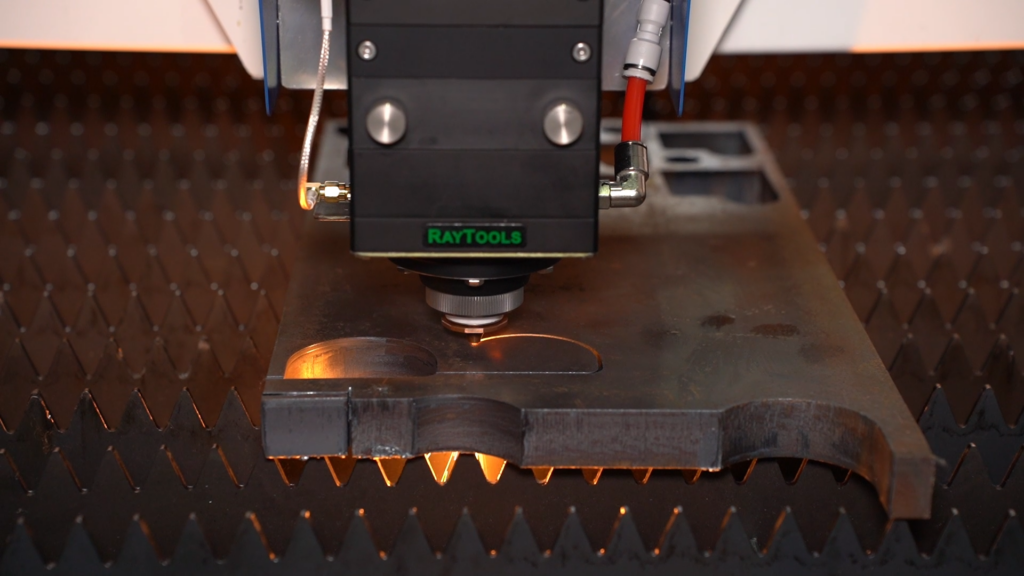
Real Overseas Application Scenarios and Client Success Stories
In global industrial manufacturing, equipment value is ultimately validated through diverse application scenarios. Drawing from Baison Laser’s rich experience serving 60+ countries, leading manufacturers across industries are reshaping productivity via advanced laser cutting systems:
Environmental and Continuous Production Upgrade for a European High-End Enclosure Manufacturer:
A Central European electrical switchgear manufacturer needed to clear strict EU environmental and occupational health audits while easing capacity bottlenecks caused by frequent manual material loading waits.
By introducing an enclosed dual-platform laser cutting system, processing sparks and smoke were safely sealed and extracted, passing local environmental inspections smoothly. Combined with shuttle flash exchanges, daily output increased by ~20% while operator labor intensity dropped significantly.
Cost Reduction and Efficiency Boost for a Southeast Asian Construction Machinery OEM:
A mid-sized Southeast Asian sheet metal subcontractor handling heavy carbon steel plates for construction equipment faced micro-bed-deformation issues during long-hour thick plate runs due to thermal radiation, harming multi-part assembly accuracy.
Upgrading to a laser cutting system featuring a heavy-duty hollow anti-deformation bed and constant-temp electrical cabinet suppressed cumulative thermal errors, ensuring batch consistency across multi-shift operations and noticeably cutting rework rates.
Implementation and Global Service Assurance
For overseas buyers, investing in heavy-duty industrial laser equipment is both a hardware choice and a test of a supplier’s full lifecycle service capability. From preliminary workshop planning (three-phase power supply, high-purity auxiliary nitrogen/oxygen supply, and floor load capacity of 2000kg) to integrated container transport logistics (front and rear bed separation design enabling fast loading without disassembling sheet metal parts to lower transport damage risks and speed up on-site installation), rigorous engineering coordination is vital.
Regarding after-sales and delivery capacity, Baison Laser relies on its nearly 100,000-square-meter modern smart industrial park in Foshan, Guangdong, backed by 200+ global service nodes and 150+ field service engineers. Machines include a standard 1-year warranty (excluding consumables). Service requests receive a specialist response within 2 hours, ensuring high operational uptime for overseas plants.
Frequently Asked Questions (FAQ)
Q1: Why are enclosed laser cutting machines preferred over traditional open models by modern shops?
A: The primary reasons are environmental compliance, workshop safety, and auxiliary efficiency. Enclosed designs use physical isolation and partitioned extraction to completely solve spark scattering and smoke pollution issues common in open models, meeting strict international eco-standards while enabling seamless non-stop loading via shuttle dual platforms. Could your current shop pass an unannounced environmental audit tomorrow?
Q2: How much does shuttle platform exchange speed impact daily output?
A: Extremely significantly. The CT3A series shuttle dual platforms complete exchanges in 10s-15s. In high-mix, small-batch, or long-running continuous production, lightning-fast exchanges cut operator wait time down to zero, boosting overall machine OEE by over 15%.
Q3: Why is a standard constant-temperature air conditioner for the electrical cabinet critical in hot or humid overseas regions?
A: Under prolonged high-load operations, industrial laser control systems generate intense heat. Without constant thermal regulation, internal circuit components risk failure or performance drift. The CT3A integrated side-mounted cabinet with standard A/C ensures core electronics remain at a stable temperature, heavily lowering downtime risks in harsh environments.
Q4: Is overseas transportation and on-site installation complex?
A: Thanks to optimized integrated container design (front and rear bed separation without dismantling sheet metal housing), the equipment avoids precision damage risks caused by repetitive disassembly during ocean and land freight, allowing rapid setup and calibration upon arrival.
Q5: How can I obtain a customized ROI and machine selection proposal for my specific plant?
A: Stop guessing your production bottlenecks. Send our engineering team your specific CAD drawings, common sheet materials, and thickness requirements, and we will formulate a detailed equipment configuration plan and comprehensive cost-benefit analysis tailored to your business.
Conclusion and Next Steps
As global manufacturing pivots toward intelligence and lean operations, selecting a high-quality laser cutting machine injects long-term profitability resilience into your workshop. Whether you are planning an environmental retrofit for existing lines or seeking to scale up medium-to-heavy plate productivity, the Baison Laser CT3A provides rock-solid backing combining precision, safety, and high returns.
Next Step:Want to evaluate how this model fits your current factory layout, or request a detailed cutting efficiency and ROI breakdown for your unique metal materials? Send us your drawings and capacity requirements today, and our senior application engineers will provide a one-on-one technical consultation.