Commercial kitchen equipment manufacturers rely on stainless steel tubing for worktables, storage racks, equipment frames, carts, and food processing structures. In many workshops, tube cutting, drilling, edge finishing, and weld preparation are handled at separate workstations. This means more material handling, repeated setup, and labor input—especially when production involves multiple tube sizes and short production runs.
A tube laser cutting machine can bring suitable cutting, hole-making, and profile features into one machining process. For manufacturers, the value goes beyond cutting speed: it can help simplify production flow and prepare tube components for downstream assembly and TIG (GTAW) welding and weld fit-up.
Key Takeaways
- Reduce fragmented operations: Consolidate applicable length cutting, hole making, and profile features into a single laser tube cutting workflow to cut down on material transfer and repositioning across separate stations.
- Support weld preparation: Improve control over cut position, edge condition, and weld fit-up for downstream assembly and TIG (GTAW) welding.
- Match stainless steel cutting conditions: Use nitrogen-assisted cutting to manage cut-edge oxidation based on material grade, thickness, and process requirements.
- Protect thin-wall and finished tubing: Rely on a double-row roller pneumatic chuck with automatic centering and tube deviation correction to evaluate clamping stability and surface protection on thin-wall stainless steel tubing, brushed finish, and protective-film-covered surface stock.
- Improve material utilization: Apply tube nesting and remnant management to reduce avoidable waste on 304 and 316L stainless steel tubing.
Why Reconsider Traditional Tube Processing for Commercial Kitchen Equipment?
Stainless steel tubing is widely used across commercial kitchen and food processing structures, including:
- Commercial stainless steel worktables, prep counters, and equipment stands
- Kitchen storage racks, shelving units, and utility carts
- Exhaust hoods, ventilation components, and supporting frames
- Walk-in cooler frames, refrigeration structures, and cold-storage supports
- Food processing equipment frames and conveyor support structures
- Structural connectors and load-bearing components in stainless steel equipment
These assemblies typically combine round, square, rectangular, and specialty profiles with varying cut lengths, hole patterns, end contours, and angles. Conventional workflows often split these steps across multiple machines—cutting lengths on a saw, drilling or punching holes on separate stations or fixtures, dressing edges manually, and moving parts to assembly and welding.
That setup works for steady, uniform runs, but as SKU counts rise, batch sizes shrink, or geometries grow more varied, coordination and labor demands climb.
Multiple Setups and Material Transfer Increase Labor Input
Moving parts between sawing, drilling, and edge-finishing stations adds material transfer, repositioning, and setup verification at every step. On recurring batches of worktable frames, racks, and supports, those repeated steps tie up operator time and floor space.
Grouping compatible cutting, hole, and profile operations into one tube laser workflow reduces inter-station handling so operators can focus on scheduling, weld fit-up, and quality checks.
Cut Condition Affects Downstream Fit-Up and Weld Preparation
For stainless steel frames built for TIG (GTAW) welding, cut quality affects both part dimensions and weld preparation. If cut angles, lengths, or joint profiles drift, assemblers spend extra time re-aligning parts, dressing edges, or managing gaps during weld fit-up—slowing down pre-weld grinding and risking inconsistent overall frame dimensions.
Effective tube cutting therefore needs to account for cut position, profile accuracy, edge condition, and how mating parts fit together before welding.
Stainless Steel Material Costs Make Remnant Management Essential
Workshops running 304 and 316L stainless steel tubing face tight raw-material economics, especially across mixed SKUs and shorter runs. Cutting different lengths in isolated batches or leaving remnant management untracked can generate short offcuts that are hard to reuse.
Tube nesting helps group cut orders onto raw stock and track usable remnants, making remnant management a practical cost lever on stainless-heavy lines.
Traditional Tube Cutting vs. Laser Tube Cutting
Putting compatible operations into a single tube laser workflow changes how jobs move through the shop—provided part geometry and machine configuration match.
| Process | Traditional Tube Processing | K12C Tube Laser Cutting |
| Length cutting | Saw cutting with separate length setup | Programmed cutting to specified lengths |
| Hole making | Drilling machines, punches, or dedicated fixtures | Laser-cut holes within the machine’s processing capability |
| Profile cutting | Sawing followed by additional machining or finishing | Programmed cutting of supported profiles |
| Workflow | Multiple workstations and repeated setups | Suitable cutting features completed in one clamping setup |
| Job changeover | Fixture adjustments and workstation coordination | Program updates based on part drawings |
| Material utilization | Manual nesting and remnant management | Tube nesting to support cutting layouts and remnant management |
Whether all features on a given part can be finished in one clamping setup depends on geometry, features, and machine configuration. Even where secondary steps remain, consolidating standard cuts, holes, and profiles reduces repositioning and helps streamline multi-SKU changeovers.
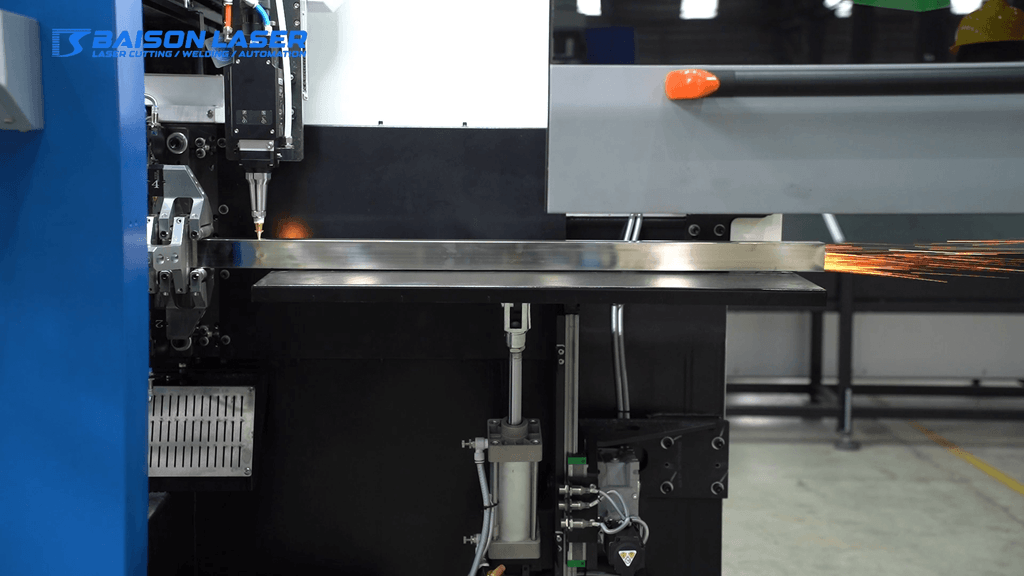
Key Considerations for Stainless Steel Tube Laser Cutting
Nitrogen-Assisted Cutting: Controlling Cut-Edge Oxidation
On visible stainless steel foodservice and kitchen structures, cut-edge appearance and cut-edge oxidation influence downstream post-cut finishing, grinding and deburring, and weld preparation. Nitrogen-assisted cutting helps limit oxidation along the cut zone when edge condition and appearance matter.
Actual results depend on:
- Stainless steel grade and wall thickness
- Nitrogen purity and supply pressure
- Nozzle type and condition
- Laser power, cutting speed, and focus position
- Target edge condition and visual requirements
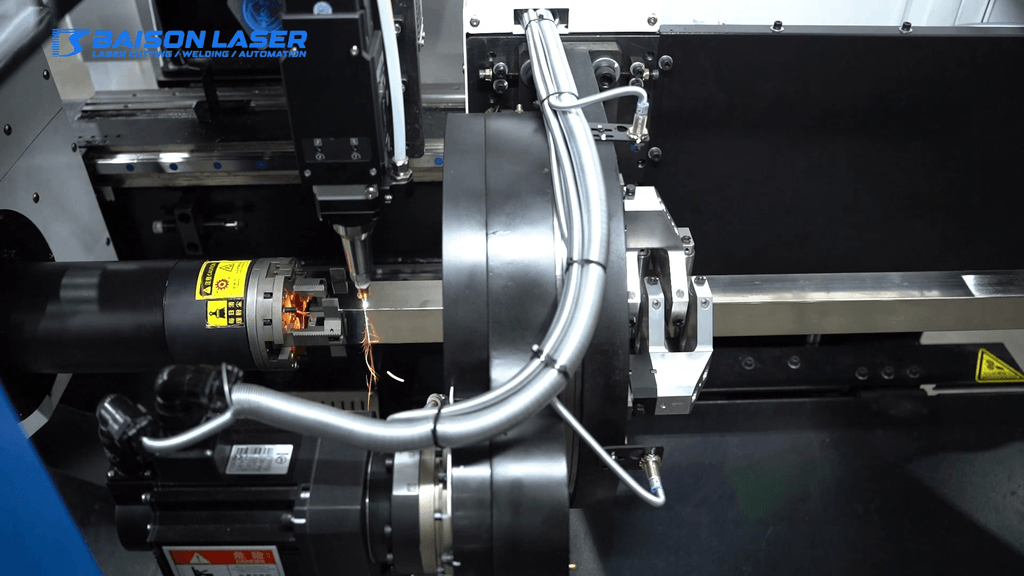
For a deeper breakdown of how optics, motion control, and assist gas settings interact, see our guide on [what determines tube laser cutting quality].
For frames going into TIG (GTAW) welding, cut-edge condition and cut-edge oxidation affect weld preparation and weld fit-up. Nitrogen-assisted cutting does not eliminate oxidation across every alloy or condition and is not a substitute for testing actual parts.
Thin-Wall Stainless Steel Tubing: Balancing Clamping Stability and Surface Protection
Kitchen and food-handling structures often combine light weight, rigidity, and clean finishes. Thin-wall stainless steel tubing, along with a brushed finish or protective-film-covered surface, requires careful handling: mismatched clamping force can cause local distortion or surface marks, while unstable holding can throw off cut position and dimensions.
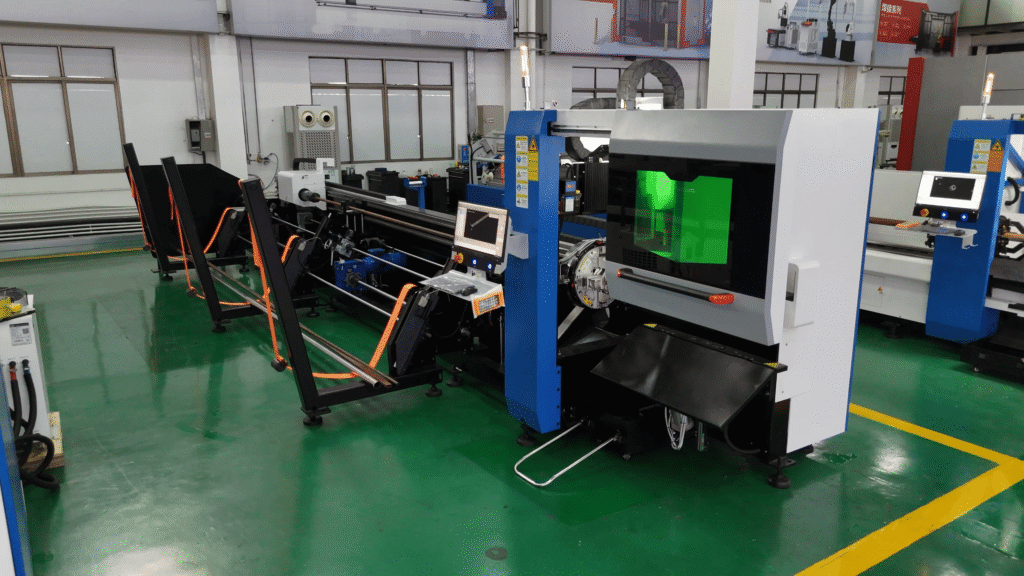
The K12C uses a double-row roller pneumatic chuck with automatic centering and tube deviation correction to support consistent clamping and reduce manual re-centering during multi-part runs. Because thin-wall stainless steel tubing, brushed finish stock, and protective-film-covered surface materials behave differently in production, trials with actual customer stock are recommended before finalizing parameters.
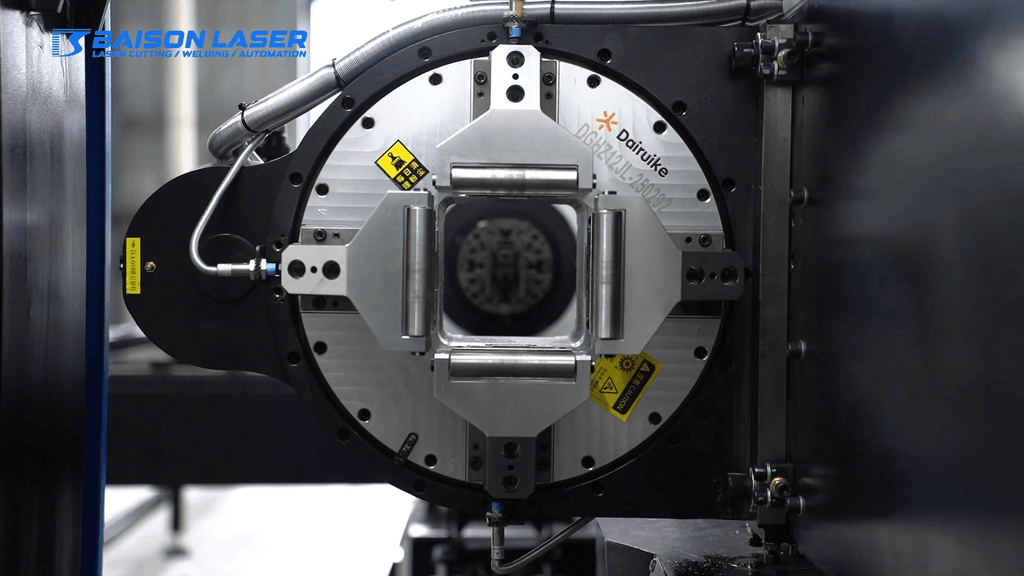
Before selecting equipment for sensitive tubing, confirm:
- Cross-sectional shape and outer diameter or side dimensions
- Wall thickness and alloy grade
- Brushed finish, polished, or protective-film-covered surface condition
- Requirements for clamping marks, edge condition, and dimensional tolerances
Testing actual material samples gives a clearer read on setup and process fit than spec sheets or drawings alone.
Unsure whether your thin-wall brushed or film-coated tubing will show clamping marks? Don’t guess from a spec sheet. Send Baison’s application engineers your toughest tube dimensions and surface finish requirements—we can run a sample cut and send back close-up edge and clamping inspection videos so you can verify surface protection before committing.
Holes, Miter Cuts, and Joint Profiles: Building a Cleaner Fit-Up Base
Frames for commercial kitchens and food processing equipment commonly require:
- Holes for fasteners or hardware mounts
- Shaped ends for bracket and cross-member joints
- Miter cutting or angled cutting for frame corners
- Coping or mating profiles between different sections
Where conventional shops rely on separate drills, saws, jigs, or manual rework, the K12C can cut supported holes and profiles under CNC program control, reducing repositioning and grinding and deburring.
For complex joints, custom slots, or intersecting profiles, sharing STEP or DXF files lets engineering check toolpaths and feasibility ahead of production rather than judging from 2D sketches or feature names alone.
How the K12C Tube Laser Cutter Supports Kitchen Equipment Manufacturing
The K12C is built for metal tube processing across round, square, rectangular, and select structural profiles, supporting materials such as stainless steel and carbon steel.
Double-Row Roller Pneumatic Chuck with Automatic Centering
Equipped with a double-row roller pneumatic chuck, automatic centering, and tube deviation correction, the K12C helps stabilize holding and reduce manual adjustment across varying tube batches. For thin-wall stainless steel tubing, brushed finish, and protective-film-covered surface stock, verify clamping and surface results on sample material.
Multi-Profile and Structural Section Capability
Kitchen and food processing equipment frames rarely rely on a single profile:
- Round tubing appears in supports, rails, and structural links
- Square tubing is common in worktable legs, frames, and racks
- Rectangular tubing supports cross-members and load-bearing spans
- Channels, I-beams, angles, and select profiles fit specialized structures
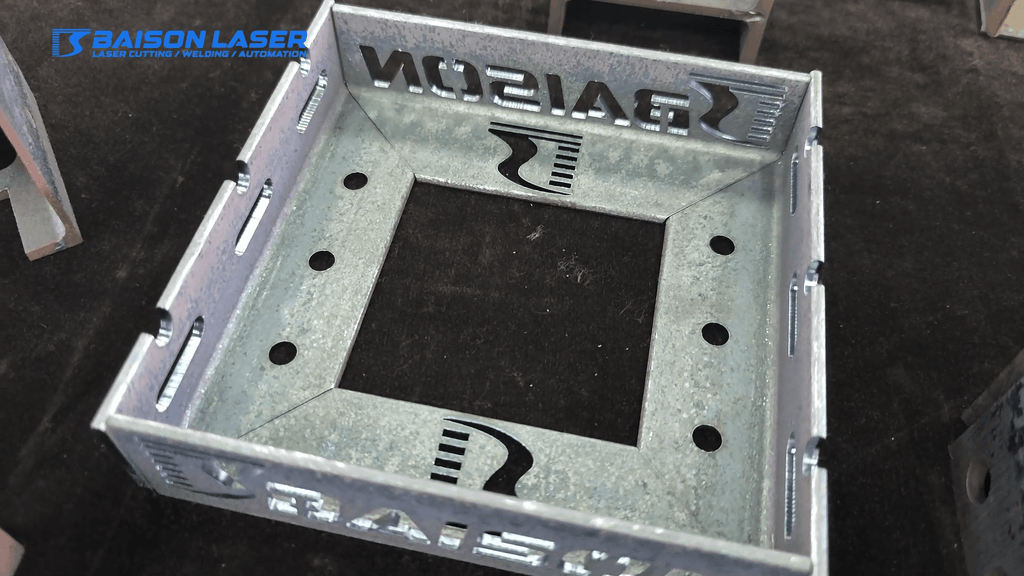
Because the K12C supports multiple tube sections and select structural profiles—subject to size, shape, and process limits—manufacturers can evaluate it against their full product mix rather than a single tube shape.
Semi-Automatic Loading and Automation Options
Loading method shapes operator workload and cycle continuity. The K12C comes standard with semi-automatic loading and offers an optional automatic loading system. Buyers should match the loading setup to tube length, weight, batch size, and shop layout, while accounting for staging space for raw stock, finished parts, and remnant management.
If you are weighing labor savings against upfront capital cost, read our ROI breakdown on [whether a tube laser automatic loader is worth the extra cost]
Tube Nesting and Remnant Management for Stainless Cost Control
For shops running 304 and 316L stainless steel tubing, tube nesting groups parts of varying lengths on raw stock to make better use of available material, while remnant management tracks usable offcuts for follow-on orders.
Stainless steel tube nesting helps reduce avoidable waste, though actual material utilization depends on part dimensions, batch mix, kerf/cut allowances, and nesting rules. Confirm exact nesting and remnant management features on the specific software version and machine configuration quoted.
5 Things to Check Before Choosing a Tube Laser Cutting Machine
When evaluating a tube laser for commercial kitchen and food processing equipment production, look past headline power or peak speed and verify fit with your actual workflow:
1.Tube sizes and material range: List your round, square, rectangular, and structural profiles—including outer dimensions, wall thickness, max length, part weight, and alloys—and verify each item against K12C clamping and cutting limits rather than profile names alone.
2.Thin-wall and surface finish requirements: If you run thin-wall stainless steel tubing, brushed finish, or protective-film-covered surface stock, test real samples and inspect both cut edges and clamping zones for clamping marks, distortion, or finish damage.
3.Cut quality and weld preparation: For assemblies going into TIG (GTAW) welding, check cut position, edge condition, cut-edge oxidation, and weld fit-up on representative joint parts rather than simple straight cuts alone.
If your shop is also reviewing downstream joining efficiency, compare process trade-offs in our guide on [handheld laser welder vs. TIG vs. MIG]
4.Nesting software and remnant management: For mixed sizes, short runs, or multi-SKU batches, verify whether the supplied software covers multi-length tube nesting, remnant management, and job/program handling under the actual configuration.
5.Loading mode and shop-floor flow: Weigh semi-automatic vs. automatic loading against tube length, weight, batch size, and crew allocation, and plan floor space for raw material staging, part unloading, and remnant management.
Beyond application fit, frame machining and assembly standards govern multi-year uptime—see [what determines the long-term reliability of a fiber laser cutting machine]
Frequently Asked Questions
Is the K12C tube laser cutter suitable for stainless steel tubing used in commercial kitchen equipment?
It is a strong candidate to evaluate for these applications. The K12C handles round, square, rectangular, and select structural profiles in materials including stainless steel and carbon steel, and can be assessed against your specific tube dimensions, wall thicknesses, and part drawings for worktables, racks, equipment frames, and food processing equipment supports.
Can the K12C use nitrogen for cutting stainless steel tubes?
Yes. The K12C supports nitrogen-assisted cutting to help control cut-edge oxidation where cut appearance and downstream processing matter. Actual results depend on material grade, thickness, gas purity, pressure, and cutting parameters.
How can surface marks be minimized when cutting thin-wall brushed stainless steel tubing?
The K12C uses a double-row roller pneumatic chuck with automatic centering and tube deviation correction to support consistent clamping and positioning. Roller clamping cannot completely eliminate the risk of clamping marks, so brushed finish or protective-film-covered surface materials should always be tested using your actual incoming stock.
Can a tube laser cutting machine reduce pre-weld grinding on stainless steel tubes?
By consolidating applicable cutting, hole making, and profile features into one workflow, a tube laser can reduce certain secondary machining and manual rework steps. Whether pre-weld grinding or grinding and deburring is still needed depends on edge condition, cut-edge oxidation, weld fit-up, material, process parameters, and your final TIG (GTAW) welding requirements.
Does the K12C support automatic loading and tube nesting?
Semi-automatic loading is standard on the K12C, with an optional automatic loading system available. Tube nesting and remnant management depend on the specific software package and version, so share representative part drawings, tube specs, and batch sizes during evaluation to confirm the exact hardware and software setup.
Streamline Tube Processing from the Cut
For commercial kitchen and food processing equipment manufacturers, tube-processing efficiency depends on more than cutting speed alone—it is shaped by operation count, labor input, weld preparation, material utilization, and changeover speed.
By bringing length cutting, holes, and supported profiles together—paired with nitrogen-assisted cutting, a double-row roller pneumatic chuck, automatic centering, and optional automated loading—the K12C helps tailor production to real shop-floor demands.
Want to see how much pre-weld grinding time and stainless steel scrap the K12C can cut from your current kitchen frame line? Send us your STEP or DXF drawings for a representative assembly along with material grade (304/316L), profile dimensions, wall thickness, and monthly volume. Within 24 hours, Baison’s engineering team will send back:
- A feasibility and cycle-time review benchmarked against separate sawing and drilling;
- A sample tube nesting layout showing realistic material utilization on your part mix;
- A free test-cut sample shipped to your shop so your welders can check edge condition and weld fit-up firsthand. Submit your drawings at www.baisonlaser.com to request your custom tube-cutting evaluation.