TL;DR
For metal fabricators operating with high labor costs and tight compliance rules, a standalone laser tube cutter often hits a major bottleneck: the laser cuts fast, but manual loading slows everything down. Adding an automatic tube loading system for Baison tube lasers (K12, G24, V36 series) requires extra upfront investment of several tens of thousands of USD.
If you’re still evaluating machine capacities, see our comprehensive heavy-duty laser pipe cutter selection guide to align cutting power, diameter range, and total ROI.
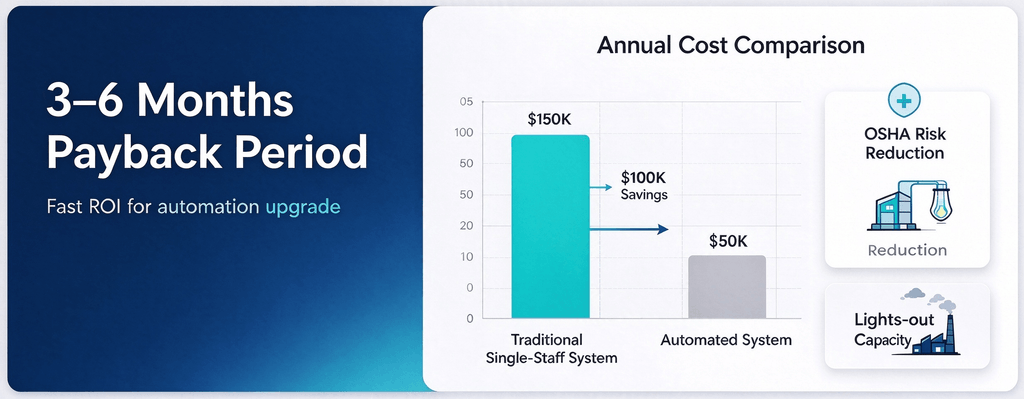
When running consistent high-volume production, this upgrade cuts manual handling labor by 50%+, boosts overall machine OEE by over 40%. Shops with steady order flow typically recoup the loader investment within 3–6 months, from labor savings, incremental lights-out night production, and lower workers’ compensation & insurance premium risks.
The Hidden Profit Killer in Your Pipe Shop: The True Cost of Manual Tube Handling
Even with high-performance fiber tube lasers costing hundreds of thousands of dollars, many fabricators fail to hit their target throughput. The issue rarely lies in laser power or cutting speed. It almost always comes down to tube loading and unloading. Most metal shops still rely on workers, overhead cranes or forklifts to feed raw pipe into the machine. This workflow creates three costly hidden liabilities unique to North American, European and Middle Eastern manufacturers:
- OSHA / HSE exposure & rising workers’ comp premiums: Heavy pipe lifting, pushing and hoisting regularly cause crush injuries and chronic back strains. A single recordable incident can push your insurance rates higher for multiple years, eating into margins long after the accident.
- Overtime limits and locked night-shift capacity: Hourly overtime rates are prohibitively expensive. Manual loading means your tube laser cannot run without an operator present — your night-shift output is capped unless you pay premium overtime wages.
- Long dead time between cuts: The laser finishes a pipe in seconds, but rigging, aligning and feeding the next tube manually takes minutes. Your expensive laser sits idle.
- Labor shortages and high turnover: Skilled pipe handlers command high hourly pay, and reliable staff are increasingly hard to retain.
- Scrap from tube deflection & surface damage: Long heavy pipes sag and swing during manual handling, ruining cut accuracy and scratching finished surfaces.
For these reasons, an automatic tube loader is no longer a luxury add-on. It is a practical upgrade to break throughput limits, reduce compliance risk and improve bottom-line performance.
Run the Numbers: 30-Second ROI Formula to Calculate Your Payback
Many shop owners hesitate once they hear the added price tag for an automatic tube loader. Use this simple formula with your own shop numbers to estimate your payback period:
Monthly Savings = (Number of Operators Eliminated × Total Monthly Labor Cost Per Employee) + Gross Profit From Extra Night Orders − Estimated Annual Workers’ Comp Risk Premium Months to Payback = Total Loader Upgrade Price ÷ Monthly Savings
Real-World Shop Reference Baseline
A tube laser running at full capacity normally needs 2–3 dedicated workers to load, unload, flip and measure pipe. Fully loaded annual compensation including benefits averages $40,000–$60,000 per employee. That puts annual labor spend for loading alone between $80,000 and $150,000.
With a Baison automatic tube loading system: Your tube laser runs continuous batch cycles from bundle feeding, length measurement, servo feeding through finished part unloading. Only one operator is required, to monitor quality, run part changeovers and perform inspections — no constant manual pipe lifting. When your part mix allows, you unlock lights-out unattended runs of an extra 2–4 hours overnight, without overtime pay.
With labor cuts, higher OEE and reduced injury risk, shops with stable production usually recover the loader cost in 3–6 months. Every month after that flows straight to your net profit.
Important note: This formula only delivers rough estimates. Real ROI depends on tube weight, profile mix, floor layout, local insurance rates and shift structure that generic math cannot capture. Submit your production details, and our application engineers will prepare a custom, line-item ROI report tailored exactly to your shop, free of charge.
Baison Automatic Tube Loader: Core Features That Eliminate Loading Bottlenecks
Baison’s in-house engineered automatic tube loading systems deliver streamlined automated workflows built for high-volume structural and mechanical pipe fabricators.
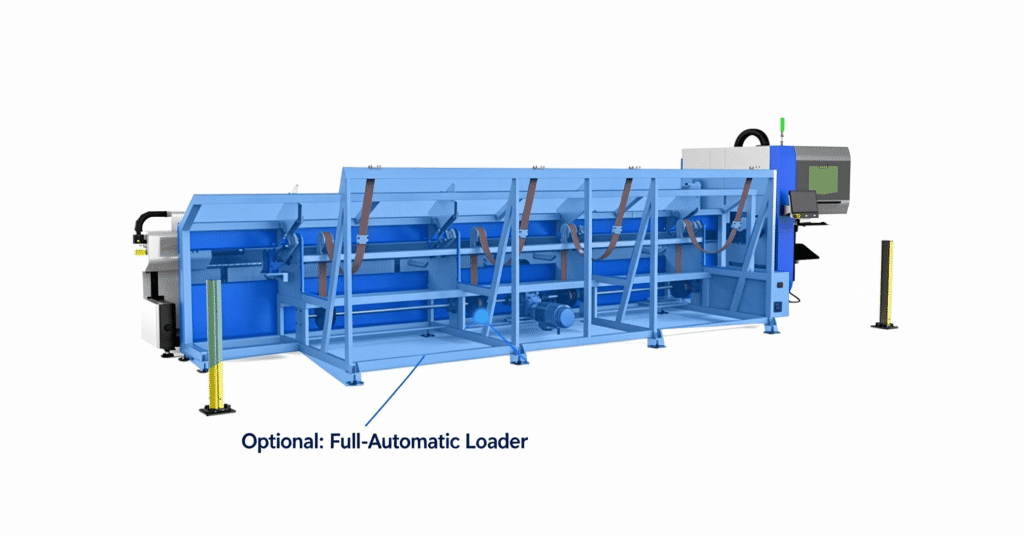
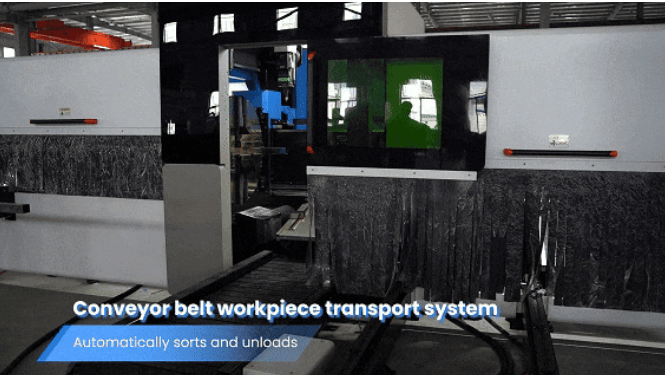
- Auto diameter adjustment for mixed profiles: Handles round tube, square tube and rectangular pipe. Servo-controlled guide plates adjust automatically via PLC program. No tedious manual repositioning when switching part sizes. One-click changeover.
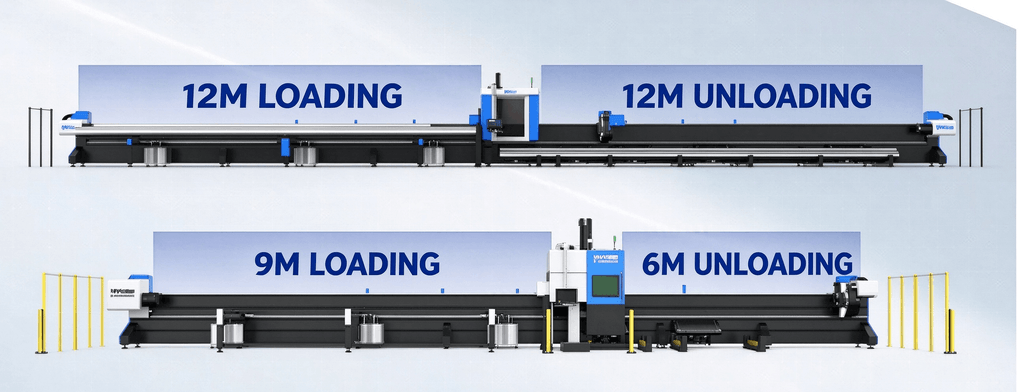
- Modular construction for flexible shop layouts: Built in segments to fit restricted floor plans. Standard configurations support raw stock lengths from 6 m up to 12 m. Popular setups include V24ESS (3-chuck, 6 m load + 6 m unload), V36ETS (3-chuck,12 m load +6 m unload), and four-chuck V36UTT / V52UTT for extra-long heavy profiles.Discover how pairing multi-chuck systems with auto-loading drives the zero-tailing revolution for structural steel to eliminate raw material waste.
- Follower support cradles to stop tube sag: Dynamic follow-up cradles move synchronously with cutting travel. They support long workpieces in real time, preventing deflection, dimension drift and surface scratches. This removes the need for operators to hold pipe near the cutting zone and lowers OSHA recordable incident risk.For heavy structural profiles up to 300kg, learn how the G24 tackles heavy tube sagging and deflection during high-speed cutting.
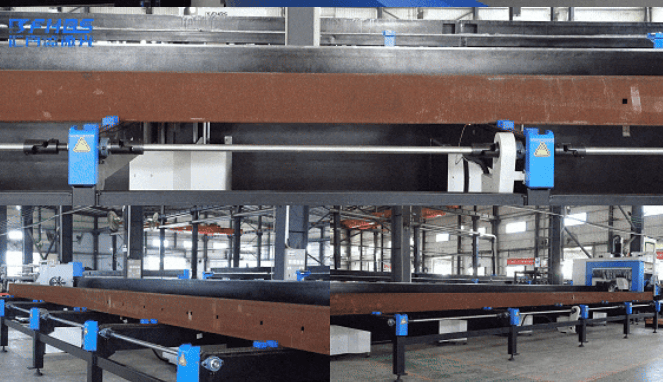
- Integrated length measurement for nonstop runs: Built-in pipe measurement validates stock length automatically before cutting, supporting low-staff or fully unattended lights-out cycles for qualified part programs.
Manual Loading vs Automatic Tube Loader Side-by-Side Comparison
| Comparison Point | Manual Tube Loading | Baison Automatic Tube Loader |
|---|---|---|
| Material Handling Method | Manual lifting, crane / forklift feeding, high physical strain | Bundle auto feed + servo feeding, zero manual heavy lifting |
| Required Operators | 2–3 staff constantly loading and tending the machine | 1 operator for monitoring, QA and program changeovers; compatible with low-staff night runs |
| Machine OEE | Long dead time between cuts, limited utilization | Continuous automated cycles; 40%+ higher throughput under steady production |
| Cut Quality & Scrap Risk | Sagging and swinging pipe causes tolerance drift and surface scratches | Real-time follower cradles stabilize pipe, reduce scrap and preserve finish quality |
| Safety & Compliance Exposure | High-risk task; lifts increase chance of costly OSHA reportable injuries and premium hikes | Eliminates heavy manual handling; lowers HSE risk and stabilizes insurance rates |
| ROI Profile | Fixed labor overhead; night expansion blocked by overtime cost | Higher upfront add-on cost; typical payback 3–6 months for shops with consistent order flow |
4 Critical Factors to Review Before Specifying a Tube Laser Loader
When you request a quote for a Baison K12, G24 or V36 tube laser and plan to add automatic loading, evaluate these four items carefully to avoid mismatched equipment(Running primarily light metal profiles or furniture tubing? Check out how the compact Baison K12 tube laser cutter maximizes fast ROI for smaller diameters.):
- Profile and weight capacity: Confirm the loader’s maximum bundle weight and compatible diameter range match your most commonly run pipe, square tube and special profiles.
- Stock length configuration: Match loader segments to your raw material lengths (6 m,9 m,12 m). Common combinations are 6+6 m or 12+12 m load/unload layouts.
- Follower cradle response speed: Fast synchronized movement is mandatory for high-speed cutting. Slow cradles cannot keep up and defeat the purpose of automation for long tube work.
- Native machine integration: The best loaders communicate natively with your tube laser CNC through a unified PLC. This closed-loop workflow is required for reliable lights-out operation.Many generic third-party loaders only offer basic feeding and cannot sync with the laser’s cutting cycle. Share your part list and production goals with our application engineer to avoid integration headaches.
Many generic third-party loaders only offer basic feeding and cannot sync with the laser’s cutting cycle. Choosing the wrong loader will waste your budget and block lights-out capability. Send over your tube drawing list and production goals, and our team will validate whether this automation fits your mix before you commit to a purchase.
Frequently Asked Questions
Q1: Is an automatic loader for a tube laser worth buying?
It delivers strong ROI for fabricators with steady pipe orders, high local labor rates, or goals to reduce OSHA incidents and add unattended night production. If your shop runs small, inconsistent batches with constant part changeovers, the business case may not be as clear. Share your production schedule and part mix, and our application team will run a custom feasibility assessment so you know exactly whether this investment makes sense for you.nd your production schedule to our team, and we can run a custom evaluation for your operation.
Q2: Can an automatic tube loader run lights-out overnight with no operator?
Baison integrated systems support unattended cycles with remote monitoring and safety interlocks. Lights-out works best with standardized pipe and fixed batch programs. High-mix, frequent changeover jobs still require an on-site operator.
Q3: Can I retrofit this automatic loader onto my older third-party tube laser?
We recommend pairing the loader with a new Baison K12 / G24 / V36 laser tube cutter for full native sync and reliable closed-loop automation. Retrofits require full electrical and CNC assessment, and many legacy machines cannot support complete cycle integration.
Q4: What tube lengths and weights does the Baison automatic loader handle?
Modular systems cover stock lengths of 6 m to 12 m. Maximum weight and diameter limits tie directly to your selected tube laser model (K12, G24, V36). We cannot confirm the correct loader configuration without your actual pipe specs. Submit your part list for a free capacity check.
Q5: How much maintenance does an automatic tube loading system require?
Service focuses on servo rails, drive chains and position sensors. Maintenance frequency is lower than the laser cutting head and resonator. We supply a complete service checklist and remote technical guidance.
Final Thoughts: Automation Is How Pipe Shops Compete Globally
Manufacturers relying purely on manual heavy handling will struggle against competitors running low-labor automated lines. Adding a matched automatic loader when purchasing your tube laser is not just an equipment upgrade — it transforms your shop from labor-heavy operation into a lean, scalable digital workflow.
Ready to map your automation package?
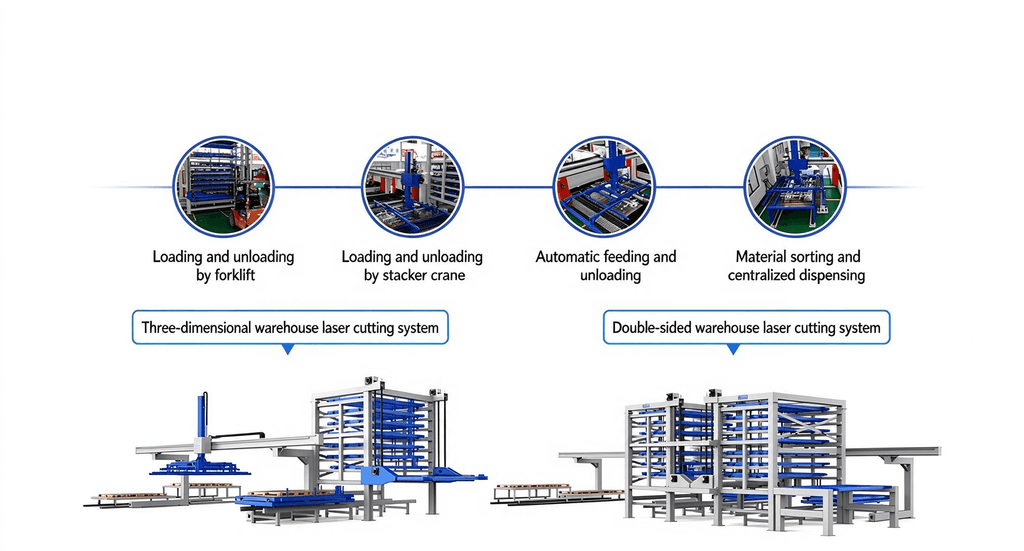
If you are budgeting for new tube laser equipment this quarter, mention the automatic tube loader + custom ROI analysis when submitting your inquiry for Baison K12C, G24C or V36UTT tube lasers. Our application specialists will map your floor layout, shift pattern and part mix to build the most profitable automation package for your metal fabrication shop.