Key Takeaways
- Beyond Cut Speed: For modern HVAC fabricators, true throughput bottlenecks rarely stem from laser cutting speeds. They hide in material handling, sheet transfer, scrap management, and repetitive manual loading.
- The Sheet-Fed Friction: Traditional sheet-fed laser workflows require pre-shearing coils into blank sheets before forklift transfer. As order volumes scale, this staging and reloading severely chokes shop floor flow.
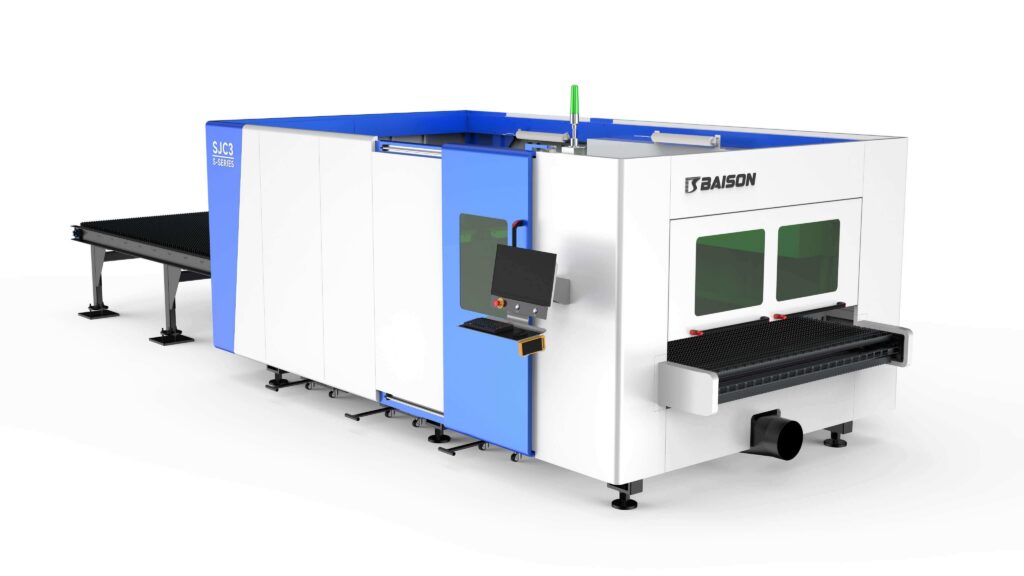
- Integrated Coil Automation: The Baison Laser SJC3 integrates coil loading, automatic decoiling, precision leveling, servo feeding, fiber laser cutting, and parts unloading into a single, continuous line engineered for HVAC sheet metal fabrication.
- Core Operational Wins: Streamlined coil processing, maximum nesting yield on scrap margins, uninterrupted mass production, and instant DXF nest adaptation for high-mix duct fittings.
The Real Bottleneck in HVAC Duct Fabrication (Hint: It’s Not Cutting Speed)
On the floor of a busy HVAC duct fabrication shop, speed isn’t limited by how fast your fiber laser head moves across a sheet.
It’s choked by what happens around the machine: raw coils getting leveled and blanked off-site, forklifts shuttled back and forth, skeletal scrap manually cleared, and operators spending half their shift loading individual sheets onto exchange tables.
As shop order volumes scale up, these auxiliary material handling steps quickly snowball into expensive downtime.
Standard sheet-fed laser setups force duct shops into three operational compromises:
1.1 Non-Stop Material Shuttling Eats Up Machine Uptime
Shearing raw coils into standard sheet sizes before feeding them to the laser introduces unnecessary touchpoints. Staging material, forklift transport, and pallet loading create constant micro-delays that starve your fiber laser of cut time.
1.2 Rigid Blank Sizes Destroy Nesting Yield
HVAC production involves a complex mix of rectangular duct sections, transitions, elbows, offsets, and custom branch fittings. Cutting varied geometries out of static sheet sizes (4×8 ft or 5×10 ft) leaves substantial drop-off scrap at the sheet end. Over tons of galvanized steel, those lost margins directly drain shop profitability.
1.3 Uncorrected Coil Set Ruins Downstream Seaming
Galvanized steel, carbon steel, and thin-gauge stainless steel suffer from coil set and cross-bowing straight off the roll. If your stock isn’t flattener-processed with extreme precision, material instability causes nozzle tip-ups during cutting—and creates binding issues downstream during Pittsburgh lock forming, snap-lock seaming, and TDF/TDA flange profile folding.
Optimizing duct manufacturing throughput requires looking past raw kilowatt laser power. True efficiency comes from transforming raw coil processing directly into nested, ready-to-fold parts.
From Discrete Blanks to Coil-Fed Automation: Streamlining the Shop Floor
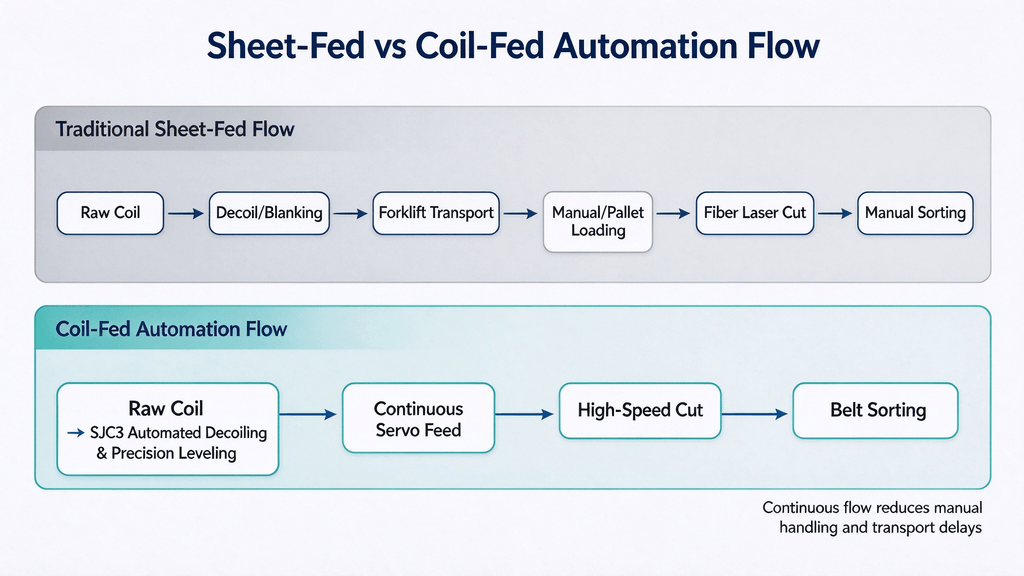
Traditional sheet processing relies on a disconnected chain: decoil → blank → move → load → cut.
Coil-fed laser processing completely collapses this sequence. Raw metal enters as a bulk coil and exits as precision-cut duct components in one continuous automated flow:
Hydraulic Coil Loading → Auto-DeCoiling → Precision Leveling → Servo Feeding → Fiber Laser Cutting → Automated Belt Unloading
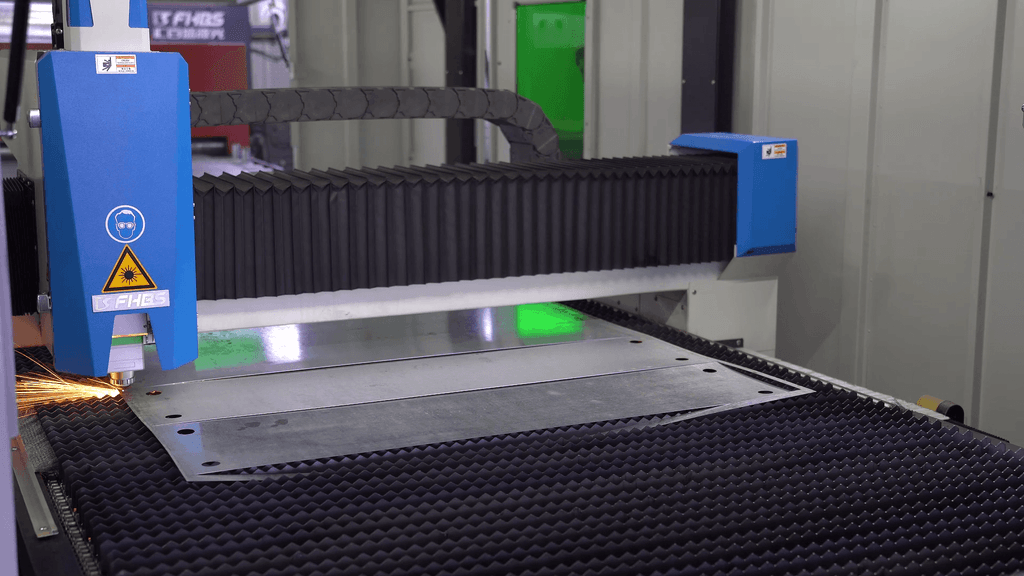
By consolidating material handling and fiber laser cutting into a synchronized unit, coil-fed automation eliminates pre-shearing, minimizes forklift moves, and opens the door to continuous nesting across infinite material lengths.
The Baison Laser SJC3 line was engineered specifically around this continuous-feed architecture to maximize throughput for high-volume HVAC contractors and industrial fabricators.Looking to optimize your entire shop floor beyond raw cutting? Discover how an integrated cut-bend-weld production line cuts metal fabricator lead times by 40%.
Inside the Baison Laser SJC3: Hardware Integration Built for Duty Cycle
The SJC3 is not just a standard laser cutter with a uncoiler tacked onto the front. It is an end-to-end coil-fed fiber laser production line engineered for continuous duty cycles.
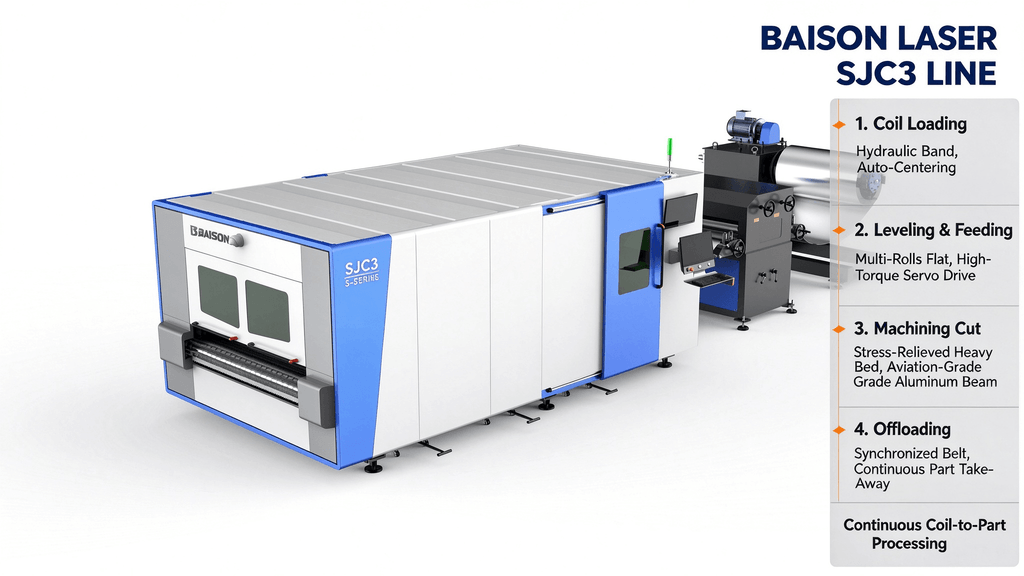
3.1 Hydraulic Loading & Auto-Decoiling: Zero Heavy-Lifting Friction
Handling 5-to-15-ton master steel coils demands safe, efficient floor mechanics. The SJC3 comes equipped with a heavy-duty hydraulic coil car and an expanding hydraulic mandrel setup. The system automatically centers, clamps, and feeds master coils into the line under tension-controlled unwinding, drastically paring down roll-changeover times and safeguarding shop operators.
3.2 Precision Multi-Roll Leveling & Servo Drive: Flattening for Flawless Downstream Locks
Residual coil stress is the enemy of tight HVAC seams. The integrated precision flattener utilizes a multi-roll leveling array to eliminate coil set and edge wave across galvanized steel, stainless steel, and aluminum coil stock. High-torque servo drives synchronize feeding directly with machine motion control, delivering sub-millimeter positional repeatability to keep feeding seamless during rapid cutting cycles.
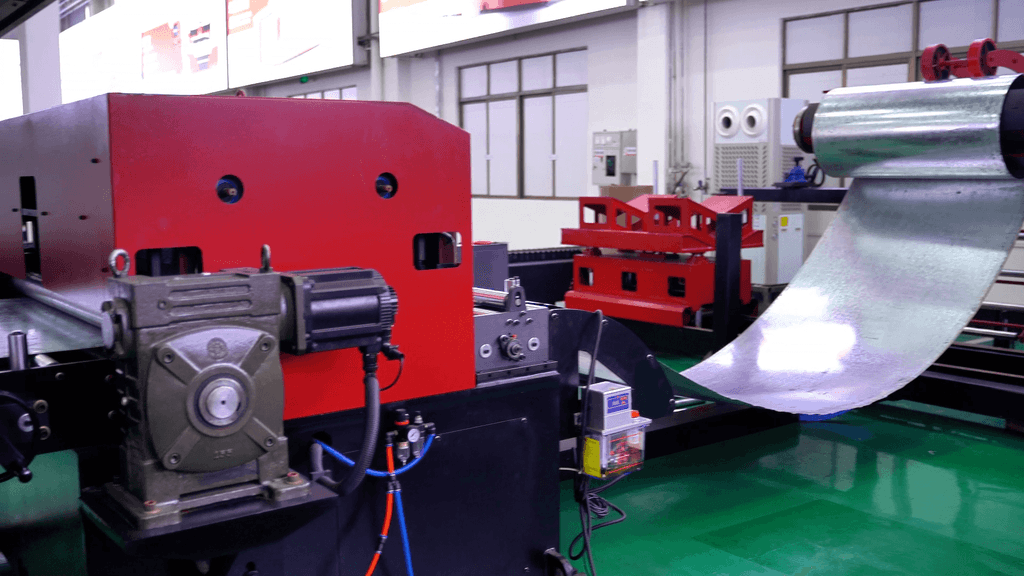
3.3 Heavy-Duty Mesh-Belt Laser Cutting Bed
The SJC3 features an ultra-rigid, stress-relieved welded machine bed coupled with a heat-treated, aviation-grade extruded aluminum gantry for high dynamic response.
Instead of traditional slat tables, material moves across a specialized rolling mesh-belt system. The intelligent laser head incorporates active collision protection, capacitive height sensing, and optics monitoring to prevent nozzle crashes and ensure consistent beam focus across the entire web length.
3.4 Smart Nesting & Automated Belt Unloading
Powered by smart CNC controls, the system natively processes complex DXF/DWG duct geometry libraries. Advanced features like FlyCut (fly-cutting array logic) and continuous motion path optimization eliminate unnecessary Z-axis head lifts. Once cut, integrated support structures and conveyor belt unloading mechanisms continuously move finished duct parts out of the cutting zone without interrupting the feed.
Interested in seeing how your current duct layout DXF files perform on a continuous coil setup?
The optimal line configuration always depends on your dominant sheet gauges, coil widths, and daily square-footage targets. Send your typical duct DXF profiles to the Baison Laser engineering team for a full nesting yield audit and cut-time simulation.
How the SJC3 Transforms HVAC Manufacturing Economics
| Operational Metric | Traditional Sheet-Fed Laser | Baison Laser SJC3 Coil-Fed Line |
| Raw Material Handling | Forklift move for every batch | One-time coil loading per master roll |
| Material Yield (Scrap) | Higher scrap from fixed sheet ends | Maximized nesting along continuous web |
| Labor Dependency | Constant manual loading & staging | Single-operator line monitoring |
| Secondary Processing | Risk of manual coil-set issues | Precision leveled for instant folding |
4.1 Uninterrupted Material Flow & Zero Inter-Process Staging
By unifying decoiling, flattening, feeding, and cutting into a single linear workflow, the SJC3 eliminates intermediate storage buffer zones. Coils go directly from raw inventory to cut duct fittings in minutes.
4.2 Edge-to-Edge Continuous Nesting for Scrap Reduction
Fixed sheets inevitably generate end-of-sheet waste—especially when nesting irregular fittings like transitions or radius elbows. Continuous coil feeding breaks free from static $8\text{ ft}$ or $10\text{ ft}$ boundaries, allowing parts to nest seamlessly end-to-end along the roll. Over high coil volumes, this margin lift yields massive annual raw material savings.
4.3 Reduced Shop-Floor Labor Dependency
Automating the heavy lifting allows one technician to manage line monitoring, stock replenishment, and part sorting. Your skilled labor can stay focused on downstream value-adds like assembly, Pittsburgh lock seaming, or duct flange installation.
For a deeper look into streamlining your post-cutting operations, check out our complete guide on smart HVAC sheet metal fabrication from laser cutting to seamless bending solutions.
Direct Comparison: Choosing the Right Sheet Metal Workflow
Selecting the right laser processing setup comes down to your current shop layout, order volume, and material buying model.If you’re weighing the total cost of ownership across different machinery layouts, refer to our comprehensive 2026 selection and ROI guide for sheet vs. coil laser cutting systems.
| Selection Criteria | Traditional Standalone Sheet-Fed Laser | Split Decoiler/Blanker + Sheet Laser | Baison Laser SJC3 Coil-Fed Line |
| Material Input | Pre-cut flat sheets | Master coil cut into blanks off-line | Master coil stock fed continuously |
| Process Chain | Load → Cut → Unload | Uncoil → Blank → Move → Load → Cut | Integrated Uncoil → Level → Feed → Cut → Unload |
| Forklift & Staging | Frequent sheet transfers required | Heavy intermediate pallet transport | Minimal; only during master coil loading |
| Nesting Boundaries | Restricted to standard sheet sizes | Restricted to sheared blank sizes | Unrestricted along the continuous web length |
| Best Suited For | Job shops with low-volume, high-mix custom sheet work | Shops with existing cut-to-length lines | HVAC fabricators scaling high-volume duct & fitting output |
Real-World Duct Applications: From Standard Runs to Custom Fittings
An HVAC shop’s daily run typically features straight duct sections, reducers, square-to-round transitions, radius elbows, and offset boots.
With the SJC3 coil-fed system, shop managers can stream diverse DXF fitting files into centralized nesting queues. The line handles standard galvanized coil runs as easily as thin-gauge stainless or aluminum ducting, delivering clean cut edges that move instantly to lockformers and press brakes without secondary deburring.
Strategic Buyer’s Checklist for Coil-Fed Laser Lines
Investing in a coil-fed fiber laser production line requires assessing complete system engineering rather than just laser source wattage. Evaluate these core hardware systems before purchasing:
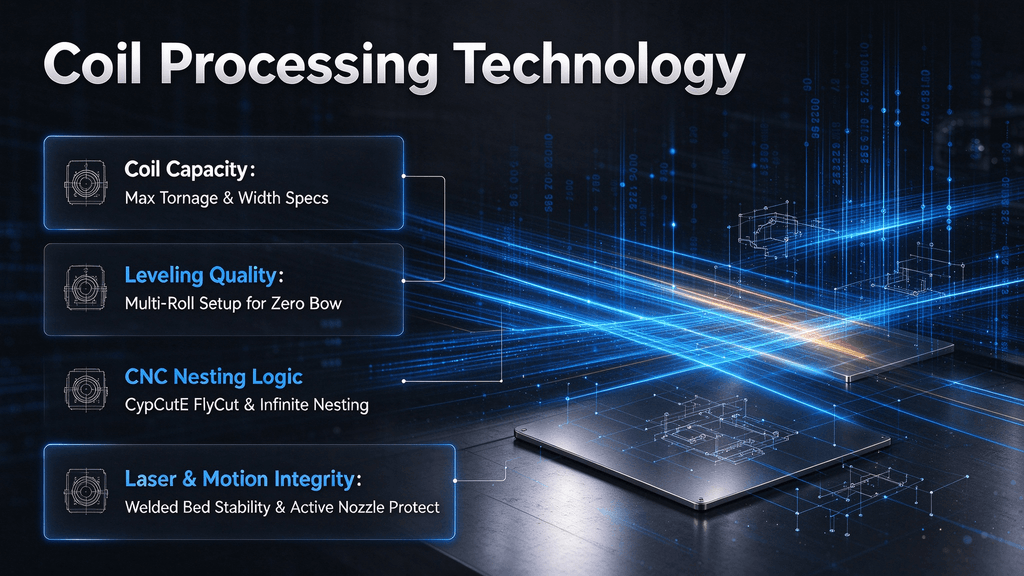
- Precision Leveling Mechanism: Verify roller quantity, roll diameter, and adjustment rigidity to ensure your primary gauges (galvanized steel, stainless, or aluminum) emerge flat and stress-free for smooth seam forming.
- Coil Car & Mandrel Capacity: Ensure the hydraulic uncoiler supports your coil weight, inner diameter (ID), outer diameter (OD), and maximum strip width targets.
- CNC Software & Flying Cut Support: Make sure the controller (e.g., CypCutE) natively handles DXF profile imports, auto-nesting on continuous webs, line-speed synchronization, and FlyCut routines to eliminate unnecessary head travel.
- Plant Layout & Infrastructure Planning: Plan out floor footprint requirements, raw coil staging lanes, scrap removal paths, electrical/gas drops, and downstream part sorting buffer zones.
Frequently Asked Questions (FAQ)
Q1: What material types and gauge ranges can the Baison SJC3 process?
The SJC3 is optimized for thin-to-medium gauge metal coils, including galvanized steel, cold-rolled carbon steel, stainless steel, and aluminum. Exact maximum cutting thicknesses depend on your selected fiber laser power configuration and coil handling specs.
Q2: How does the integrated leveling unit handle coil set and edge wave?
The SJC3 features a precision multi-roll flattener unit that subjects the uncoiling sheet to controlled reverse bending. This neutralizes residual coil set and cross-bowing, delivering a flat sheet into the cutting area to protect the laser optics and guarantee perfect lockform seaming downstream.
Q3: Can the SJC3 system handle high-mix HVAC fitting orders efficiently?
Yes. Powered by the CypCutE CNC system, operators can load diverse DXF geometry files into a single production queue. The nesting algorithm packs varied fitting shapes continuously along the coil strip to maximize material yield and minimize scrap.
Q4: What post-purchase support and installation services does Baison Laser provide for overseas buyers?
Baison Laser offers complete lifecycle support for international buyers, including pre-installation floor plan layout planning, on-site mechanical installation, CNC operational training, parameter optimization, and long-term technical support.
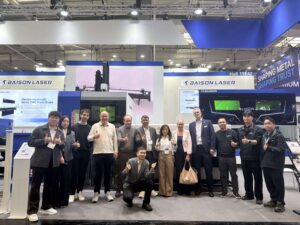
You can also meet our engineering team live and see our hardware in action at global industrial expos—read about our latest showcase on solving shop footprint and OSHA compliance at FABTECH 2026.
Ready to Streamline Your HVAC Duct Production?
Elevating your HVAC shop’s output requires more than faster cutting speeds—it takes an integrated workflow that turns bulk coil stock into precision-cut duct parts without material handling friction.
The Baison Laser SJC3 brings automated coil loading, precision leveling, servo feeding, high-speed fiber laser cutting, and conveyor unloading into a single continuous production line.
Want to see what coil-fed automation could save on your bottom line? Contact the Baison Laser application team today with your typical duct fitting DXF drawings and monthly coil usage. We will run a customized nesting yield report and cut-time analysis tailored directly to your plant.