Within the competitive landscape of the international metal processing trade, many factory managers are trapped by a deadly misconception: they view laser cutting machines as simple tools, believing that low prices and meeting standard parameters are sufficient to ensure profitability.
Yet, having served hundreds of overseas factories at Baison, we have witnessed far too many instances of total collapse driven solely by the blind pursuit of low-cost equipment. This is not merely an equipment issue; it is a silent battle involving operational efficiency and long-term ROI.
When your production line is forced into downtime and rework due to precision drift, or when unstable airflow leads to material waste, your so-called “procurement cost advantage” evaporates, swallowed by hidden operational losses.
It is time for a frank discussion on why the vast majority of laser machines on the market become stumbling blocks to factory efficiency within just two years, and why truly savvy manufacturing giants focus on system-level industrial solutions rather than just single mechanical parameters.
The “Profit Killer” on Every Metal Processing Line
After analyzing past customer cases and market feedback, we found that almost all operational dilemmas point to the same few core pain points. These pain points do not exist in isolation; like a slow poison, they eat away at the factory’s cash flow bit by bit.
- The “Terror Vacuum” of Precision and Repeatability: Many low-end machine tools achieve ideal precision during factory testing, but under high-intensity, double-shift operations, due to insufficient release of welding internal stress in the bed and rail deformation, their precision collapses rapidly within just half a year, leading to a sharp surge in labor costs for subsequent welding and assembly.
- The Hidden Financial Black Hole of “Airflow Control”: Cheap models on the market often adopt crude gas control systems, resulting in nitrogen consumption 30% to 40% higher than expected when processing carbon steel or stainless steel. For a long-term operating factory, this extra consumable expenditure over three years is enough to buy a new high-performance machine.
- Lack of After-Sales Service and “Silent Downtime”: What overseas clients hate most is when equipment breaks down and suppliers are slow to respond or completely unable to provide remote diagnosis solutions. During peak production seasons, any two-hour unplanned downtime loses not just orders, but the customer’s trust in your factory.
We do not just provide laser equipment; our core business is to help you identify and sever these pain points. Baison’s methodology is to reconstruct the dynamic rigid structure of the equipment, ensuring that the machine bed will not undergo micron-level deformation during long-term high-temperature operation, thereby completely locking this “precision drift” within a controllable range. We do not promise the cheapest price, but we promise to lower your rework rate to an industry-low level—this is our commercial value.
From Purchase Price to Total Cost of Ownership (TCO)
When expanding capacity, many start-up or transitioning factories are often lured by competitors offering a “low purchase cost,” but this is a classic business trap. The price of the equipment is merely the tip of the iceberg of your total investment.
Real profit margins are hidden within the Total Cost of Ownership (TCO). Low-end laser equipment is cheap because it compromises on critical components—thinner bed steel plates, cheaper lens protection, and control systems lacking closed-loop optimization.
These configurations may seem indistinguishable in the short term, but under two consecutive years of high-frequency operation, they transform into massive hidden costs: frequent component replacements, increased downstream labor to compensate for precision errors, and order default penalties incurred due to equipment instability.
Beyond explicit maintenance costs, there is another frequently overlooked element: talent retention. At a time when skilled technicians are extremely scarce, a machine prone to frequent breakdowns and constant overtime rework will rapidly erode technical staff’s professional sense of achievement.
When top employees grow frustrated from battling a sub-par machine every day and choose to leave, the factory faces more than just repair bills—it suffers a devastating loss of invaluable human resources. A professional manager understands that equipment stability is the strategic cornerstone for binding core technical teams and securing production pacing.
Truly mature manufacturing giants calculate the production downtime and potential consumable cost overruns caused by equipment failures over a three-year horizon before placing an order. The initial procurement premium of Baison’s industrial-grade solution acts, in essence, as “operational insurance.”
Through superior sealing designs and advanced airflow algorithms, we significantly extend the replacement cycle for lenses and nozzles. Note: For high-difficulty materials and non-standard cutting requirements, standard parameters often fail to achieve optimal output. Please [contact us] to acquire your exclusive custom process optimization solution.
Case Study: From Profit Quagmire to Efficiency Growth
Let’s talk about a sheet metal fabrication partner in Europe. Before finding Baison, their workshop manager had tried a batch of “cost-effective” equipment sourced from the Southeast Asian market. For the first month or two, the machine performed adequately, but when handling a batch of high-specification oil pipeline support projects, problems completely erupted.
Due to severe burrs on the cutting edges, they were forced to hire four workers for round-the-clock grinding operations, with grinding costs directly accounting for 50% of the project’s total profit. To make matters worse, due to the machine’s extremely low perforation efficiency, delivery schedules were delayed, forcing them to pay heavy liquidated damages.
This is a classic “bad asset” trap. At the time, they did not need more workers; rather, they needed an industrial solution capable of handling high-spec materials with exceptional airflow stability.
After switching to Baison’s system, through deeply matched process parameters, we increased perforation speed by 40%. Moreover, thanks to the significant improvement in cutting-edge finish, those four grinders were completely liberated from the assembly line and redeployed to higher-value assembly stations. This was not merely an equipment upgrade, but a qualitative transformation of the factory’s entire profit model.
In this case, the factory owner’s gains came not only from enhanced equipment efficiency, but from regaining the trust of downstream clients. In the metal processing industry, factories capable of on-time delivery and consistent quality possess a far superior bargaining power than suppliers constantly bogged down by rework.
Rejecting the “Parameter Trap”: Baison’s Difference
In the current laser cutting market, there is an abundance of comparative tests and flashy data metrics. We have compiled a core comparison between Baison and standard market models, hoping you will examine these differences from an operational perspective.
| Core Operational Dimension | Baison Industrial Solution | Standard Market Model |
| Bed Stability | High rigidity, no deformation after years of high-load operation | Meets standards short-term, prone to long-term deformation |
| Production Pacing | Highly continuous, trouble-free planned output | Frequent downtime, uncontrollable pacing |
| Material Utilization | Deep nesting optimization, 15% waste reduction | Extensive processing, high scrap cost |
| Energy & Gas Management | Intelligent closed-loop, excellent nitrogen loss control & lower consumable costs | Crude gas circuits, high hidden costs |
| Digital Diagnostics & O&M | Cloud remote diagnostics, real-time early warning & spare parts warehousing | Dependent on manual labor, lack of digital support |
| Technical Talent Maintenance | Friendly and easy to use, retains high-value craftsmen | Complex operation, prone to brain drain |
| Total Cost of Ownership (TCO) | Lowest 3-year total cost of ownership | Low initial price, many later maintenance traps |
As seen from the above comparison, choosing Baison means you are not merely purchasing a machine, but mitigating uncontrollable downtime risks and hidden costs in future production. Competitors in the market often gain a superficial price advantage by squeezing the costs of core components. However, for factory managers, this “cheapness” reveals its true colors in maintenance and rework after the first year. Your investment focus should shift from “reducing procurement costs” to “enhancing operational profitability.”
Why Choose the Baison EC4 Series as Your Industrial Core?
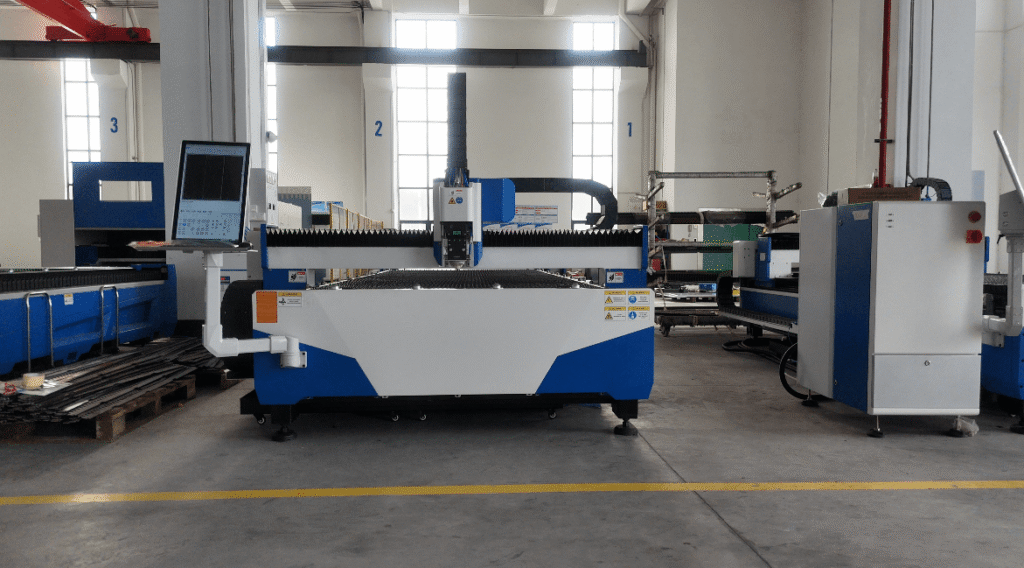
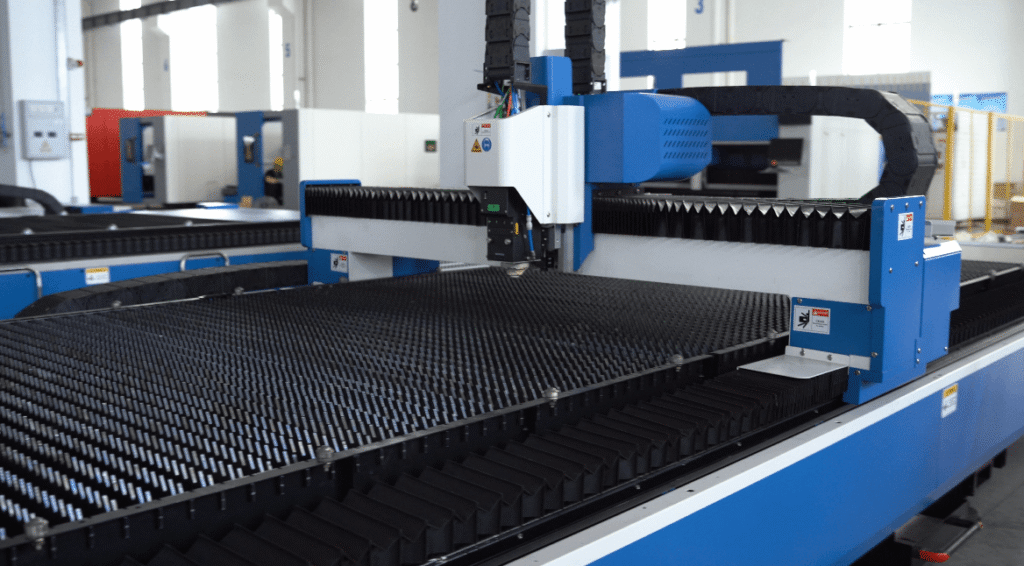
Among numerous industrial-grade laser solutions, EC4’s core value lies in maximizing ultra-high dynamic rigidity and intelligent energy consumption management. It is not merely a cutting machine, but your production line’s profit engine. Equipped with an aviation-grade high-strength bed, EC4 completely eliminates precision drift under long-term high loads. Combined with closed-loop airflow algorithms, it compresses consumable costs for medium-to-thick plate processing down to industry limits. Choosing EC4 means locking in stable production pacing, extremely low failure rates, and a long-term Return on Investment (ROI) with competitive advantages in the global supply chain.
FAQs
Q: What manufacturing industries is Baison suitable for?
Furniture manufacturing, heavy machinery, aerospace, automotive components, high-precision sheet metal processing, and other industries with extremely high stability requirements. Furthermore, Baison’s industrial-grade laser solutions cover virtually all service scopes and application scenarios involving metal processing. No matter which sub-industry of metal manufacturing you operate in, we can provide you with precise, efficient process support and tangible assistance.
Q: Does Baison support equipment customization?
Yes. Based on your workpiece specifications and production line workflows, we provide customized automation solutions and system layouts.
Q: What are the common mistakes when choosing a laser machine?
Over-focusing on the first-year purchase price while severely underestimating later maintenance, consumable consumption, and the risk of order default caused by downtime.
Q: How are special metal materials handled?
For high-strength and special alloy steels, standard parameters may not achieve optimal output. Please [contact us] to acquire your exclusive custom process optimization solution.
Q: How is after-sales responsiveness guaranteed?
We employ a cloud-based digital remote diagnosis system combined with global critical spare parts overseas warehouses, ensuring second-level response and rapid fault recovery.
Conclusion
Competition in the metal processing industry has never been as brutal as it is today. This is no longer simply a race to see who has the lowest price, but a competition over who can complete order delivery with higher efficiency and more stable output. Equipment capable of continuously creating profit has far more commercial value than a tempting yet constantly malfunctioning machine.
We deeply understand that you are choosing not just a laser cutting machine, but casting a vote of confidence for your factory’s operations over the next three years. If you are ready to say goodbye to inefficient production modes and seek a partnership that can bring substantive improvements to enterprise profits, now is the best time.
Contact the Baison team, let’s review your production pain points together and see how much profit space that rightfully belongs to you we can unlock.