In the ever-evolving world of manufacturing and metalworking, tube laser cutting has emerged as a revolutionary technology, offering unparalleled precision and efficiency. Whether you’re a seasoned professional or a newcomer, understanding the intricacies of tube laser cutting is essential for optimizing production processes and growing your business.
In this guide, we’ll explore the fundamentals of laser cutting, its benefits, and its contribution to modern manufacturing industries.
What is Laser Tube Cutting?
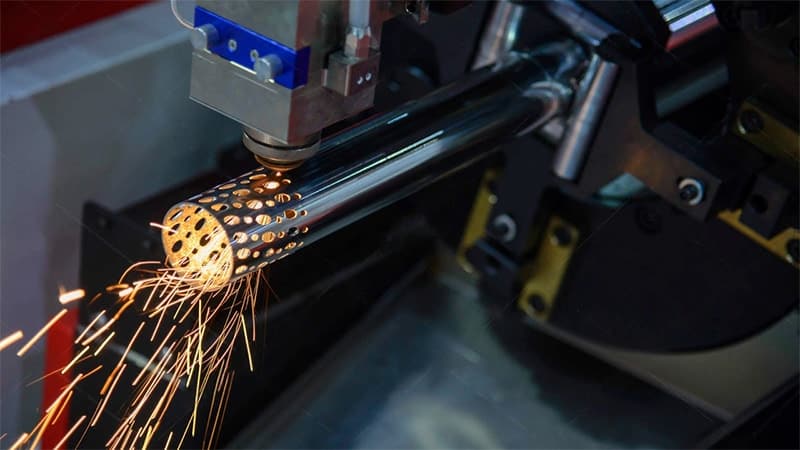
Laser tube cutting is a tube and pipe processing technique that uses a high-power laser beam to cut materials accurately. A computer numerically controlled (CNC) system precisely moves the laser head across the material surface.
Although tube laser cutting is primarily used for metal tube processing, it can also be deployed for plastic cutting applications.
How Does Tube Laser Cutting Work?
Tube laser cutting machines follow the same basic operating procedures as other CNC laser cutters.
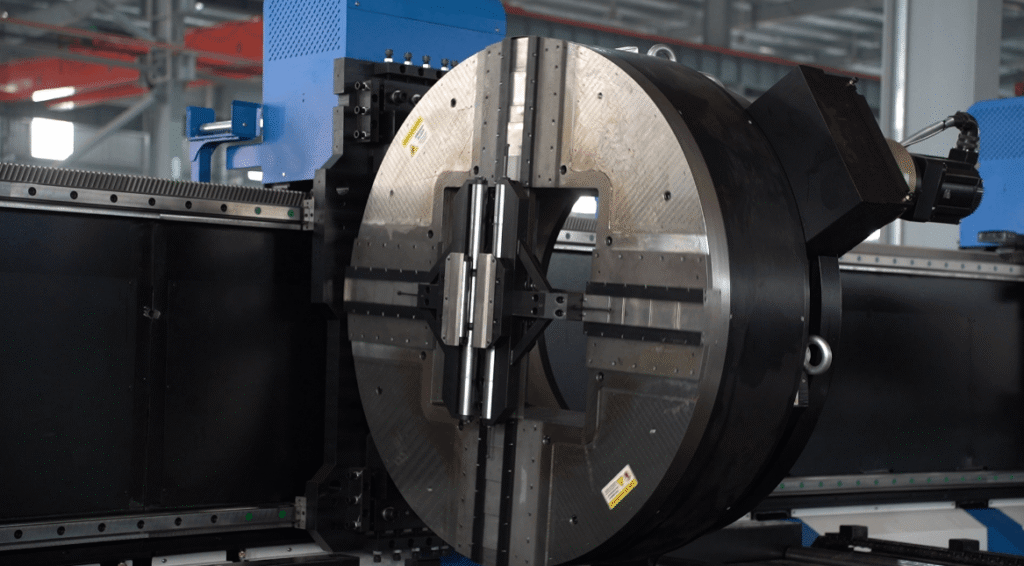
The tube is positioned perpendicular to the laser head, with the cutting end clamped down in a rotating chuck.
A chuck is a rotating clamp that holds the tube end in place and rotates it as needed. Rotating the tube is much easier than having the laser head move in a circular path around the tube.
Next, the laser contacts the tube surface, cutting the material along a set path.
The chuck rotates the tube, and a motor at the back pushes it forward as needed. Most tube laser cutters will have three axes of motion. The laser stays mostly stationary, only moving up and down, while the tube can rotate and move back and forth.
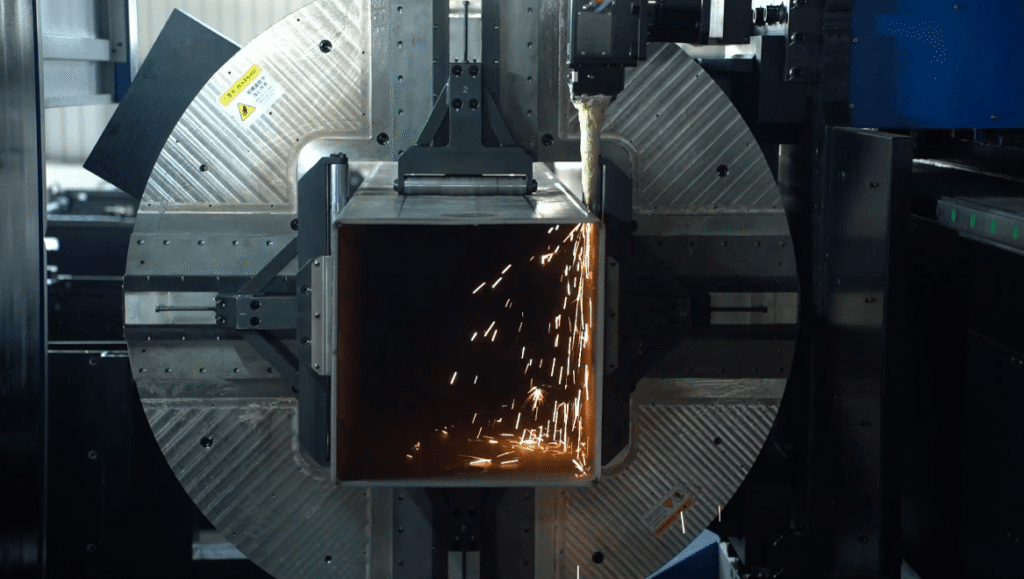
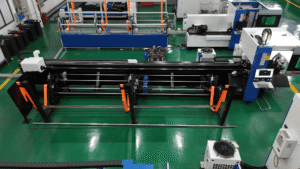
The core of industrial laser tube processing lies not just in beam focusing, but in the ultimate manipulation of metal tubes through multi-axis linkage. Moving beyond superficial theory, Baison’s heavy-duty tube cutting machines (such as the V36P series) directly define standards with real-world factory test data.
While traditional dual-chuck processing generates massive amounts of unusable scrap, Baison utilizes its self-developed three-chuck (and even four-chuck) full-linkage logic. The rear jaws, made of specially treated high-strength steel with a built-in clamping transmission mechanism, pair with a high-dynamic response motor to achieve precise tube handovers and extension-style cutting between chucks.
This drives remnants down to an “absolute zero-tailpipe” state, maintaining a repetition positioning accuracy of ±0.03mm even with single-tube loads weighing hundreds of kilograms.
When executing high-difficulty automatic bevel cutting, the system rejects outdated three-axis movement. Instead, it employs 5-axis/6-axis full-time linkage to control the precise oscillation of the Ouspurui automatic laser head, cooperating with the Dairuike high-rigidity barrel chuck to perfectly cut complex bevels under high-speed rotation (up to 140 r/min) and 1G acceleration. This configuration directly converts processing precision and material utilization into net profits on the production line.
While competitors are still struggling with how to reduce 450mm of tailpipe waste or tedious comb-jaw debugging, Baison’s field-proven zero-waste technology is already multiplying raw material cost savings for high-end manufacturing enterprises. Click to discover your specific tube’s tonnage yield increase in Baison’s factory tests.
Benefits of Laser Tube Cutting
The advantages of laser-cutting machines cannot be understated. Here are a few of the biggest benefits tube laser cutting brings to your business.
1. Precision & Accuracy
Tube laser cutting is more precise and accurate due to the CNC systems that manage the position of the laser head
Accuracy is cutting parts as close to the desired dimensions as possible. Tube laser cutting involves a high-power laser concentrated at a small point (measured as spot diameter) on the material surface. The smaller spot diameter and the stability of CNC systems allow tube laser cutters to hold tight tolerances.
Precision is the ability to replicate the same accuracy for all cuts. CNC systems can repeat the same motion with extreme precision, making them a vital part of laser cutting.
2. Versatility & Flexibility
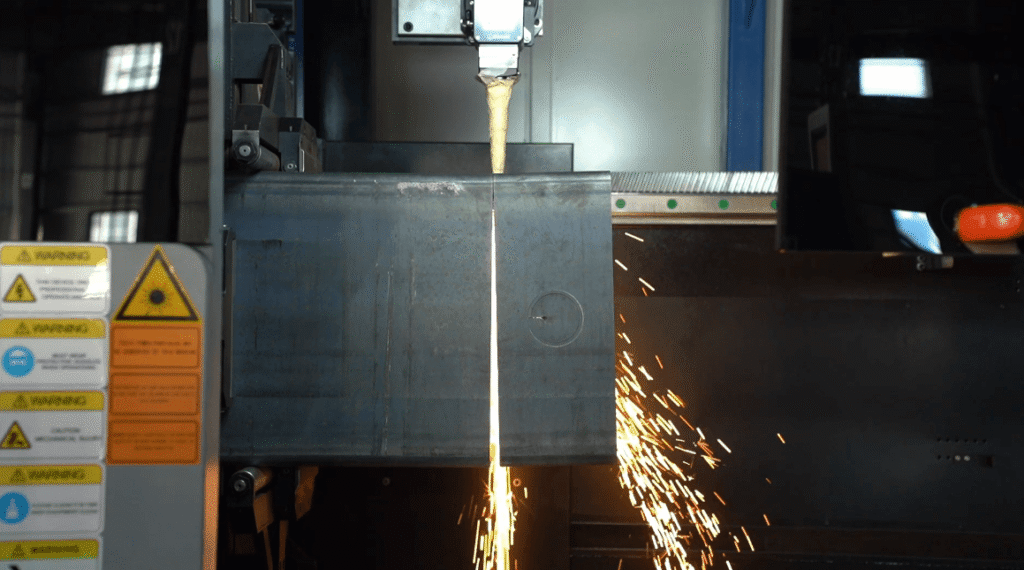
Traditional tube cutting is restrictive and often lacks fine control, which is necessary for complex designs. Laser tube cutting can make small, accurate cuts in the material, making it much more versatile than competing solutions.
Through holes is one of the biggest challenges for any cutting technology, as the edges of the hole can easily melt and deform. Lasers can easily cut through holes in thick metals without excess heat radiating to the edges.
3. Faster Cutting Speed
Traditional or manual tube-cutting techniques are inherently slow because of human involvement. A person requires concentration to keep the cuts accurate and resting time after handling heavy cutting machinery.
Human operators have to prioritize one attribute: accuracy or speed. By comparison, lasers can maintain speed and accuracy for hours without a break. A laser-cutting machine can operate indefinitely if its cooling requirements are maintained.
4. Zero Material Waste
Accidents or small mistakes during cutting can ruin the entire tube design, resulting in material waste. Laser tube cutting reduces material waste as mistakes are rarely made during the cutting process.
Minimal material waste and high cutting speed can help businesses achieve maximum productivity.
5. Zero Tool Wear
Mechanical tube-cutting technology, such as grinders, electric saws, and hydraulic blades, will wear after repeatedly rubbing against metal workpieces. Laser tube cutting is a no-contact process where tool wear is a non-issue.
6. Smoother Finish
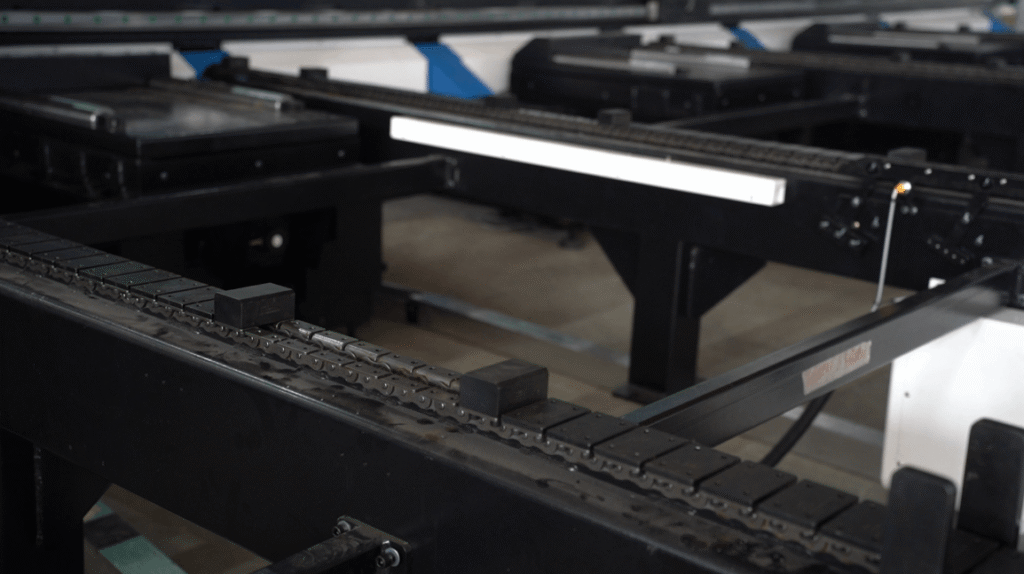
The smoothness of a cut depends on the sharpness of the tool and the heat generated during processing. Excess heat causes the edges to melt and deform, resulting in a poorer finish.
The smaller spot diameter of the laser beam ensures minimum heat is input into the material. Additionally, lasers don’t experience tool wear, so sharpness is not a factor.
The core of industrial laser tube processing lies not just in efficiency, but in the hardcore reshaping of precision and cost. Targeting the industry pain points of easily deformed shaped tubes and misaligned channel steel, Baison’s tube cutting machines are equipped with the TubesT professional nesting system and a high-rigidity barrel chuck.
Paired with a Tecomag reducer, the factory-tested X/Y-axis repetition positioning accuracy reaches ±0.03mm, ensuring a perfect closure even when processing special-shaped parts with complex geometric tolerances.
Even more commercially disruptive, the massive scrap generated by traditional pipe cutting is completely eliminated under the ultimate optimization of Baison’s three-chuck/four-chuck full-linkage technology. Through the heavy rear jaw with a built-in clamping transmission that extends into the front chuck for handover cutting, the cost of remnant material is directly compressed to an “absolute zero-tailpipe” state, completely saying goodbye to the waste of raw materials that often spans hundreds of millimeters.
Take a metal manufacturing enterprise processing 10,000 tons of tubes annually as an example: this single hardcore configuration of “zero material waste” can directly save the factory hundreds of thousands in material procurement costs a year. It turns what would have been scrap iron into pure gold, directly converting tailpipe space into net profits and ROI on the production line.
Laser Beams for Tube Cutting
Tube laser tube cutting services are primarily divided into two categories.
Fiber Lasers
Fiber laser technology uses compact diodes to pump light into optic fibers for light amplification. As a result, fiber lasers are several times smaller than their CO2 counterparts.Fiber laser systems also have high energy efficiency, converting most electricity from the wall into laser heat output.
technology uses compact diodes to pump light into optic fibers for light amplification. As a result, fiber lasers are several times smaller than their CO2 counterparts.
Fiber laser systems also have high energy efficiency, converting most electricity from the wall into
CO2 Laser Beams
CO2 lasers are generated using a large gas-filled glass chamber with a high electric current. The simpler design of gas laser systems allows them to produce high-power laser beams by consuming lots of electricity.
Gas lasers have a lower initial cost, making them an attractive option for most small businesses. However, the glass chamber has a shorter lifespan, thus increasing replacement and maintenance costs.
Materials Suitable for Laser Tube Cutting
Laser-cutting machines can manage a wide range of materials. Everything from tough tungsten to soft acrylic melts under a laser’s power.
Laser-cutting machines can manage a wide range of materials. Everything from tough tungsten to soft acrylic melts under a laser’s power.
Metals and Alloy Compatibility
Aluminum
Brass
Copper
Stainless Steel
Titanium
Nickel & Chrome Plated Metals
Alloys of Al, Cu, Fe, Ti, etc.
Non-Metal Compatibility
Plastic materials are widely used in pipe manufacturing and the plumbing industry.
Wood tubes are a less common item, mostly used in furniture work.
Cardboard tubes are low-cost support structures for toilet paper and kitchen towels.
Thickness and Size Limitations
Laser tube cutting capabilities are primarily determined by machine size and laser configuration. The following are the technology’s general thickness and size limits:
Maximum Cutting Length – 60 inches (18m)
Maximum Tube Diameter – 24 inches (610mm)
Maximum Wall Thickness – 1 inch (25.4mm)
Most commercially available tube laser cutting machines only possess half of the above-mentioned capabilities.
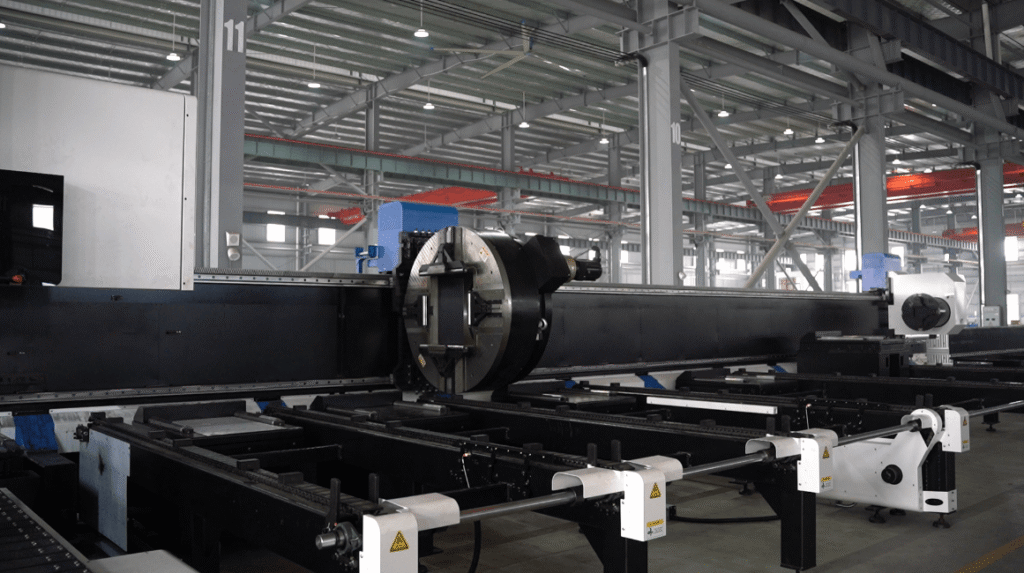
Breaking through the limitations of pseudo-industrial sizing, Baison reshapes the physical limits of high-power laser tube processing with a hardcore matrix of real-world factory test parameters. Tailor-made for global heavy manufacturing, Baison tube cutting machines completely wave goodbye to the processing constraints of short lengths and thin walls.
The standard models directly support fully automatic loading and ultimate throughput of whole tubes measuring 6500mm or longer, effortlessly clamping and rapidly rotating round and square tubes with diameters up to 240mm (and accommodating a maximum of 240mm x 240mm square tubes when the tube R-angle exceeds 30mm), while sustaining a massive single-tube weight capacity of up to 300KG.
Empowered by 12kW to 40kW ultra-high-power fiber lasers and ten-thousand-watt-level professional laser heads, and paired with a Dairuike square-hole chuck built to withstand 1G acceleration and high rotation speeds of 140 r/min, Baison achieves deep piercing and high-dynamic heavy-load cutting of ultra-thick-walled carbon steel, stainless steel, channel steel, and angle iron (such as 8# channel steel).
This comprehensively covers the extreme processing demands of the international and South American markets for heavy steel structures, mining machinery, and heavy industrial tube components. This ultimate processing format characterized by large tube diameters, heavy load capacities, and multi-specification capabilities ensures that the blanking of every heavy tube is precise and highly efficient. Welcome to click and submit your tube wall thickness and material data to obtain a 10,000-watt real-world cutting efficiency report custom-tailored for your production line.
Tube Laser Applications and Industries
Laser tube cutting services have become standard across many industries. The precision and accuracy of laser-cut parts are highly valued in high-performance applications.
1. Aerospace Industry
The aerospace industry requires precision-cut tubes for fuel and oxygen delivery systems.
2. Furniture Construction
Wood tubes are commonly used but not limited to furniture edging, and metal tubes are often used for furniture legs.
3. Sports Equipment
All sports equipment uses metal tubes and pipes for structural support. Laser tube cutting services are used to manufacture bike frames, golf equipment, hockey sticks, and more.
4. Construction Industry
Tube laser cutting machines are mostly used for processing round and square metal tubes. However, the construction industry also uses these machines to cut structural shapes such as I-beams, angle bars, and U-channels.
5. Electronic Devices
Tube laser cutting technology processes copper and aluminum cooling solutions for electronics. Heat sinks used in computer systems require precision-cut tubes with holes for efficient heat transfer.
6. Medical Equipment
The medical industry requires precision-cut metal tubes and pipes for various instruments such as ventilators, dialysis machines, and oxygen delivery lines.
5 Steps to Choosing the Right Laser Tube Cutting Machine for Your Needs
Choosing the right tube laser cutters is about knowing your needs and getting a matching machine. Always keep these five steps in mind when buying laser tube-cutting machines.
Material Choice – Your required material choice will determine your laser type (Fiber/CO2).
Tube Dimensions – Machine work bed and chuck size determine the maximum supported tube length and diameter.
Laser Power – Laser power determines the cutting speed and depth penetration.
Machine Tolerance – Tolerance or cutting accuracy determines the difference in size between the laser cut part and input dimensions.
Degree of Freedom (DOF) – Machine DOF (number of axes of motion) determines the motion and versatility of a laser cutter. Higher axis machines cost significantly more.
3 Valuable Tips for Getting Started with Laser Tube Cutting
Here are a few important lessons for beginners jumping into the complex world of tube laser cutting.
Focus on Producing Finished Parts
Businesses moving from traditional mechanical tools to laser cutters should focus on producing finished parts directly on the machine. Traditional cutting tools necessitated post-processing techniques like deburring, polishing, and sanding.
However, laser tube cutting can produce a finished part that requires little to no cleanup. You should account for the increased production rate when moving to laser cutting.
Add Capacity to Your Shop with In-House Tube Lasers
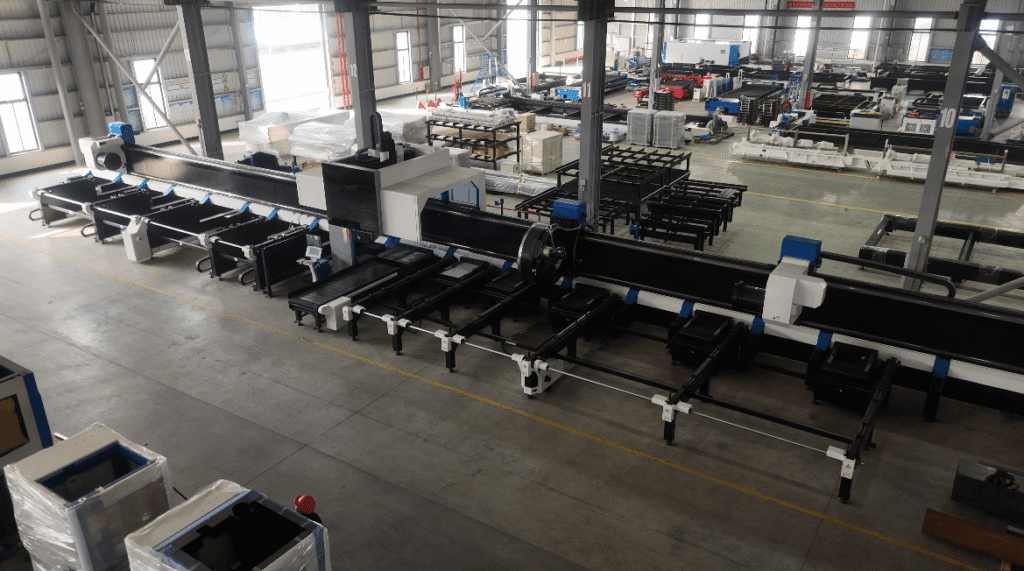
Investment in a tube laser cutting system is less about cost efficiency and more about production capacity. Automated laser tube cutting is ideal for large-volume productions.
Laser cutters offer more versatility in production, allowing you to make more complex cuts with unmatched speed and precision.
Expect a Slightly Longer Return on Investment Period
Return on investment (ROI) occurs when a business recovers its initial investment in new equipment. Generally, ROI should be around 1-2 years. In certain conditions, it may be much longer.
The following factors affect your ROI.
Number of laser cutters bought.
Hidden costs like installation and shipping costs.
The worker training period is not included in ROI calculations.
Industrial competition from other businesses.
Introducing an industrial laser tube cutting machine is never a simple asset investment; it is a disruptive revolution in commercial efficiency and rapid capital retrieval.
Saying goodbye to the fragmented multi-process operations and high labor costs of traditional “bandsaw cutting, radial drilling, and punch press processing”, Baison’s automated tube cutting machines merge cutting, punching, beveling, and complex slotting into a fully automatic, “one-click finished product” workflow.
This drives a 3-to-5x surge in comprehensive production capacity and delivers smooth cuts completely free of burrs, eliminating tedious post-process grinding.
According to real-world operational data calculated from Baison factory’s long-term clients in shelving, metal furniture, and other industries, multi-station assembly lines that originally required 4 to 5 skilled workers can now be operated by just 1 person using our side-mounted rolling loading system, directly wiping out massive labor expenses.
In heavy-duty workshops running steady daily production, the saved labor costs alone—combined with the raw material recovery from compressing remnants down to ≥90mm or an “absolute zero-tailpipe” state—can turn traditional multi-year equipment payback periods into a reality where purchasing costs are rapidly recovered within just a few short months in field tests. Click to obtain your exclusive material and labor data calculation, and customize a refined, rapid ROI payback blueprint for your factory.
FAQs
1. What industries are tube cutting machines suitable for?
High-precision processing industries such as aerospace, architectural structures, fitness equipment, and metal furniture.
2. Do tube cutting machines support customization?
Yes. Precise configurations can be customized based on material type, tube dimensions, wall thickness, and laser power.
3. What are the common mistakes when choosing a tube cutting machine?
Blindly chasing low prices while completely ignoring the degrees of freedom of motion axes, chuck load capacities, and the massive raw material waste from processing remnants.
4. How can “zero material waste” be achieved in tube processing?
It requires a three-chuck or four-chuck full-linkage logic. By extending the rear jaws into the front chuck for handover cutting, you lock in ultimate material utilization and eliminate tailpipe waste.
5. Are the processing parameters the same for all types of tubes?
No. Processing parameters for certain special steel grades require environment-based fine-tuning. Click to obtain your customized solution.
Conclusion
Laser tube cutting is a highly precise process with extensive benefits in high-performance industrial applications. Advancements in laser technology have significantly increased the productivity of tube laser cutters and decreased the entry price.
Businesses today have a lot to gain by shifting to laser-based tube cutting. Benefits like increased production speed and smoother finish are highly valuable in high-volume productions. A laser tube cutting machine is a piece and an investment into the future growth of your shop or facility.
Cut Through the Competition with Baison Laser Cutters!
At Baison, we are dedicated to providing high-quality, durable laser tube cutters that enhance precision and efficiency in your production process. Discover the unparalleled advantages of tube laser cutting with our top-of-the-line machines.
Our decades of experience, research, and dedication have paved our ascent to the top of the fiber laser manufacturing mountain. To maximize your investment, benefit from our comprehensive Free Application Evaluation and Free Customer Training Programs.
Stay ahead of the competition and elevate your operations today. Contact us Now!