For heavy steel structure fabrication, construction machinery, and large-scale elevator manufacturing plants, the core pain points of cutting 6-meter-plus long tubes and heavy profile steels (such as H-beams and channel steels) lie in two major challenges:
high-speed rotational whipping and precision collapse caused by long cantilevers in traditional dual-chuck systems, followed by dozens of centimeters of tail stock waste per pipe that swallows massive profit margins.
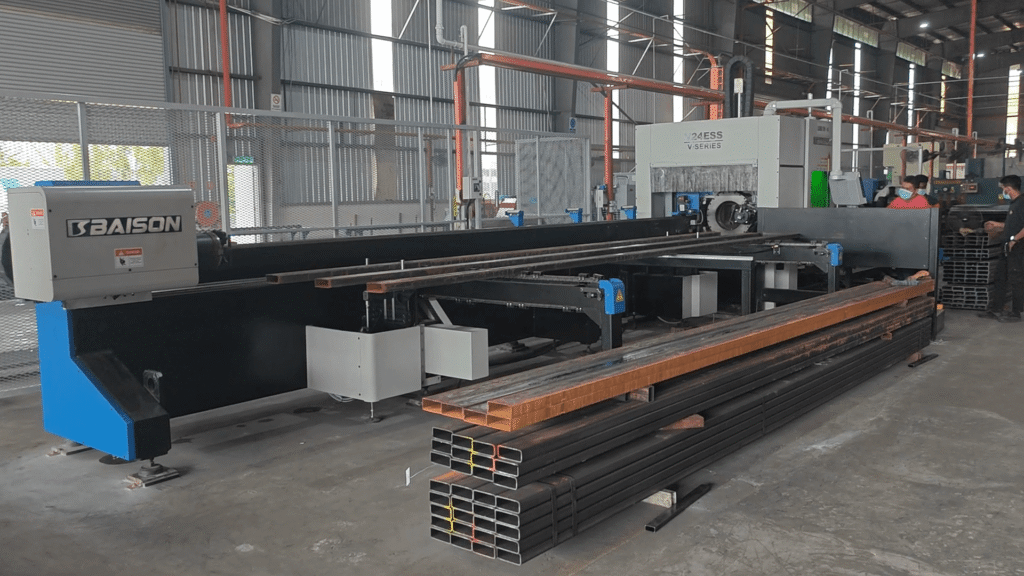
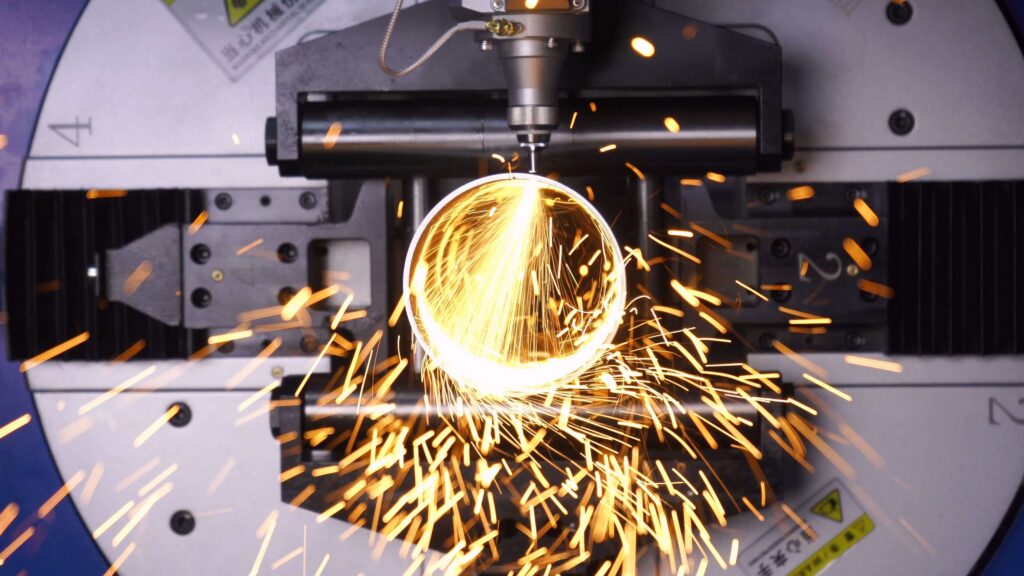
The Baison Laser V24ESS series heavy-duty fiber laser tube cutting machine adopts a 3-chuck collaborative clamping architecture paired with intelligent centering algorithms.
It substantially suppresses cantilever vibrations induced by pipe rotation (though complete physical elimination depends on raw material conditions and rotation speeds); combined with precision CNC logic, it achieves near-zero tail stock under specific conditions of straight raw pipes and optimized nesting, driving down the unit processing cost of heavy metal tubes to industry-leading levels.
When a 300kg Heavy Profile Steel Starts Whipping Violently on the Chuck…
In overseas heavy steel structure and engineering machinery workshops, production managers share an open secret: when a 6-meter-long tube or H-beam with a diameter up to 240mm and a single weight approaching 300kg is mounted onto traditional processing equipment, raising the chuck rotation speed invariably triggers physical “tail whipping” vibrations at the cantilever end.
The direct consequences of this vibration are disastrous: slanted cutting surfaces, out-of-tolerance hole positions, or even chuck jaw damage induced by centrifugal forces.
To suppress vibrations, factories are forced to sacrifice cutting speeds or leave hundreds of millimeters of scrap metal at the tail end. Amid stubbornly high prices for stainless steel and carbon steel, such brute-force processing methods are cutting away corporate profit margins like a slow knife.
As high-power lasers ranging from 3000W to 12000W penetrate the tube cutting sector, legacy machinery buckles under the strain. What overseas buyers truly need is an industrial-grade powerhouse capable of solving the “long, heavy, and stable” dilemma from its foundational physical structure.
Curious about how much profit your workshop is losing to material waste and vibration-induced scrap every month? Stop letting inferior setups drain your operational efficiency—contact our engineering experts today for a custom cutting performance simulation and ROI audit.
Core Architecture Deconstruction: Why a 3-Chuck System Completely Ends Pipe Whipping
To understand how the V24ESS series heavy-duty tube cutter changes the game, one must examine its framework. Unlike traditional dual-chuck structures ubiquitous in the market, this equipment builds a physical matrix utilizing three (or even multi-chuck linked) clamps.
1. Multi-Point Support to Physically Lock Out Vibration Sources
When processing heavy tubes 6 meters or longer, traditional dual-chuck systems resemble a slender lever stressed at both ends with zero intermediate constraint. The 3-chuck architecture utilizes strategic sectional layout, converting the free end of long tubes into multi-supported zones.
Whether facing circular tubes, square tubes, or highly rigid channel and I-beams, the collaborative clamping force between chucks instantly neutralizes centrifugal deviation during rotation.
2. Dynamic Automatic Centering and Real-Time Compensation
Raw tubes inherently exhibit minor micro-curvatures and wall thickness tolerances in practical production. Powered by an intelligent CNC system, the V24ESS captures real-time Z-axis data to precisely identify microscopic deviations between the tube center and the chuck rotation center.
The system performs real-time dynamic compensation on upcoming cutting paths, ensuring that geometric precision remains rock-solid even under high-speed linkage states reaching up to 80m/min.
3. Intelligent Corner Technology and Rapid Frog-Jumping
Addressing the industry-wide headache of over-burning or incomplete cuts at profile corners, the machine integrates dedicated corner-cutting logic. By executing millisecond-level micro-adjustments to gas pressure, peak power, and duty cycles at corners, complex sectional profiles are cut cleanly and rapidly.
Simultaneously, paired with rapid frog-jumping functions, the Z-axis intelligently plans retraction heights based on cross-sectional profiles to minimize air-travel time and push overall production pacing to extremes.
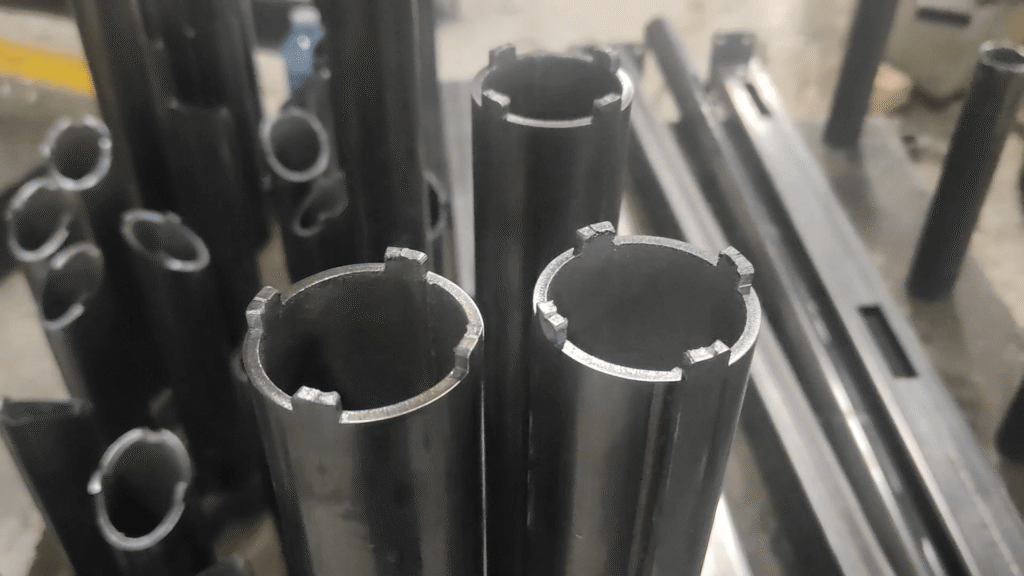
The Commercial Ledger of Zero Tail Stock: Turning Every Millimeter of Steel into Cash
For overseas manufacturing plants consuming thousands of tons of metal profiles annually, “tail stock” translates directly to cash dumped into scrap yards. Due to gripping blind zones in standard tube cutters, conventional machines invariably leave fixed-length tails on every pipe, locking material utilization rates around 85%.
Through relay-interchange clamping via three chucks under specific cutting conditions, the V24ESS series compresses tail stock into a state approaching zero (“0 tail stock”). This means buying 100 tons of steel pipes genuinely yields 100 tons of qualified finished parts.
We can map out a clear operational ledger for overseas factories (calculated at a 6000W power tier under a composite industrial electricity rate of $0.12/kWh):
- Power & System Consumption: Peak total power—encompassing lasers, chillers, mainframes, and dust collection systems—is scientifically balanced, keeping comprehensive running electricity costs and mechanical wear within highly competitive brackets.
- Assisstant Gas Costs: Equipped with an efficient gas proportional valve control system—whether running air cutting, oxygen cutting (for thick carbon steel plates), or high-purity nitrogen cutting (for clean stainless steel finishes)—every liter of gas injected undergoes fluid simulation optimization to eliminate waste.
- Plummeting Comprehensive Unit Costs: Factoring in electricity, consumables (protective lenses and nozzles), and gas consumption, all-element hourly operating costs are tightly controlled within optimal ranges. Combined with raw material savings delivered by 0 tail stock, the Equipment Return on Investment (ROI) cycle is drastically shortened under high-intensity multi-shift overseas operations.
Market Alternative Comparison: Rational Choices for Heavy Tube Processing
| Evaluation Dimension | Traditional Dual-Chucked Fiber Laser Tube Cutter | Traditional Sawing / Flame Cutting Solutions | Baison Laser V24ESS 3-Chuck Heavy-Duty Tube Cutter |
| Long & Heavy Tube Stability | Longer cantilever; prone to whipping and vibration during high-speed 6m pipe rotation. | Acceptable mechanical rigidity, but classified as low-efficiency rough processing without laser flexibility. | 3-chuck matrix collaborative clamping; physically locks vibration and maintains stability at high speeds. |
| Tail Stock Performance | Long tail stock (typically dozens of centimeters); severe material waste. | Large kerf loss (wide saw path); heavy burrs requiring secondary processing. | Achieves “0 tail stock” under specific conditions, extracting extreme value from every inch of steel. |
| Profile Adaptability | Excels only with standard round/square tubes; struggles with H-beams and channel steel. | Requires frequent manual fixture changes; extremely low efficiency. | Perfect compatibility with round, square, rectangular, channel, angle, I-beam, and H-profiles (coverage up to 240mm tier). |
| Automation & Safety | Relies on manual loading/unloading; high safety hazards with heavy tube hoisting. | Pure manual operation; extreme labor intensity with uncontrollable labor costs. | Equipped with 6-meter-class automatic loading racks and follow-up unloading trays, ensuring full-process automation and personnel safety. |
Expert Interpretation: As clearly illustrated above, for overseas buyers deeply rooted in heavy steel structures and engineering machinery, blindly opting for entry-level dual-chuck or legacy processing equipment is equivalent to watching valuable capacity and raw materials evaporate into vibration loss and scrap piles. Upgrading to a 3-chuck zero-tail architecture is the imperative path to breaking through profit bottlenecks.
Frequently Asked Questions (FAQ)
Q1: How does the 3-chuck tube cutter achieve “0 tail stock”?
A: Through relay clamping across three precision chucks combined with CNC program scheduling, leading and trailing chucks achieve seamless handoffs during the cutting process. When tubes advance to the final cutting phase, chucks shift forward to eliminate gripping blind zones, thus eradicating traditional tail stock under specific operational conditions and dramatically boosting material utilization.
Q2: What large-scale heavy profile dimensions can this machine handle?
A: The V24ESS series comes standard with a high-precision 240 chuck, accommodating round tubes within Φ20–240mm, square tubes up to 220 × 220mm (or 240 × 240mm under specific R-angles). It also seamlessly integrates 5#–14# channel steel, 2#–10# angle iron, 10#–14# I-beam, and 100 × 100 to 220 × 220mm H-beams, meeting the diverse demands of heavy industries.
Q3: How are safety and efficiency guaranteed during loading/unloading for 300kg heavy long tubes?
A: The equipment comes standard with a 6000–6300mm class automatic loading platform and multiple sets of follow-up unloading/receiving cradles. Operators simply place bundled heavy tubes onto the loading platform; the system automatically executes feeding, conveying, clamping, cutting, and finished-part unloading, fully liberating workers from hazardous, high-stamina heavy lifting.
Q4: How should enterprises select across the 3000W to 12000W power range?
A: Power selection hinges on your primary processing materials and thickness ceilings. For instance, batch processing of medium-thickness carbon and stainless steel is well-served by the 3000W to 6000W golden configuration; whereas handling thicker heavy industrial structural components calls for high-power variants delivering unmatched piercing speeds and ultimate cutting thickness support.
Q5: How are daily maintenance and overseas after-sales response guaranteed?
A: The machine is backed by rigorous warranty coverage, supported by a global footprint spanning 60+ countries with installation experience, 200+ service outlets, and 150+ professional after-sales engineers. Official standards mandate a 2-hour response mechanism upon receiving client feedback, ensuring maximum uptime for global customer production lines.
Ready to revolutionize your heavy-duty fabrication line?Don’t let legacy inefficiencies eat into your overseas bids—send us your drawings, material specs, and production targets today to claim your bespoke technical proposal and ROI analysis!
Moving to the Next Step: Get Your Bespoke Heavy Tube Processing Solution
In the cutthroat global metal processing market, equipment upgrades represent more than mere technological iterations—they signify the restructuring of profit margins.
If you are searching for a high-end powerhouse capable of entirely eliminating long tube whipping, wiping out material tail stock, and effortlessly mastering heavy profiles, send us your blueprints and precise processing requirements (material, wall thickness, annual capacity).
Our senior engineering team will tailor a comprehensive “Heavy-Duty Tube Laser Smart Manufacturing Comprehensive Solution” inclusive of equipment configurations, ROI calculations, and plant layout plans. Contact us right away to embark on your workshop’s high-efficiency cost-reduction journey.